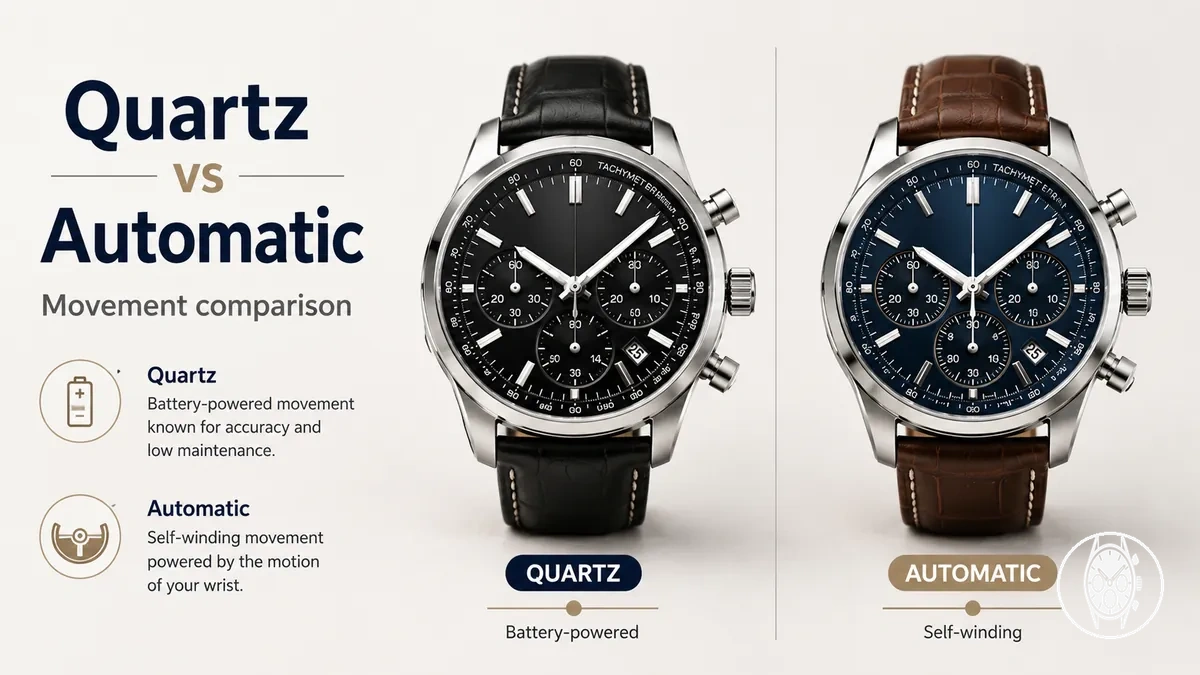
Quartz vs Automatic Men's Chronograph Watches
A quartz chronograph is the more convenience-led movement type when accuracy and battery-powered operation are the priority, while an automatic chronograph suits buyers who prefer a self-winding mechanical movement and accept a finite power reserve and greater servicing exposure. Both movement types can provide a chronograph function for measuring elapsed time, so the core quartz-versus-automatic trade-off is practical ownership versus mechanical involvement.
Both movement types can provide a chronograph function for measuring elapsed time, so the core quartz-versus-automatic trade-off is practical ownership versus mechanical involvement.
For a men's chronograph watch worn as an everyday timekeeper, the accuracy difference can be substantial: Seiko specifies its quartz calibre 8T63 at ±15 seconds per month with an approximate 3-year battery life, while Seiko specifies its automatic calibre 8R48 at +25 to −15 seconds per day when worn at 5°C to 35°C, with an approximately 45-hour power reserve. These are model-specific specifications rather than universal values for every quartz chronograph or automatic chronograph, and Seiko states that actual 8R48 accuracy is affected by conditions including wearing time, temperature, arm movement, and mainspring winding. Within the wider category of men's chronograph watches, that difference separates convenience-led practical ownership from the additional interaction associated with a mechanical movement.
The power source creates the clearest ownership distinction between the two movement types.
The power source creates the clearest ownership distinction between the two movement types. Citizen's technical guidance identifies a battery as the power source for a quartz watch and a mainspring as the power source for a mechanical watch; it also identifies a quartz crystal oscillator as the regulating element in quartz and a balance as the regulating element in mechanical watches. For an automatic chronograph, available running time after winding is model-specific: Seiko specifies about 45 hours for calibre 8R48, while Tissot lists 65 hours for one PRX Automatic Chronograph configuration and 68 hours for another, so power reserve must be checked for the individual movement rather than treated as a universal automatic value.
Maintenance, ownership cost, and buyer fit therefore need model-level verification rather than a universal price or service interval: the reviewed manufacturer evidence does not establish one service cost or interval that applies to all quartz and automatic chronographs. A buyer prioritising the cited ±15-seconds-per-month accuracy and approximately 3-year battery interval has a concrete quartz reference point, while a buyer accepting model-specific mechanical accuracy and a cited 45-to-68-hour power-reserve span has a concrete automatic reference point. Product examples should remain illustrative; the movement choice should first be judged by accuracy, power source, power reserve, maintenance requirements, ownership cost for the specific watch and service provider, and the buyer's preferred level of ownership effort.
Table of Contents
What Quartz and Automatic Mean in a Chronograph Watch
A quartz chronograph is a chronograph whose movement uses a battery and quartz-crystal regulation, while an automatic chronograph is a chronograph whose mechanical movement uses a mainspring and a self-winding rotor. Citizen identifies the power source of a quartz watch as a battery and the power source of a mechanical watch as a spring, so the primary distinction is the movement's power source and regulation system.
The movement type changes how the watch is powered and regulated without changing the chronograph's basic stopwatch function. Citizen states that an ordinary quartz watch regulates time with a quartz crystal oscillator operating at 32,768 Hz, while a mechanical watch regulates time with a balance; Longines explains that an automatic movement uses wrist motion to turn a rotor that winds the mainspring. In a chronograph, those movement systems power and regulate the watch while the chronograph mechanism provides elapsed-time operation through its stopwatch controls.
Automatic is one category within the broader mechanical family rather than a synonym for every mechanical watch.
Automatic is one category within the broader mechanical family rather than a synonym for every mechanical watch. Longines separates mechanical movements into automatic, or self-winding, and hand-wound types, with the rotor distinguishing automatic winding from hand winding. This distinction prevents terminology overlap when comparing chronograph movement types: an automatic chronograph is mechanical and self-winding, while a hand-wound chronograph is mechanical but not automatic.
Quartz, Automatic, and Mechanical Chronograph Scope
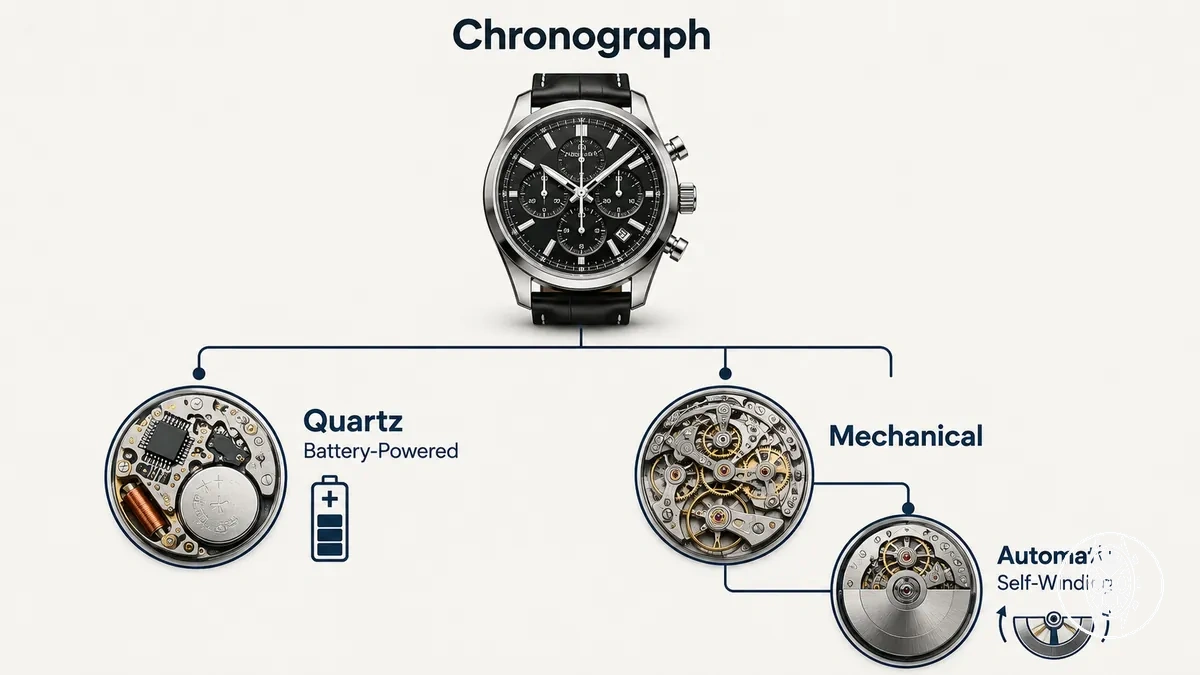
For chronograph movement wording, quartz is the battery-powered electronic category, mechanical is the broader non-quartz family powered by a mainspring, and automatic is the self-winding category within that mechanical family. Citizen distinguishes quartz watches by battery power and quartz-crystal regulation from mechanical watches powered by a mainspring, while Longines describes an automatic movement as a mechanical movement whose rotor winds the mainspring through wrist motion. Automatic is therefore one type of mechanical chronograph rather than a category separate from mechanical.
Accuracy, Power Source, and Everyday Reliability
A quartz chronograph generally offers more stable everyday timekeeping when low maintenance and low dependence on usage frequency are priorities, while an automatic chronograph links continued operation and accuracy more closely to its power reserve, wearing frequency, and servicing condition. Citizen identifies a battery as the power source for quartz watches and a mainspring as the power source for mechanical watches, establishing the main reliability trade-off between battery-powered operation and mechanically stored energy.
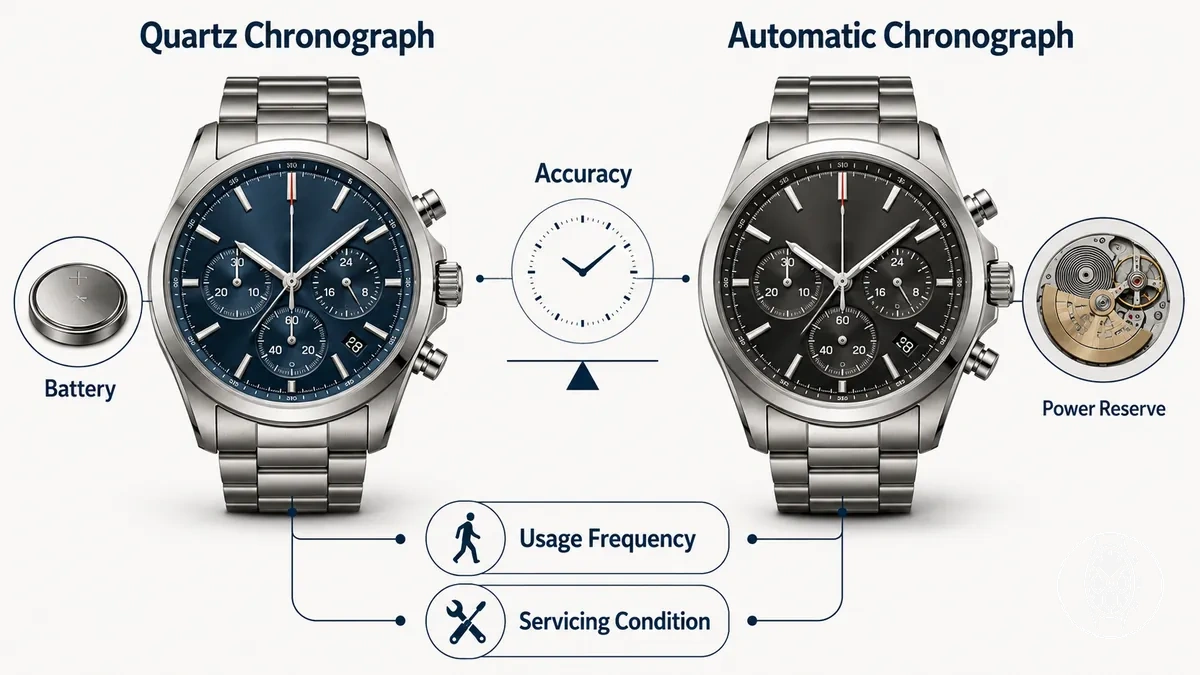
For occasional wear or travel, the reserve condition creates a practical difference in restart behaviour. Seiko specifies an approximate 3-year battery life for its 8T63 quartz chronograph movement, while Seiko specifies an approximately 45-hour power reserve for its 8R48 automatic chronograph movement; an 8R48 that exhausts that reserve must be wound before normal operation resumes. These are model-specific values rather than universal battery-life or power-reserve figures, but they show why an automatic chronograph is more sensitive to usage frequency than the cited battery-powered quartz chronograph in periods of non-wear.
For occasional wear or travel, the reserve condition creates a practical difference in restart behaviour.
Accuracy also differs substantially between the cited examples: Seiko specifies the quartz 8T63 at ±15 seconds per month, whereas the automatic 8R48 is specified at +25 to −15 seconds per day when worn on the wrist within a temperature range of 5°C to 35°C. Seiko states that the 8R48's actual daily accuracy is affected by conditions including temperature, arm movement, time worn, and the degree to which the mainspring is wound. Everyday reliability therefore depends not only on movement type but also on reserve state, usage pattern, operating conditions, and movement condition.
| Attribute | Quartz chronograph example | Automatic chronograph example |
|---|---|---|
| Power source | Battery; Citizen identifies battery power as the quartz-watch power source | Mainspring; Citizen identifies spring power as the mechanical-watch power source |
| Accuracy | Seiko 8T63: ±15 seconds per month | Seiko 8R48: +25 to −15 seconds per day when worn at 5°C to 35°C |
| Stored running condition | Seiko 8T63: approximately 3-year battery life | Seiko 8R48: approximately 45-hour power reserve |
| Usage frequency | The cited battery-powered 8T63 does not use wrist motion to replenish its power source | The cited 8R48 requires sufficient mainspring reserve; wrist motion operates its self-winding mechanism during wear |
| Servicing condition | One universal service interval for quartz chronographs is not established by the cited specifications; verify the specific watch and movement requirements | One universal service interval for automatic chronographs is not established by the cited specifications; verify the specific watch and movement requirements |
Quartz Chronograph Battery Life and Timekeeping Precision
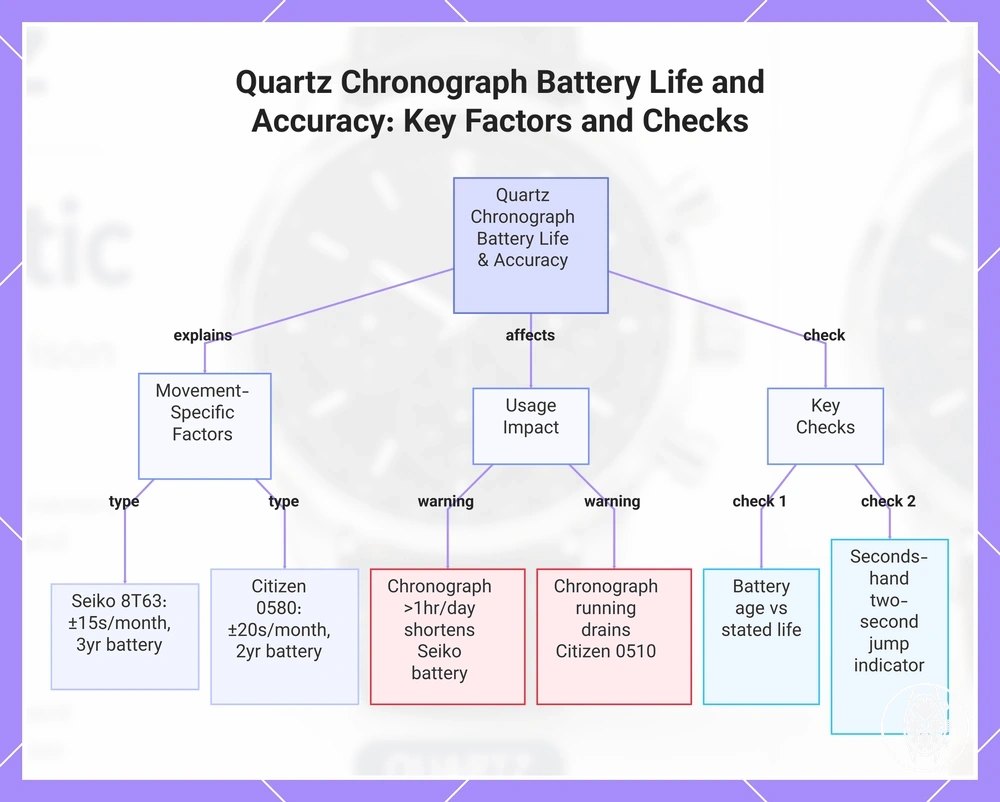
A quartz chronograph uses a battery and electronic regulation for timekeeping precision, but battery life and accuracy are movement-specific rather than universal. Seiko specifies its quartz 8T63 at ±15 seconds per month under normal temperatures of 5°C to 35°C and lists an approximate 3-year battery life; its 8T63/8T68 instructions also identify a 32,768 Hz quartz oscillator, tying the stated precision to electronic regulation.
A quartz chronograph uses a battery and electronic regulation for timekeeping precision, but battery life and accuracy are movement-specific rather than universal.
Chronograph usage can shorten the interval before battery replacement: Seiko states that using the 8T63/8T68 stopwatch for more than 1 hour per day can reduce battery life below the specified period, while Citizen specifies approximately 2 years for its 0580 when the alarm is used for 15 seconds per day and the chronograph for 12 hours per day. Citizen also specifies ±20 seconds per month for the 0580 at 5°C to 35°C, so battery-life and accuracy expectations should remain tied to the movement, functions, usage pattern, and model condition.
- Battery age: Compare the installation date with the specific movement's stated battery life; Seiko lists approximately 3 years for the 8T63, while Citizen lists approximately 2 years for the 0580 under its stated usage conditions.
- Chronograph use: Check usage against the movement instructions; Seiko warns that more than 1 hour of daily stopwatch use can shorten 8T63/8T68 battery life, and Citizen warns that leaving its 0510 chronograph running will rapidly drain the battery.
- Seconds-hand behavior: On Seiko 8T63/8T68 movements, a small seconds hand advancing at two-second intervals is the specified battery-life indicator; Seiko instructs owners to arrange battery replacement as soon as possible when this occurs.
- Service history: If the battery replacement date or fitted cell is unknown, remaining battery life cannot be calculated reliably from the manufacturer's nominal interval, so verify the watch's service record and movement specification.
- Water resistance: The reviewed movement evidence does not establish one resealing or post-replacement water-resistance procedure for every quartz chronograph; after battery work, verify the case-specific procedure required by the watch manufacturer or service documentation.
This chart shows the movement-specific factors affecting quartz chronograph battery life and accuracy, along with key checks to perform.
Automatic Chronograph Power Reserve and Mechanical Variation
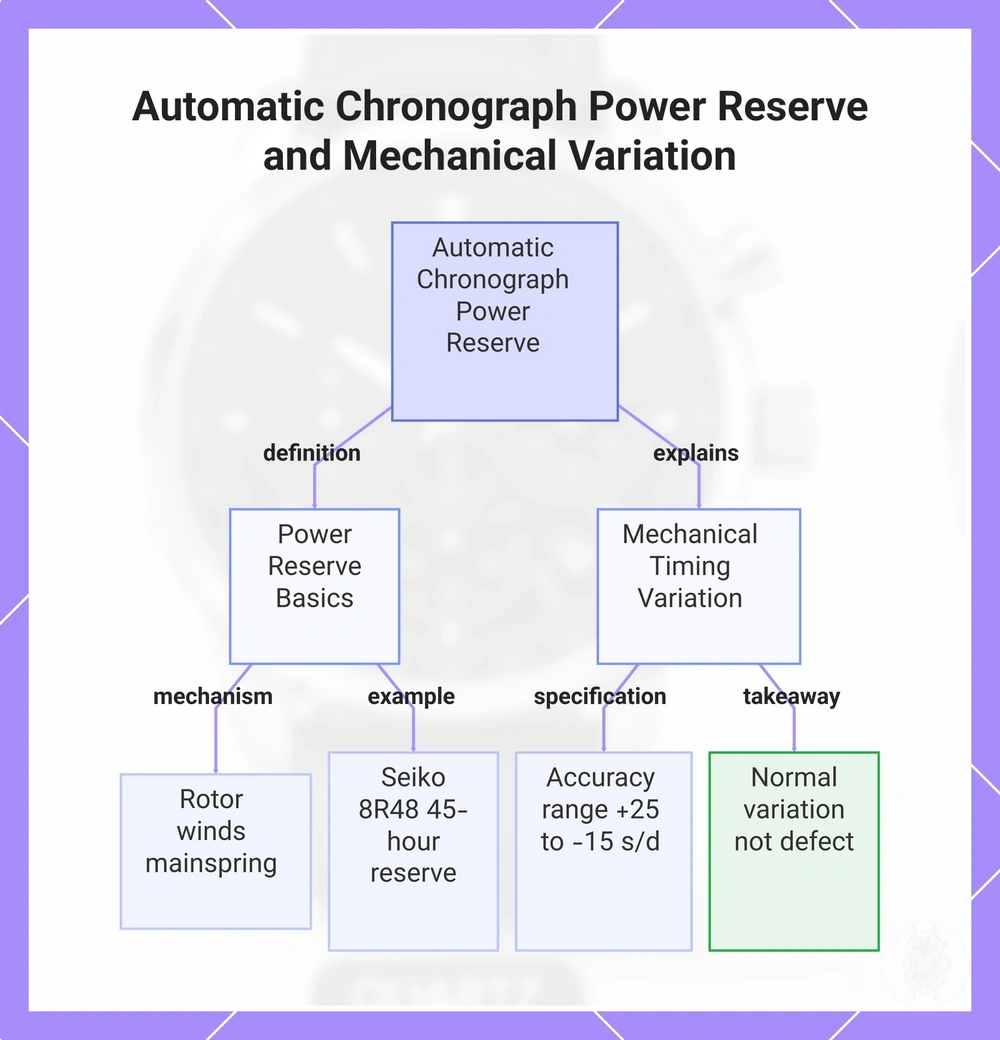
An automatic chronograph uses a rotor to wind a mechanical mainspring, and its power reserve is the stored running time available before that energy is exhausted. Longines explains that wrist movement turns the rotor and winds the mainspring, while Seiko specifies an approximately 45-hour power reserve for its 8R48 automatic chronograph movement. Wearing frequency therefore affects winding needs: if the cited 8R48 remains unworn long enough to exhaust that reserve, it must be wound and restarted before normal timekeeping continues.
Mechanical regulation also produces movement-specific timing variation rather than one universal accuracy value.
Mechanical regulation also produces movement-specific timing variation rather than one universal accuracy value. Seiko specifies the 8R48 at +25 to −15 seconds per day when worn on the wrist at 5°C to 35°C and states that actual daily rate is influenced by temperature, arm movement, time worn, and the degree of mainspring winding; service history and movement condition should therefore be checked against the specific watch rather than assumed from the movement category alone. Mechanical variation is consequently part of automatic chronograph ownership under defined operating and condition factors, not evidence that every automatic chronograph is defective.
This chart shows the definition of automatic chronograph power reserve, a specific example, and explains that mechanical timing variation is normal and not a defect.
This chart shows the definition of automatic chronograph power reserve, a specific example, and explains that mechanical timing variation is normal and not a defect.
Chronograph Function, Movement Complexity, and Watch Feel
A quartz chronograph and an automatic chronograph perform the same core chronograph function of measuring elapsed time, but their movement architecture can produce different watch feel through pusher feedback, subdial behavior, sweep or ticking, and service complexity. Seiko specifies its quartz 8T63 with two stepping motors and stopwatch measurement in 1/5-second increments, while Seiko's automatic 8R46 uses a mechanical chronograph architecture with a column wheel and vertical clutch. The stopwatch purpose is therefore similar, while the tactile and visual behavior follows the specific movement and chronograph mechanism.
| Decision variable | Quartz chronograph example | Automatic chronograph example |
|---|---|---|
| Chronograph mechanism | Seiko 8T63: quartz movement driven by two stepping motors | Seiko 8R46: automatic mechanical movement using a column wheel and vertical clutch |
| Sweep or ticking | Seiko 8T63: stopwatch display advances in 1/5-second increments | Seiko 8R46: 28,800 vibrations per hour, equal to 8 vibrations per second, provide the movement's mechanical regulating frequency |
| Pusher feedback | No universal tactile value is specified for quartz chronographs; feedback must be assessed by the specific pusher and movement construction | Seiko states that the 8R column wheel provides better tactile sensation for starting, stopping, and resetting than a cam-and-lever construction |
| Service complexity | No universal service-complexity rating is established for quartz chronographs; construction differs by movement and chronograph architecture | Seiko states that mechanical chronographs require a high level of technical skill because of their complexity, with this finding applying to its 8R mechanical chronograph context rather than every automatic chronograph |
When the wearer presses the chronograph pushers, the mechanism can change both pusher feedback and visible subdial behavior. Seiko states that the 8R vertical clutch reduces shuddering or jumping of the chronograph hands when starting or stopping, while its column wheel improves tactile sensation; by contrast, Seiko specifies the electronically driven 8T63 stopwatch in 1/5-second increments. These model-specific examples show that tactile feel and displayed motion are consequences of movement complexity and mechanism design rather than universal traits of every quartz or automatic chronograph.
When the wearer presses the chronograph pushers, the mechanism can change both pusher feedback and visible subdial behavior.
Perceived craftsmanship and service complexity should also be judged at movement level rather than assigned one universal value to either category. Seiko states that calibre 8R46 is designed and hand assembled in-house by skilled watchmakers, while the reviewed manufacturer evidence does not establish an equivalent universal craftsmanship measure or service-complexity score for quartz and automatic chronographs as complete categories. Movement architecture can therefore change mechanical feel, sweep or ticking behavior, service exposure, and perceived craftsmanship, while the underlying stopwatch function remains the measurement of elapsed time.
Quartz Chronograph Advantages and Limitations
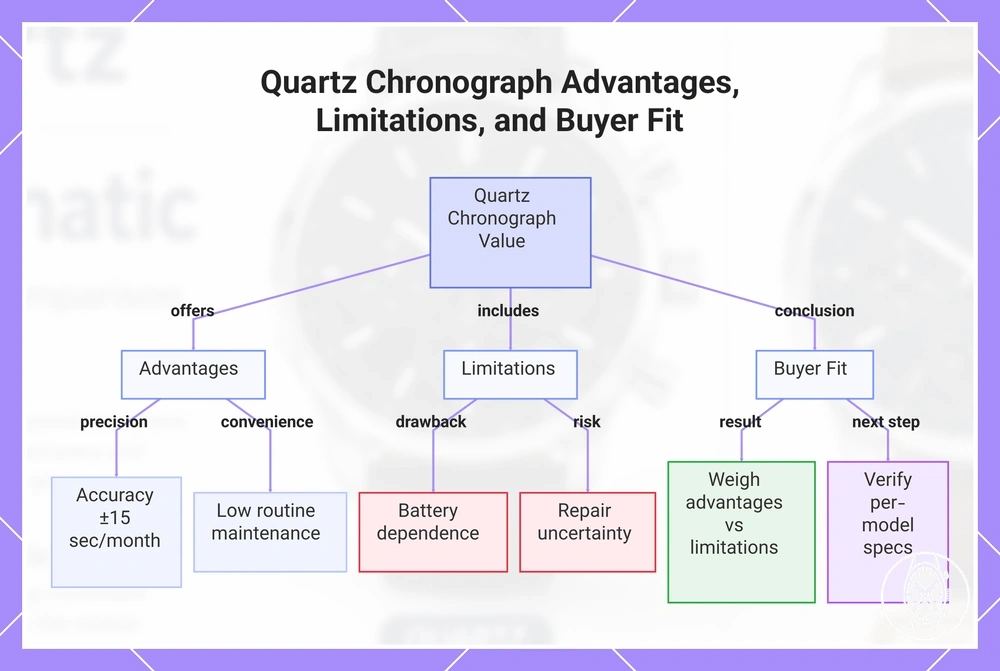
A quartz chronograph offers buyer-facing advantages in accuracy, convenience, and low maintenance day to day, but its limitations include battery dependence, model-specific repair practicality, and ownership expectations that still include periodic service. Seiko specifies its 8T63 quartz chronograph movement at ±15 seconds per month with an approximate 3-year battery life, providing a model-specific example of dependable electronic timekeeping without daily winding. The practical quartz value proposition is therefore accurate battery-powered operation with relatively little routine interaction rather than maintenance-free ownership.
- Accuracy: Seiko specifies the 8T63 at ±15 seconds per month, giving a concrete precision reference for that quartz chronograph movement rather than a universal quartz accuracy figure.
- Affordability: Seiko Australia lists the 8T63-powered SSB405 at AUD 525 and SSB455 at AUD 625, showing two current quartz chronograph price points within one manufacturer and territory; these prices do not establish that every quartz chronograph costs less than every automatic alternative.
- Low maintenance: The 8T63 uses a battery with an approximate 3-year stated life, so routine ownership does not require winding, although battery replacement and movement-specific servicing remain part of long-term care.
- Battery dependence: Once the fitted battery is depleted, continued operation requires battery replacement; the replacement interval remains specific to the movement, battery, chronograph usage, functions, and model condition.
- Repair practicality: The reviewed manufacturer evidence establishes no universal repair-cost, repairability, or service-interval advantage for quartz chronographs, so practical repair expectations should be checked against the specific movement, parts availability, case construction, and service provider.
For an owner who wears a chronograph intermittently, battery-powered operation can preserve normal running without the winding requirement associated with a depleted mechanical power reserve, provided the battery remains serviceable. That convenience does not remove service exposure: battery replacement, case-sealing requirements after battery work where applicable, and electronic or mechanical component faults remain ownership considerations. Perceived prestige is also a preference-based limitation rather than a measurable performance deficit, because the reviewed evidence provides no standardised prestige scale that ranks quartz chronographs below mechanical watches.
Long-term ownership expectations are best set from the specific watch's stated accuracy, battery life, purchase price, service requirements, and intended chronograph usage.
A quartz chronograph is therefore a stronger buyer fit when accuracy, convenience, affordability within a verified budget, and low routine maintenance matter more than mechanical interaction or perceived craftsmanship. Buyers should balance those advantages against battery dependence, model-specific repair practicality, service support, and the absence of a universal long-term cost advantage. Long-term ownership expectations are best set from the specific watch's stated accuracy, battery life, purchase price, service requirements, and intended chronograph usage.
This chart maps the key advantages and limitations of quartz chronographs and shows how to evaluate their fit for a buyer.
This chart maps the key advantages and limitations of quartz chronographs and shows how to evaluate their fit for a buyer.
Automatic Chronograph Advantages and Limitations
An automatic chronograph offers advantages in mechanical appeal, no battery dependence, and visible craftsmanship, while its limitations include power-reserve management, service complexity, ownership effort, and model-specific thickness, weight, and cost exposure. Tissot specifies the PRX automatic chronograph T137.427.11.041.00 with a self-winding mechanical movement, up to 65 hours of power reserve, 14.54 mm thickness, 184 g weight, and an Australian price of A$3,235; these are model-specific values rather than automatic-chronograph category limits. :contentReference[oaicite:0]{index=0} The practical appeal is therefore mechanical ownership and craftsmanship rather than freedom from servicing or other ownership requirements.
- Advantages: An automatic chronograph uses mechanical stored energy rather than a replaceable watch battery as its movement power source, giving the owner self-winding operation and mechanical appeal when sufficient mainspring reserve is maintained.
- Craftsmanship: Seiko states that its 8R46 automatic chronograph calibre uses a column wheel and vertical clutch and is designed and hand assembled in-house by skilled watchmakers; this is a craftsmanship signal for that movement, not a universal quality ranking for all automatic chronographs. :contentReference[oaicite:1]{index=1}
- Ownership effort: Power reserve places a measurable boundary on non-wear: Tissot specifies up to 65 hours for the cited PRX chronograph, so exhausting that reserve requires the mechanical movement to be wound and restarted before continued use. :contentReference[oaicite:2]{index=2}
- Thickness and weight: Tissot specifies the cited PRX automatic chronograph at 14.54 mm thick and 184 g, showing that case profile and wrist weight should be evaluated at model level rather than assumed from the movement category. :contentReference[oaicite:3]{index=3}
- Service complexity and cost exposure: The reviewed manufacturer evidence does not establish one universal service interval, repair cost, or service-complexity score for automatic chronographs; Tissot's A$3,235 Australian price for the cited model establishes purchase cost for that configuration only, while servicing exposure must be verified for the specific calibre and service provider. :contentReference[oaicite:4]{index=4}
For a buyer who wears the watch regularly and values mechanical interaction, an automatic chronograph can make the rotor, mainspring, and chronograph mechanism part of the ownership experience rather than invisible electronic functions. The cited Tissot example combines a 65-hour power reserve with a 14.54 mm case and 184 g weight, so leaving it unworn beyond its available reserve affects restart requirements while its dimensions can affect wrist comfort. :contentReference[oaicite:5]{index=5} Service complexity and cost exposure remain movement- and provider-specific, so mechanical appeal should not be treated as evidence that every automatic chronograph is easier to maintain or more valuable.
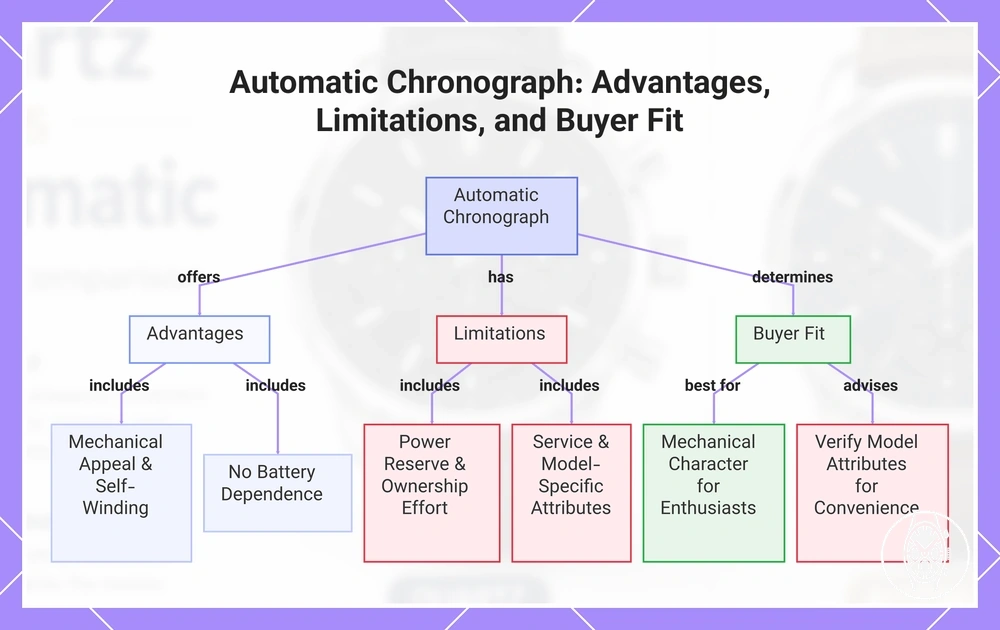
An automatic chronograph is the clearer buyer fit when mechanical appeal, craftsmanship, self-winding operation, and engagement with the movement outweigh the preference for minimal ownership effort.
An automatic chronograph is the clearer buyer fit when mechanical appeal, craftsmanship, self-winding operation, and engagement with the movement outweigh the preference for minimal ownership effort. Buyers who prioritise reduced thickness, lower weight, predictable servicing costs, or freedom from power-reserve management should verify those attributes on the exact model because the automatic category has no single value for any of them. The boundary is therefore preference-based: automatic chronographs provide mechanical character, while their limitations become more important as convenience, comfort, and controlled cost exposure move higher in the buyer's priorities.
This chart summarizes the key advantages and limitations of automatic chronographs and explains how buyer preferences determine the best fit.
This chart summarizes the key advantages and limitations of automatic chronographs and explains how buyer preferences determine the best fit.
Maintenance, Repair Cost, and Long-Term Ownership
Maintenance differs between quartz and automatic chronographs because quartz ownership centres on battery replacement and sealing checks, while automatic ownership adds periodic mechanical servicing of the movement and chronograph mechanism. Seiko specifies approximately 3 years of battery life for its 8T63 quartz chronograph, while Longines Australia recommends a full service every 6 to 8 years for its mechanical watches; these are manufacturer-specific intervals rather than universal service schedules. Maintenance should therefore be treated as part of the movement decision and long-term ownership burden.
| Maintenance factor | Quartz chronograph | Automatic chronograph |
|---|---|---|
| Power-related upkeep | Battery replacement is required when the fitted cell is depleted; Seiko specifies approximately 3 years for calibre 8T63, with shorter life possible when its stopwatch is used for more than 60 minutes per day. | Movement power does not require battery replacement, but mechanical servicing remains part of ownership; Longines Australia recommends a full service every 6 to 8 years for its mechanical watches. |
| Gasket checks and water resistance | Seiko states that opening the case for battery replacement can reduce the designed water resistance and recommends a water-resistance test after battery work; for watches rated 10 bar or higher, Seiko instructs that the test be performed each time the battery is replaced. | Seiko states that ageing gaskets can impair water resistance and that gaskets should be replaced during overhaul, so sealing condition remains part of mechanical servicing as well. |
| Chronograph repair and service complexity | No universal repair-complexity value is established for quartz chronographs; repair practicality is specific to the calibre, electronic components, pushers, case construction, parts supply, and service network. | Mechanical chronograph repair can involve movement disassembly, cleaning, lubrication, adjustment, function checks, and replacement of worn components; Longines describes full mechanical service as including complete movement disassembly and servicing. |
| Service availability | Availability is model-specific and depends on supported parts and qualified service access; Tissot states that it guarantees spare-parts availability for at least 10 years after production ends for standard watches. | The same parts-support constraint applies to mechanical models; Tissot states a minimum of 10 years for standard watches and up to 20 years for gold watches after production ends. |
| Repair cost | No universal repair cost or comparable cost range is established across quartz and automatic chronographs because labour, movement architecture, required parts, water-resistance work, territory, and service provider differ by watch. A model-specific estimate is therefore required for meaningful cost comparison. | |
For a quartz chronograph owner, battery replacement can also become a water-resistance maintenance event rather than only a cell change. Seiko states that its 8T63 battery can last approximately 3 years under the stated usage conditions and that more than 60 minutes of stopwatch use per day can shorten that interval; when the case is opened, sealing and water-resistance checks become relevant as well. An automatic chronograph avoids battery work for movement power, but long-term ownership instead includes mechanical servicing, lubrication, adjustment, service history, and possible chronograph repair.
Repair cost remains model-specific rather than inherently lower for quartz or higher for automatic chronographs.
Repair cost remains model-specific rather than inherently lower for quartz or higher for automatic chronographs. Service availability also has a measurable ownership boundary: Tissot guarantees spare parts for at least 10 years after production ends for standard watches and up to 20 years for gold watches, while other manufacturers and calibres can follow different policies. Buyers who value predictable upkeep should therefore verify battery interval, gasket checks, water-resistance requirements, servicing interval, parts support, and local service availability for the exact watch before comparing long-term cost.
Long-term ownership is easier to judge when maintenance records and water-resistance care are considered alongside movement preference.
Long-term ownership is easier to judge when maintenance records and water-resistance care are considered alongside movement preference. The next level of detail is maintaining a chronograph watch, where battery work, gasket condition, water-resistance checks, and mechanical servicing can be evaluated at the individual-watch level.
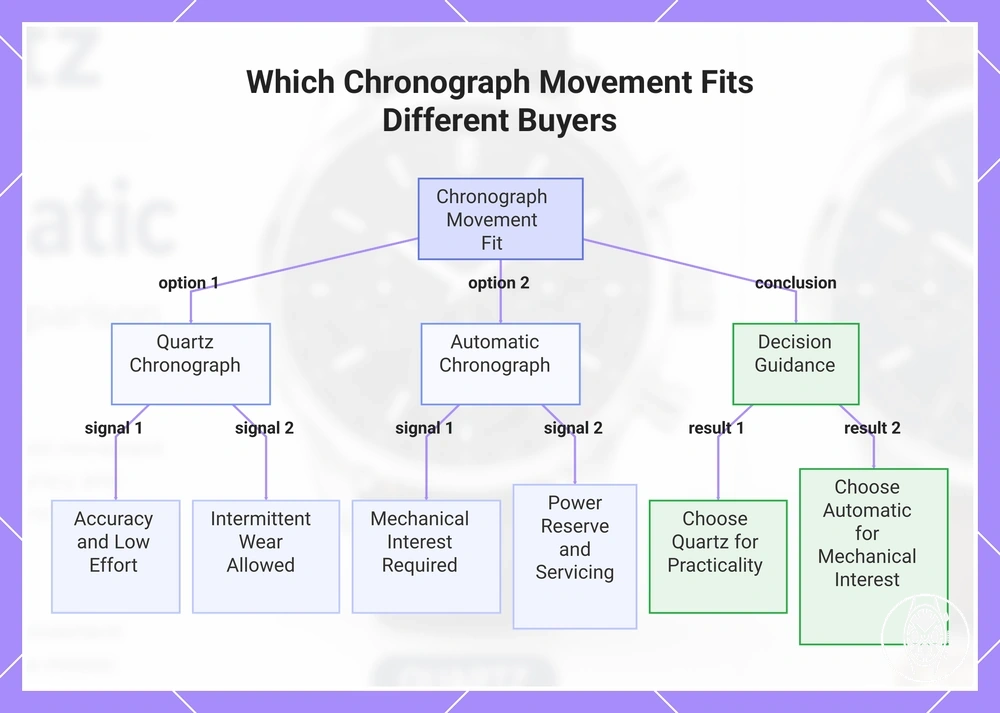
Which Chronograph Movement Fits Different Buyers
The right movement choice depends on buyer needs: a quartz chronograph fits buyers who prioritise accuracy expectations, lower routine ownership effort, and independence from wearing frequency, while an automatic chronograph fits buyers who value mechanical interest and accept power-reserve and servicing requirements. Seiko specifies its 8T63 quartz chronograph at ±15 seconds per month with approximately 3 years of battery life, while its automatic 8R48 is specified at +25 to −15 seconds per day with approximately 45 hours of power reserve; these are model-specific reference points rather than category-wide guarantees. Budget tolerance, maintenance comfort, wearing frequency, style preference, and mechanical interest therefore determine buyer fit, so neither movement is a universal winner.
- Quartz-leaning signals: Prioritise tighter model-specific accuracy, battery-powered convenience, intermittent wear without winding, and lower tolerance for routine mechanical interaction.
- Automatic-leaning signals: Prioritise mechanical interest, self-winding operation, movement craftsmanship, and willingness to manage power reserve and mechanical servicing.
- Budget tolerance: No universal price threshold separates quartz from automatic chronographs, so compare the purchase price and expected service requirements of the exact models under consideration.
- Maintenance comfort: Quartz ownership includes battery replacement and movement-specific care, while automatic ownership replaces battery dependence with winding, power-reserve management, and mechanical servicing.
For a daily user or occasional wearer who wants dependable timing with limited routine interaction, a quartz chronograph is the more practical fit when its stated accuracy and battery interval meet the buyer's expectations. Seiko specifies the 8T63 at ±15 seconds per month with approximately 3 years of battery life, so wearing frequency does not determine whether that movement remains wound during normal battery condition. This makes quartz a clearer fit when accuracy expectations, practical convenience, and maintenance comfort outweigh mechanical involvement.
This makes quartz a clearer fit when accuracy expectations, practical convenience, and maintenance comfort outweigh mechanical involvement.
For a mechanical-watch enthusiast, an automatic chronograph is the stronger fit when the rotor, mainspring, mechanical regulation, and chronograph architecture are part of the desired ownership experience. Seiko specifies approximately 45 hours of power reserve for the 8R48, so a watch using that movement can stop after its stored energy is exhausted and require winding and resetting before continued use; Seiko also specifies its accuracy at +25 to −15 seconds per day under the stated wearing conditions. Regular wearing frequency, tolerance for that ownership effort, and mechanical interest therefore support automatic-fit criteria rather than indicating that automatic is inherently superior.
Regular wearing frequency, tolerance for that ownership effort, and mechanical interest therefore support automatic-fit criteria rather than indicating that automatic is inherently superior.
For a gift buyer, movement choice should follow the recipient's habits, style preference, and maintenance comfort rather than the giver's preference: quartz better matches someone who values practical accuracy and limited interaction, while automatic better matches someone with established mechanical interest and comfort with servicing. Budget tolerance should be assessed against the exact watch because the reviewed evidence does not establish one universal price boundary at which quartz or automatic becomes the better value. Deciding whether chronograph watches are worth it should therefore include expected use, ownership effort, service tolerance, and emotional value as separate criteria from movement preference.
Budget tolerance should be assessed against the exact watch because the reviewed evidence does not establish one universal price boundary at which quartz or automatic becomes the better value.
The final buyer fit comes from matching accuracy expectations, budget tolerance, maintenance comfort, wearing frequency, style preference, mechanical interest, and long-term ownership effort to the specific watch. Choose quartz when practical convenience and predictable electronic timekeeping dominate those criteria; choose automatic when mechanical involvement and watchmaking character justify power-reserve management and greater servicing exposure.
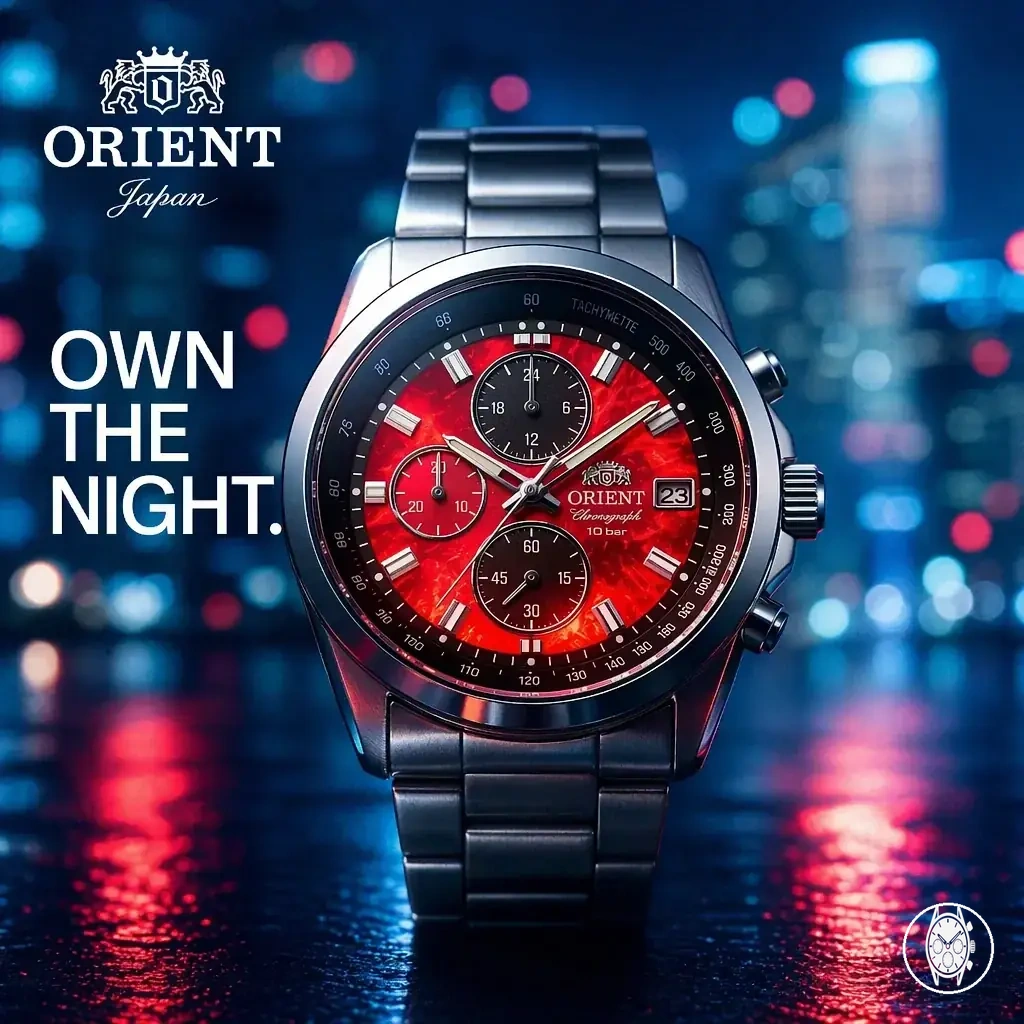
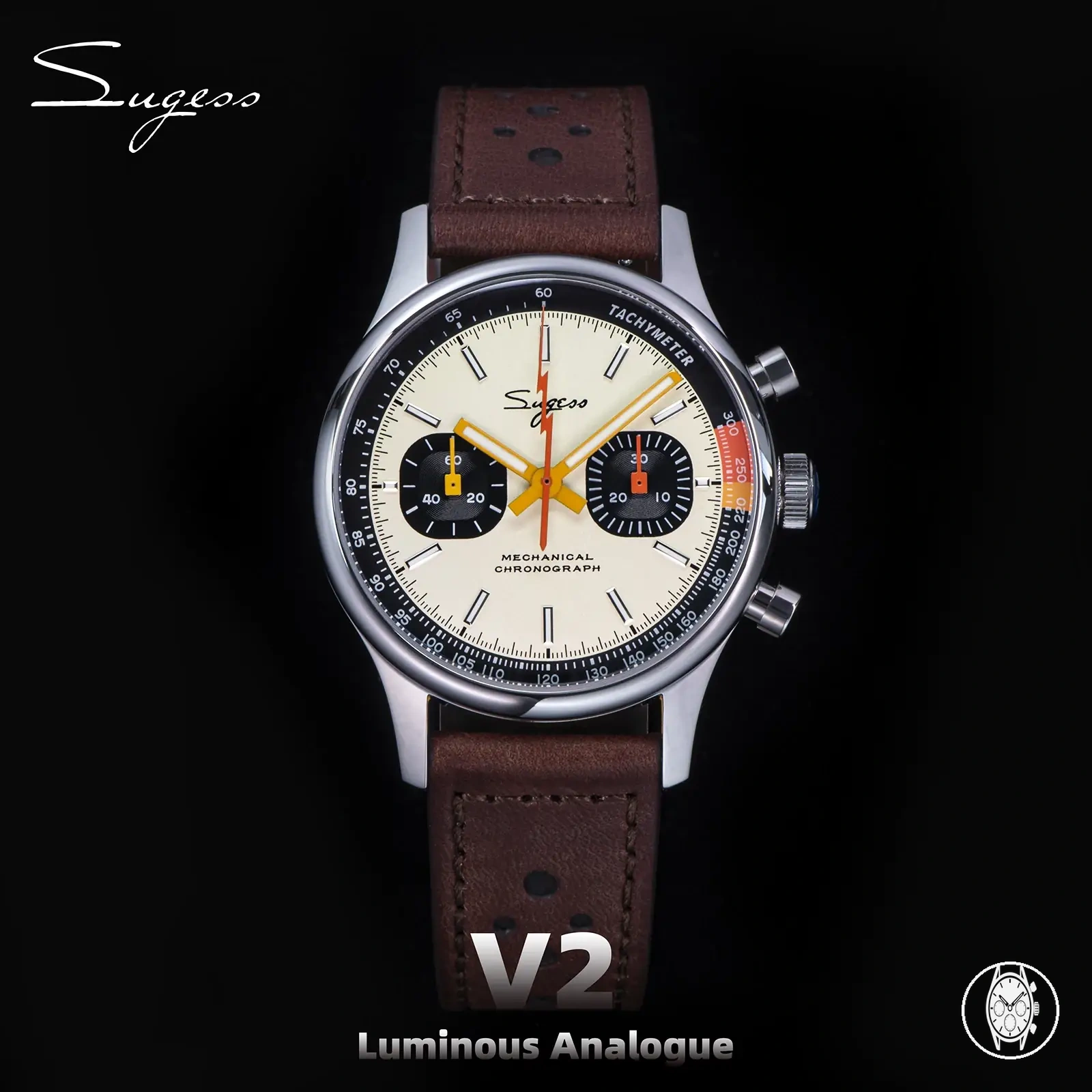
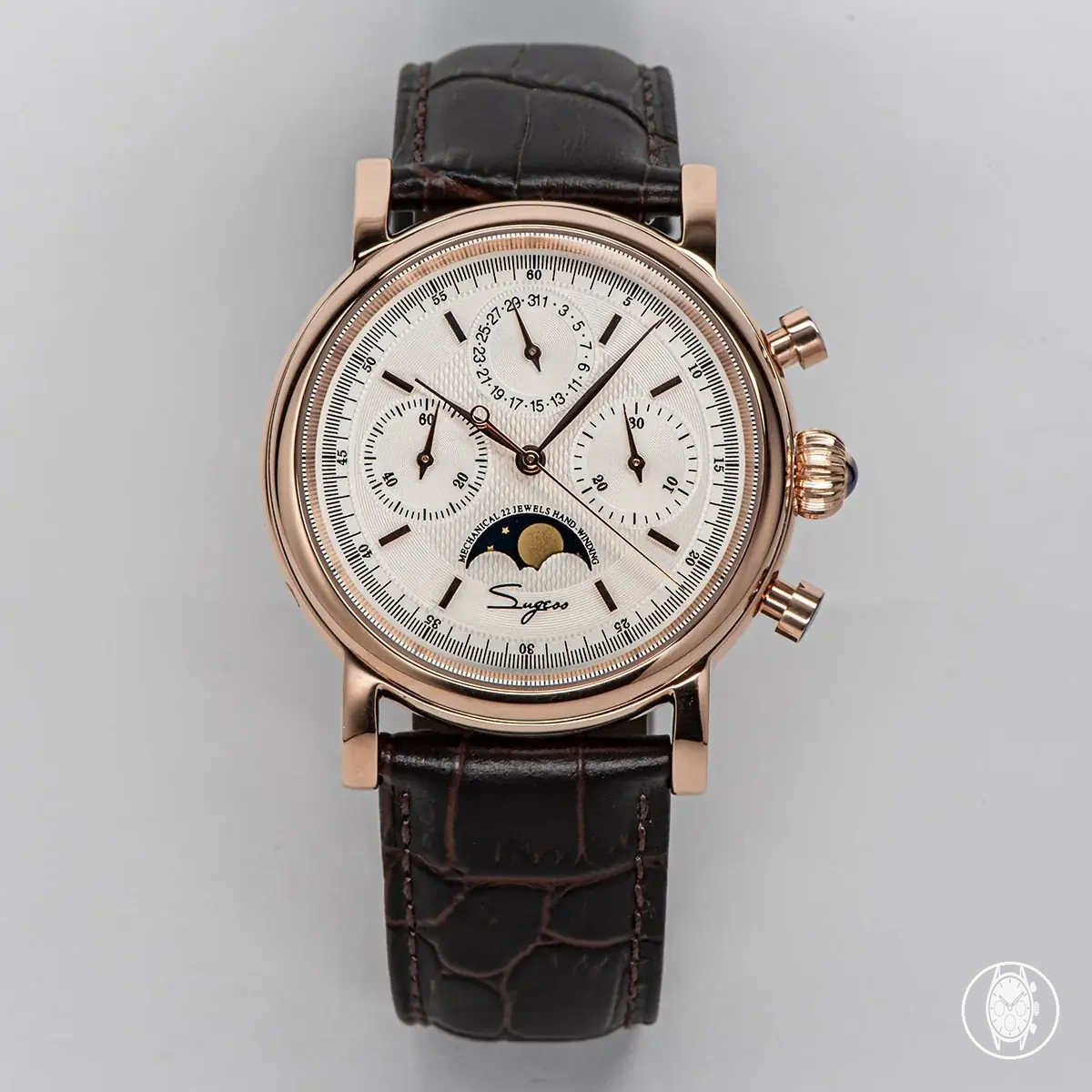
The products below are useful examples for comparing available options.
The products below are useful examples for comparing available options. Before buying, check that the compatibility criteria, key features, and product details match your needs.

This chart shows the key factors that determine whether a quartz or automatic chronograph movement is the right fit for a buyer, based on accuracy expectations, maintenance comfort, wearing frequency, and mechanical interest.
When a Quartz Chronograph Is the Better Choice
A quartz chronograph is usually the better choice when the buyer prioritises accuracy, convenience, lower upkeep, practical value, and battery-powered reliability for everyday wear. Seiko specifies its 8T63 quartz chronograph movement at ±15 seconds per month with an approximate 3-year battery life, while its instructions state that more than 1 hour of stopwatch use per day can shorten that battery interval. These conditions favour quartz when consistent timekeeping and limited mechanical ownership effort matter more than interaction with a self-winding movement.
- Low upkeep: The cited Seiko 8T63 uses an approximately 3-year battery interval under its stated conditions, so routine ownership centres on eventual battery replacement rather than maintaining a mechanical power reserve.
- Accuracy: Seiko specifies the 8T63 at ±15 seconds per month, giving buyers with defined accuracy expectations a concrete model-specific reference.
- Price sensitivity: No universal price threshold makes quartz preferable for every budget; practical value should be judged from the purchase price and expected service requirements of the specific watch.
- Occasional or everyday wear: The battery-powered 8T63 does not rely on wearing frequency to wind a mainspring, which suits buyers who rotate watches or want the chronograph ready between periods of non-wear.
- Practical gifting: Quartz is a suitable movement choice when the recipient values convenience and limited ownership effort; a recipient with established mechanical interest may prefer an automatic chronograph instead.
For a buyer who wants a chronograph for work, travel, occasional use, or everyday wear without managing a mechanical power reserve, quartz provides the clearer practical fit. The recommendation remains limited to buyers whose priorities are accuracy, convenience, lower upkeep, price sensitivity, maintenance comfort, and practical value rather than mechanical engagement. :contentReference[oaicite:0]{index=0}
When an Automatic Chronograph Is the Better Choice
An automatic chronograph is usually the better choice when the buyer values a mechanical movement, tactile ownership, watchmaking character, and non-battery operation enough to accept greater upkeep and uncertain service cost. Seiko specifies its 8R48 automatic chronograph calibre as automatic with manual winding, with approximately 45 hours of power reserve, +25 to −15 seconds per day precision, and 34 jewels; these are model-specific values that make wearing frequency, mechanical complexity, and service tolerance part of the buyer-fit decision. Automatic therefore fits buyers whose mechanical interest and ownership experience outweigh the convenience advantages of quartz.
- Mechanical interest: Choose an automatic chronograph when interacting with a self-winding mechanical movement is part of the desired ownership experience rather than only a way to power the chronograph.
- Regular wear: Seiko specifies approximately 45 hours of power reserve for calibre 8R48, so exhausting that stored energy during non-wear requires winding before normal operation resumes.
- Service tolerance: No universal service cost applies to automatic chronographs; the relevant cost remains specific to the calibre, chronograph mechanism, required parts, territory, and service provider.
- Movement complexity: Seiko specifies 34 jewels and 30-minute and 12-hour chronograph counters for the 8R48, providing a concrete example of mechanical complexity a buyer may deliberately value.
- Non-battery operation: The automatic movement stores mechanical energy in its mainspring rather than relying on a movement battery, but that preference carries power-reserve management and mechanical servicing obligations.
For a buyer who wears the watch regularly and values mechanical character, the 45-hour Seiko 8R48 example gives a practical boundary for wearing frequency and winding expectations. The recommendation remains conditional on accepting service cost uncertainty, mechanical complexity, and greater ownership effort; an automatic chronograph is not inherently more accurate, more durable, or financially superior because of its movement type. :contentReference[oaicite:0]{index=0}
Value Trade-Offs Between Quartz and Automatic Chronographs
Value trade-offs between a quartz chronograph and an automatic chronograph come from purchase price, ownership cost, servicing exposure, upkeep, craftsmanship, and buyer satisfaction rather than movement type alone. Tissot Australia lists the PR516 quartz chronograph T149.417.11.041.00 at A$855 and the PR516 Automatic Valjoux T149.462.11.011.00 at A$3,100, giving a same-collection price comparison without establishing a universal quartz-versus-automatic price gap. Value therefore extends beyond upfront price to the costs and benefits the buyer expects during ownership.
| Value criterion | Quartz chronograph | Automatic chronograph |
|---|---|---|
| Purchase price | Tissot Australia: PR516 quartz T149.417.11.041.00 at A$855; this is a model-specific Australian price. | Tissot Australia: PR516 Automatic Valjoux T149.462.11.011.00 at A$3,100; this is a model-specific Australian price. |
| Upkeep | Battery upkeep applies to the movement; Tissot specifies a Renata 394, 1.55 V battery for the cited PR516 quartz model. | Mechanical upkeep replaces battery dependence with a self-winding mechanical movement; Tissot specifies up to 68 hours of power reserve for the cited PR516 Automatic Valjoux. |
| Servicing exposure | No universal quartz chronograph service-cost range is established by the reviewed manufacturer evidence; cost must be assessed for the specific movement, required work, territory, and service provider. | No universal automatic chronograph service-cost range is established by the reviewed manufacturer evidence; movement complexity, parts, labour, condition, territory, and service provider determine the applicable cost. |
| Craftsmanship and perceived value | Practical value is strongest when the buyer gives more weight to electronic operation, convenience, and battery upkeep than to mechanical interaction. | Perceived value is strongest when the buyer assigns value to the self-winding mechanical movement, chronograph mechanism, and watchmaking craftsmanship. |
| Durability and resale uncertainty | The reviewed evidence establishes no movement-wide durability advantage, resale percentage, or retained-value threshold; model, condition, service history, age, brand position, and market demand must be evaluated separately. | |
For a buyer who prioritises practical use and price sensitivity, a quartz chronograph can offer stronger cost-value when its lower purchase price and battery upkeep match the intended usage frequency. In Tissot Australia's cited PR516 examples, the A$855 quartz model costs A$2,245 less upfront than the A$3,100 Automatic Valjoux, a calculated difference between two specific configurations rather than a market-wide saving. Quartz value is therefore strongest when lower initial expenditure, predictable battery upkeep, and limited interest in mechanical servicing align with buyer satisfaction.
Quartz value is therefore strongest when lower initial expenditure, predictable battery upkeep, and limited interest in mechanical servicing align with buyer satisfaction.
Ownership cost should be evaluated separately from purchase price because servicing exposure, parts, labour, water-resistance work, and repair availability are not priced uniformly across quartz and automatic chronographs. A buyer comparing chronograph watches by value should therefore compare the exact model's purchase price, upkeep requirements, condition, and service support rather than treating movement type as a complete cost measure. Resale uncertainty also remains unresolved without comparable evidence for the same model, age, condition, market, and sale period, which sets the boundary for budget-value claims.
Resale uncertainty also remains unresolved without comparable evidence for the same model, age, condition, market, and sale period, which sets the boundary for budget-value claims.
For a buyer who values mechanical operation, an automatic chronograph can justify greater purchase-price and servicing exposure when craftsmanship and ownership experience contribute materially to satisfaction. Tissot specifies up to 68 hours of power reserve for the cited A$3,100 PR516 Automatic Valjoux, giving regular wearers a measurable mechanical benefit, while a buyer who assigns little value to that feature may prefer the quartz model's cost-value profile. Automatic value is therefore strongest when mechanical upkeep, movement interaction, and perceived craftsmanship are benefits the buyer actively wants rather than costs tolerated without corresponding satisfaction.
For a buyer who values mechanical operation, an automatic chronograph can justify greater purchase-price and servicing exposure when craftsmanship and ownership experience contribute materially to satisfaction.
The better movement choice is the one whose purchase price, ownership cost, servicing exposure, battery upkeep or mechanical upkeep, craftsmanship, usage frequency, and expected buyer satisfaction align with the intended use case. Treat durability and resale as model- and condition-specific uncertainties, then favour quartz for practical cost-value or automatic for mechanical perceived value only when those criteria match the buyer's priorities. :contentReference[oaicite:0]{index=0}
Before buying, check that the compatibility criteria, key features, and product details match your needs.
The products below are useful examples for comparing available options. Before buying, check that the compatibility criteria, key features, and product details match your needs.