Men's Chronograph Watches by Budget and Value
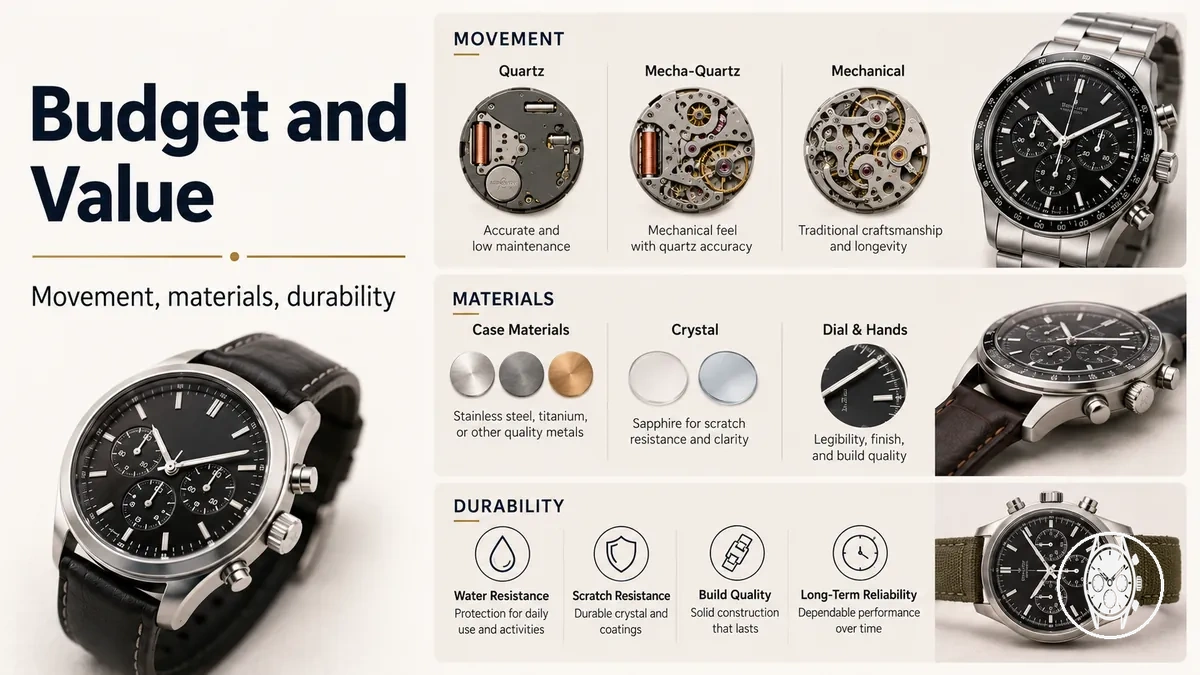
Men's chronograph watches offer better value when their movement type, materials, durability, maintenance requirements and ownership cost match the buyer's intended use and expectations. A budget is therefore a decision frame for balancing those attributes within an acceptable price range, with price acting as one signal rather than the only signal.
A budget is therefore a decision frame for balancing those attributes within an acceptable price range, with price acting as one signal rather than the only signal.
A buyer may face two chronographs in a similar price band yet get different movement, case, crystal and maintenance characteristics, so the upfront cost alone does not establish the value outcome. The men's chronograph watch guide provides the wider decision context; here, the focus narrows to how budget, construction and expected ownership cost affect the trade-off.
A watch is better value when its movement, materials and ownership cost match the buyer's use case.
A watch is better value when its movement, materials and ownership cost match the buyer's use case. For a concrete Australian price reference, Seiko Australia lists the SSB451 quartz chronograph at AUD 625 with a stainless-steel case, sapphire crystal, 10-bar water resistance and an approximate three-year battery life; Seiko's service documentation also states that battery replacement is chargeable and recommends a water-resistance check for watches rated at 10 bar or above when the battery is replaced. This illustrates why interpreting a budget means checking what the price includes and what the movement may require during ownership rather than treating a price band as a quality grade.
This illustrates why interpreting a budget means checking what the price includes and what the movement may require during ownership rather than treating a price band as a quality grade.
A higher price range can represent a different movement and construction package rather than a proportional increase in value: Seiko Australia's January 2026 specifications put the Prospex Speedtimer SRQ059 mechanical chronograph at an AUD 3,900 recommended retail price, with an automatic Calibre 8R48, stainless-steel construction, dual-curved sapphire crystal, 10-bar water resistance and a 45-hour power reserve. These are model-specific reference points, not universal budget boundaries, so buyer expectations should be tested against movement type, materials, durability for the intended wear conditions and likely ownership cost before judging one men's chronograph watch as better value than another.
Table of Contents
What Budget Means for a Men's Chronograph Watch
A budget for a men's chronograph watch is the spending range used to set acceptable expectations for chronograph quality, function and trade-offs in movement type, materials and durability. Budget therefore acts as a value filter: price defines the spending boundary, while value reflects how well the watch's attributes meet the buyer's intended use and ownership expectations.
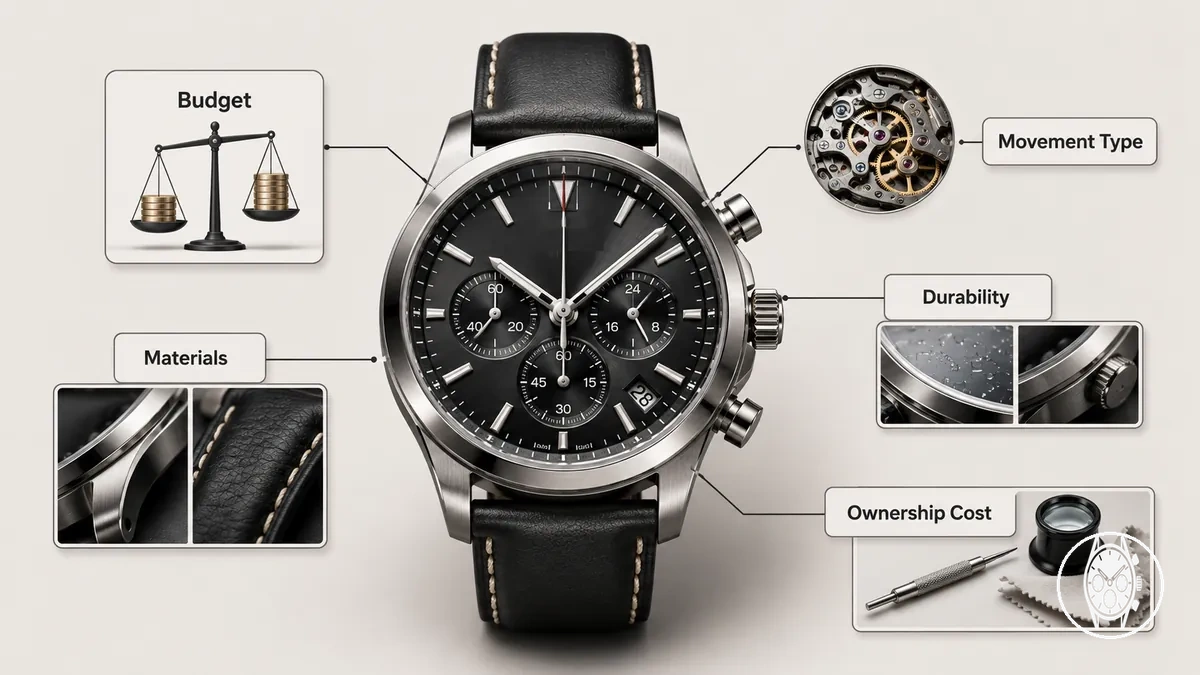
What Budget Means for a Men's Chronograph Watch becomes clearer when a buyer converts the spending range into explicit value expectations for movement type, materials, durability and ownership cost. For example, suppose a buyer sets an illustrative maximum of AUD 600 and compares one chronograph priced at AUD 500 with another at AUD 600: the AUD 600 watch represents better value only if its movement, construction, durability or expected maintenance provides a useful advantage for that buyer's intended wear. The numerical amounts are illustrative rather than market thresholds, so this comparison defines how to use a budget without assigning a quality grade to a particular price band.
Budget level therefore establishes the acceptable combination of price, function and ownership expectations rather than a ranking of individual men's chronograph watches.
Budget level therefore establishes the acceptable combination of price, function and ownership expectations rather than a ranking of individual men's chronograph watches. A lower-priced watch can meet the required value criteria when its movement type, materials and durability satisfy the intended use, while a higher-priced watch justifies the extra cost only when its additional attributes matter to that buyer.
Chronograph Watch Price Ranges and Expected Trade-Offs
Men's chronograph watch price ranges change the likely trade-offs in movement expectations, materials, finishing and ownership requirements rather than creating fixed quality outcomes. No universal Australian-dollar boundary defines entry-level, mid-range and premium chronographs, so these price bands should be read as comparative tiers and checked against each model's actual specifications.
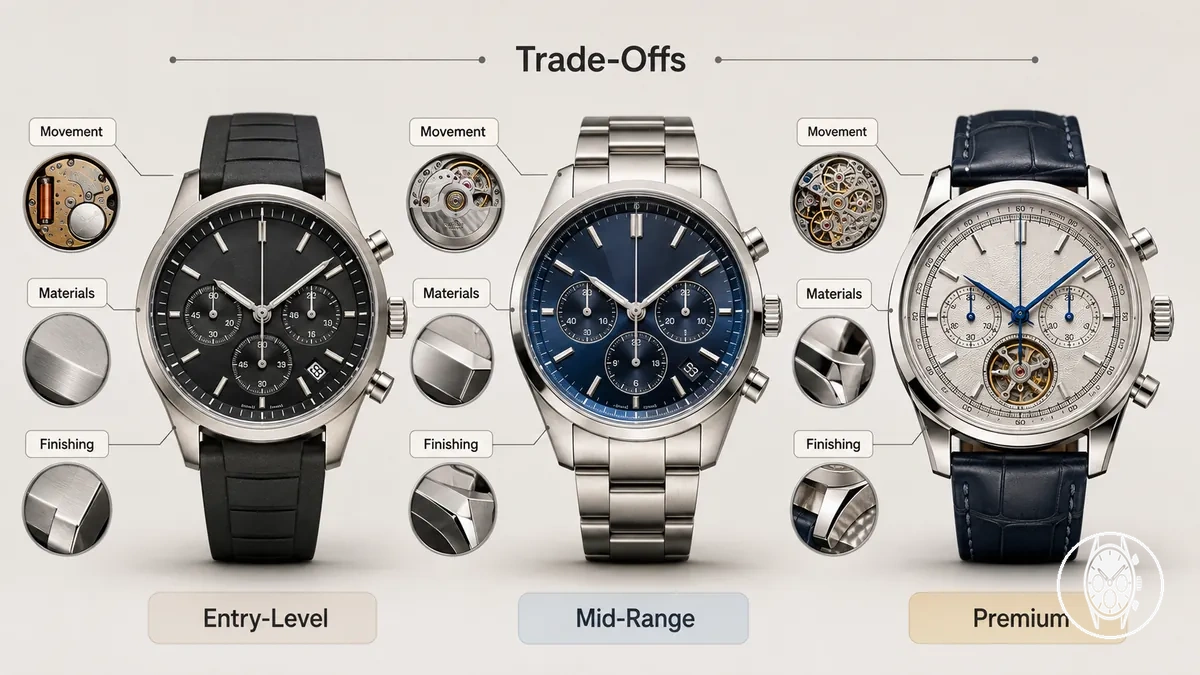
Chronograph Watch Price Ranges and Expected Trade-Offs are most useful when movement type, case material, crystal, finishing and durability are compared together rather than inferred from price alone. Current Australian manufacturer examples show why: Citizen Australia lists the CA0840-87M Eco-Drive chronograph at AUD 650 with a B612 Eco-Drive movement, stainless-steel case, sapphire crystal and WR100/10-bar water resistance, while Seiko Australia lists the SSC935 Speedtimer at AUD 1,150 with a V192 solar movement, stainless-steel case, curved sapphire crystal and 10-bar water resistance; Seiko also lists the mechanical SRQ047 at AUD 3,900 with an automatic 8R48 chronograph movement, stainless-steel case, sapphire crystal and 45-hour power reserve.
| Price band | Common movement expectation | Material and finishing clues | Likely trade-off | Buyer decision signal |
|---|---|---|---|---|
| Entry-level | Quartz or light-powered quartz can prioritise straightforward chronograph function and lower movement complexity. | Sapphire crystal and stainless steel are possible rather than exclusive to higher tiers; Citizen Australia's AUD 650 CA0840-87M provides both. | More of the value can sit in practical timing function and everyday construction rather than mechanical complexity or elaborate finishing. | Check movement type, crystal, case material and stated durability specifications instead of assuming that the tier determines quality. |
| Mid-range | Quartz, solar and mechanical choices can overlap, so the movement expectation remains model-specific. | Seiko Australia's AUD 1,150 SSC935 combines a V192 solar movement, stainless-steel case, curved sapphire crystal and 10-bar water resistance. | Extra cost can add movement features, finishing or construction details without producing a proportional improvement in every durability attribute. | Identify which added specifications affect the intended use and whether they justify the extra ownership cost. |
| Premium | Complex mechanical chronograph movements become a relevant option, although premium price alone does not prove a mechanical movement. | Seiko's SRQ047 uses the automatic 8R48 chronograph movement with stainless-steel construction, sapphire crystal and a 45-hour power reserve at an Australian recommended retail price of AUD 3,900. | A larger share of the price can reflect movement construction, finishing and ownership experience rather than a simple increase in every functional specification. | Compare the mechanical architecture, finishing, service expectations and intended ownership period with the practical benefit they provide. |
For a buyer comparing entry-level, mid-range and premium chronographs, the useful interpretation is conditional: an AUD 650 example can already include stainless steel, sapphire crystal and 10-bar water resistance, while a higher-priced mechanical example can direct more of its cost toward movement construction and finishing. The price-band sections that follow can therefore examine each tier separately without treating price itself as a durability or quality score.
Entry-Level Chronographs
Entry-level chronographs can combine a quartz movement with basic case construction, mineral crystal and simple finishing while still providing daily-use value when straightforward timing, accuracy and low maintenance matter more than mechanical complexity. Citizen Australia specifies the entry-priced AN8168-51H with Calibre 0520 quartz movement, stainless-steel case and bracelet, mineral crystal, 44 mm case diameter and a chronograph measuring in 1-second increments for up to 60 minutes, showing that this price tier can retain practical materials and timing functions.
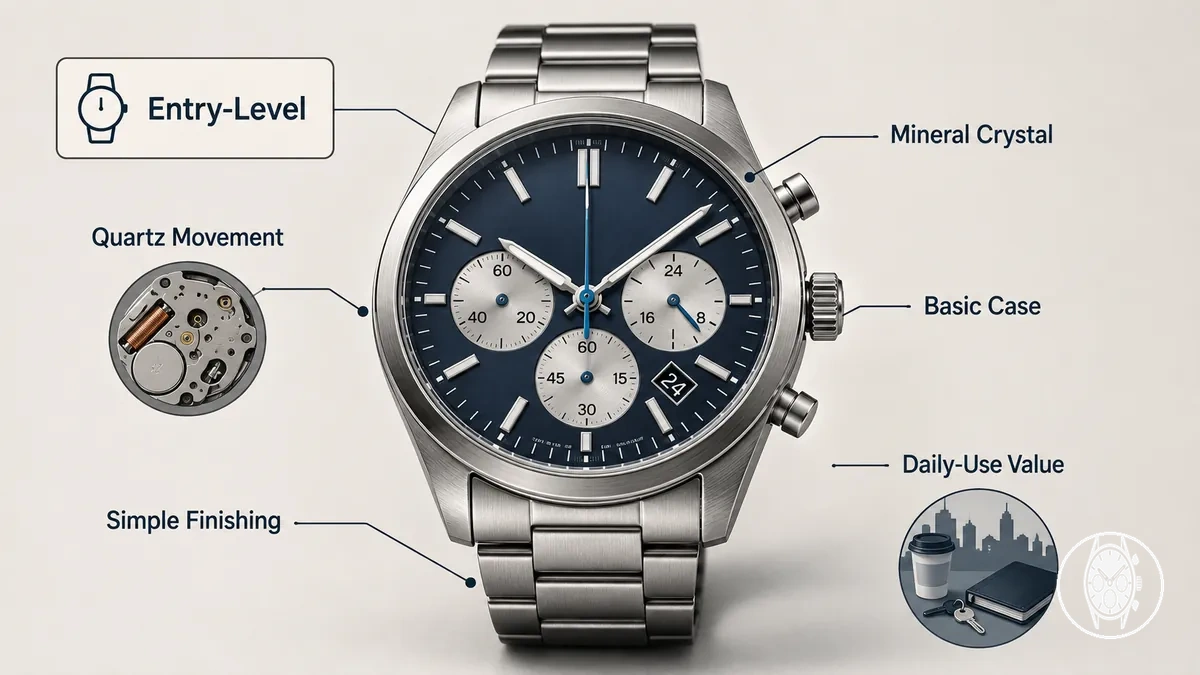
For a buyer seeking reliable casual timing without mechanical complexity, the Citizen AN8168-51H provides a concrete daily-use example: Citizen Australia specifies normal timekeeping accuracy of ±20 seconds per month, an approximately 2-year battery life and WR50/5-bar water resistance. Those specifications support an acceptable-value case for routine casual use where battery-powered accuracy and a 60-minute chronograph meet the buyer's requirements; the most likely compromise in this example is the material and finishing specification, including mineral crystal rather than sapphire and simple finishing rather than more elaborate construction.
Mid-Range Chronographs
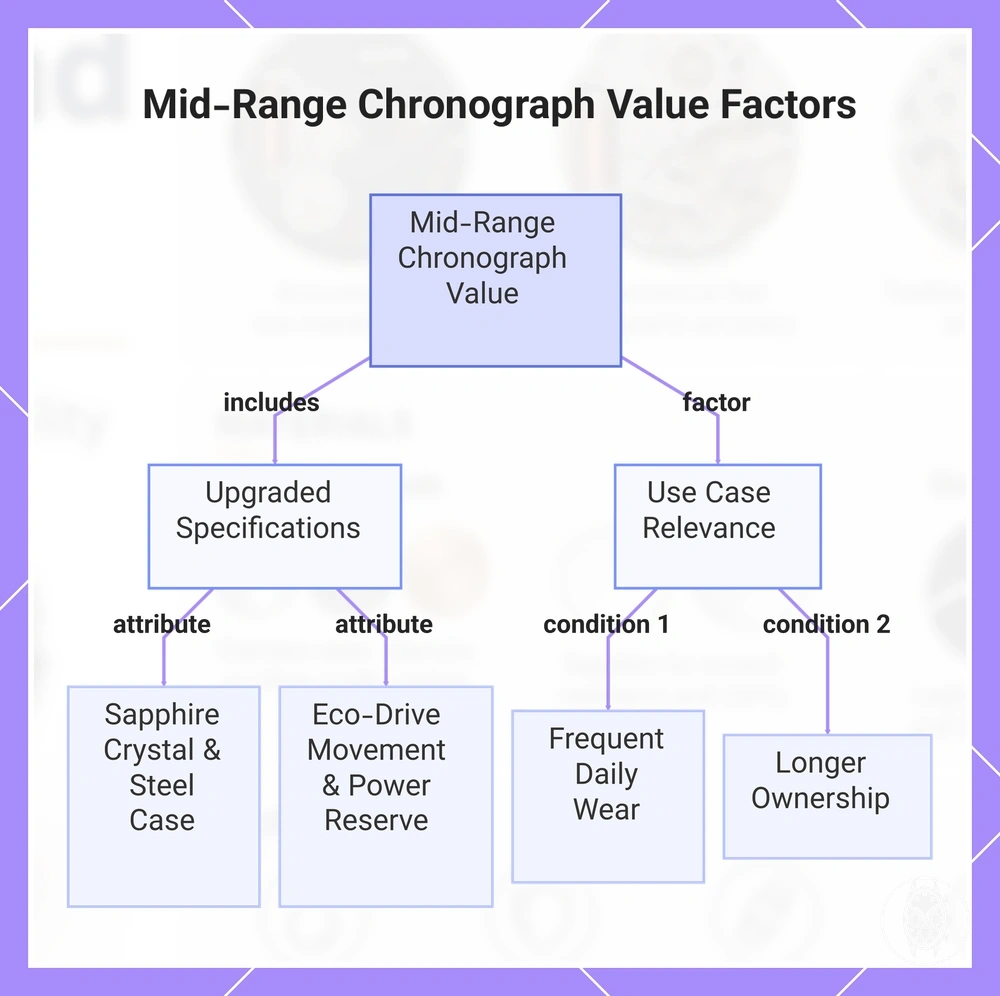
Mid-range chronographs can provide better value when the additional cost corresponds to explicit upgrades in movement, materials, durability, crystal quality, case and bracelet construction, and finishing that matter for daily wear or longer ownership. Citizen Australia specifies the CA4540-54A at AUD 899 with a B620 Eco-Drive movement, stainless-steel case and bracelet, sapphire crystal, WR100/10-bar water resistance and a stated 9-month power reserve, making those model-specific attributes concrete decision signals rather than treating the mid-range price itself as evidence of value.
For a buyer expecting frequent daily wear, the trade-off is whether the upgraded specifications justify the higher ownership cost for that use case: Citizen Australia specifies the CA4540-54A with a 43 mm stainless-steel case, sapphire crystal and WR100/10-bar water resistance, while its light-powered Eco-Drive movement provides a stated 9-month power reserve when fully charged. In practical terms, sapphire crystal, stainless-steel construction and the specified water-resistance level can support the buyer's durability expectations, while the light-powered movement reduces reliance on routine disposable-battery replacement; the added price has stronger value only when those movement, materials, finishing and daily-wear attributes are relevant to the intended ownership conditions.
This chart shows the key upgrades and use-case conditions that determine whether a mid-range chronograph offers better value than its price suggests.
This chart shows the key upgrades and use-case conditions that determine whether a mid-range chronograph offers better value than its price suggests.
Premium Chronographs
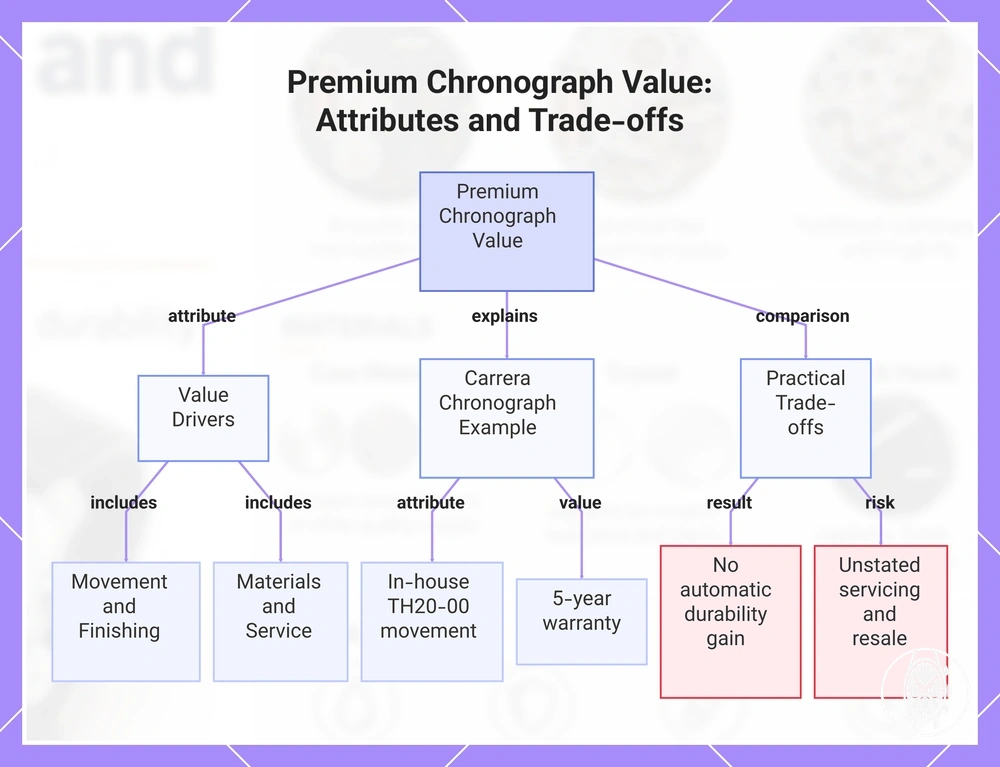
Premium chronographs can add value through a higher-grade movement, more detailed finishing, stronger materials and a defined service framework, but the higher price does not automatically produce better practical value or durability for every buyer. TAG Heuer Australia lists the Carrera Chronograph CBN2011.BA0642 at A$10,250 with an in-house TH20-00 automatic movement, 80-hour power reserve, 42 mm fine-brushed and polished steel case, sapphire crystal, steel bracelet and 100 m water resistance; its specification also includes a sunray-brushed dial and fine-brushed/polished bracelet finishing, showing that part of the cost supports movement construction and finishing as well as chronograph function.
For a buyer considering long-term ownership, the trade-off is whether those movement, materials, finishing and durability attributes justify the added price and ownership cost for the intended use.
For a buyer considering long-term ownership, the trade-off is whether those movement, materials, finishing and durability attributes justify the added price and ownership cost for the intended use. TAG Heuer Australia states a 5-year warranty for this Carrera model, which provides a defined service expectation, but the reviewed product specification does not state a lifetime servicing cost or quantify resale or collectability value; those elements therefore remain separate ownership considerations rather than proven practical returns from the premium price.
This chart shows the value-adding attributes of premium chronographs, a concrete example, and the practical trade-offs a buyer should consider.
This chart shows the value-adding attributes of premium chronographs, a concrete example, and the practical trade-offs a buyer should consider.
Cost Factors That Shape Chronograph Watch Value
The most useful criteria for judging chronograph watch value are attributes that change accuracy, durability, comfort or ownership cost, including movement specification, case and crystal materials, water-resistance suitability, bracelet or strap construction, and service requirements. A visible feature is a weaker decision signal when it changes appearance without improving an outcome the buyer needs, so each specification should be evaluated under its intended use condition.
Cost Factors That Shape Chronograph Watch Value are clearer when each component is connected to a specific condition and ownership consequence.
Cost Factors That Shape Chronograph Watch Value are clearer when each component is connected to a specific condition and ownership consequence. Movement accuracy should be checked against the manufacturer's stated specification, material quality should be assessed against expected wear, water resistance should match actual exposure, comfort should reflect the case and strap configuration, and service requirements should be treated as part of ownership cost rather than as an unrelated future expense.
| Entity/part | Attribute/criterion | Value/condition | Effect/risk/decision |
|---|---|---|---|
| Movement | Accuracy and service complexity | Use the stated accuracy specification and identify the movement as quartz, solar-quartz or mechanical chronograph. | A movement that meets the required accuracy with acceptable maintenance demands provides a stronger practical value signal than decorative detailing alone. |
| Case and crystal | Materials and durability | Identify the stated case material and crystal type, such as mineral or sapphire, and relate them to the expected wear condition. | Material quality matters when it changes resistance to expected wear or replacement exposure; decorative finishing alone does not establish greater durability. |
| Water resistance | Use-condition suitability | Compare the stated water-resistance specification with the manufacturer's permitted-use guidance and the buyer's expected water exposure. | A specification that exceeds the buyer's actual use may add cost without producing an equivalent practical benefit. |
| Bracelet or strap | Comfort and construction | Assess fit, adjustment, clasp or buckle construction, material and replacement requirements under regular wear. | A comfortable, serviceable configuration can support longer daily use more directly than purely visual surface treatments. |
| Servicing | Ownership cost | Check the movement's maintenance requirements, service availability, parts access and expected service pathway before comparing total value. | A chronograph with greater service complexity can create additional cost pressure even when its purchase specification appears stronger. |
For an illustrative comparison, suppose two chronographs cost AUD 1,000 and AUD 1,300: if the AUD 300 difference produces only decorative finishing while both meet the buyer's required accuracy, durability and comfort conditions, the added price has weaker practical value. If the same illustrative AUD 300 instead provides a material, movement or service-related attribute that changes the expected ownership outcome, that difference becomes a stronger decision signal because it affects function or ownership cost rather than appearance alone.
Movement Architecture and Price
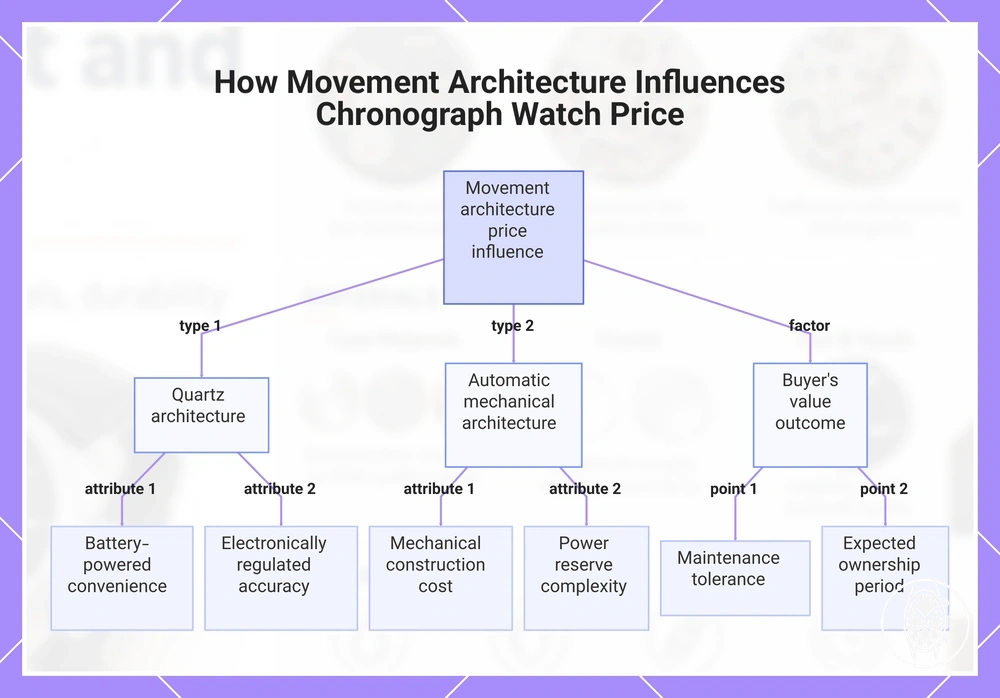
Movement architecture influences chronograph watch price because movement type, complexity, accuracy expectations, service needs and battery dependence change both the functional specification and perceived value of the watch. A quartz chronograph can prioritise electronically regulated accuracy and battery-powered convenience, while an automatic mechanical chronograph can place more of its cost in mechanical construction, power reserve and movement complexity; the stronger value outcome depends on the buyer's maintenance tolerance and expected ownership period.
For a concrete contrast, Citizen Australia's AN8175-55E uses Calibre 0520 quartz architecture with battery dependence, while TAG Heuer Australia specifies the Carrera CBN2011.BA0642 with an in-house TH20-00 automatic movement, an 80-hour power reserve and a 28,800-vibrations-per-hour frequency at A$10,250. The TAG Heuer example also differs in materials, finishing and brand positioning, so its price cannot be attributed to movement architecture alone; the practical decision signal is whether the buyer values mechanical complexity and accepts its service needs more than the simpler operating requirements associated with quartz.
This chart shows how quartz and automatic mechanical movement architectures affect chronograph watch price through key attributes and buyer decision factors.
This chart shows how quartz and automatic mechanical movement architectures affect chronograph watch price through key attributes and buyer decision factors.
Case Materials, Crystal, and Strap Quality
Chronograph watch materials affect value when the case, crystal, strap or bracelet, and clasp change durability, comfort, appearance or replacement risk under the buyer's expected wear condition. Stainless steel, plating and crystal type should therefore be treated as separate attributes rather than as a single quality label; the retained evidence likewise frames material value around use conditions rather than appearance alone. :contentReference[oaicite:0]{index=0}
| Entity/part | Attribute/criterion | Value/condition | Effect/risk/decision |
|---|---|---|---|
| Case | Base materials | Verify whether the case is stainless steel or another stated base material and judge it under the expected daily-wear condition. | The material upgrade has practical value when it improves the required durability or maintenance characteristics rather than only changing appearance. |
| Case finish | Plating or coating | Treat plating as a surface treatment over the stated base material rather than as evidence that the complete case uses a different structural material. | Additional cost has weaker practical value when the finish changes appearance without improving a durability attribute the buyer needs. |
| Crystal | Crystal type | Check whether the watch specifies mineral crystal or sapphire crystal and relate that choice to the buyer's expected contact and wear conditions. | The decision signal is whether the crystal specification materially reduces the buyer's expected replacement or cosmetic-wear risk. |
| Bracelet or strap | Construction and comfort | Assess the stated material, articulation or flexibility, adjustment range and suitability for repeated daily wear. | A bracelet or strap supports value when its construction maintains acceptable comfort and usability for the intended ownership period. |
| Clasp | Closure and adjustment | Check the stated clasp type, security and adjustment method rather than treating visual complexity as a quality measure. | A clasp upgrade is most relevant when it improves fit, security, comfort or serviceability. |
For a current numerical reference, Citizen Australia specifies the CA4540-54A chronograph at AUD 899 with a 43 mm stainless-steel case, sapphire crystal, stainless-steel bracelet and push-button clasp, showing how several material attributes can be bundled into one price rather than priced independently. :contentReference[oaicite:1]{index=1} The practical trade-off is therefore to judge whether those materials solve a real durability, comfort or wear-risk requirement for the buyer; a visible plating or finishing change alone provides a weaker value signal when the underlying use outcome remains unchanged.
Brand Positioning, Finishing, and Specification Level
Brand positioning, finishing and specification level influence chronograph watch value when they add identifiable attributes beyond basic timing function, but brand tier alone does not establish greater durability, accuracy or lower ownership cost. Useful criteria include finishing quality, dial detail, bracelet feel, warranty confidence and specification completeness; perceived prestige is a weaker decision signal when the higher price is not matched by practical attributes that matter under the buyer's ownership condition.
For a concrete example, TAG Heuer Australia specifies the Carrera Chronograph CBN2011.BA0642 at A$10,250 with a 42 mm fine-brushed and polished steel case, sunray-brushed dial, applied indexes, fine-brushed and polished steel bracelet, folding clasp, sapphire crystal, 100 m water resistance, an automatic TH20-00 movement with an 80-hour power reserve and a stated 5-year warranty. These attributes make finishing and specification level measurable, while brand positioning contributes mainly to perceived value; they do not establish future service cost or prove a superior ownership outcome, so the trade-off is whether the finishing, specification and warranty attributes justify the price for the buyer's actual use and ownership expectations. :contentReference[oaicite:0]{index=0}
Quartz and Automatic Chronographs as Value Choices
Quartz and automatic chronographs represent different value paths rather than a universal ranking: quartz places practical value on accuracy, simpler maintenance and battery-powered operation, while automatic value is tied more closely to mechanical construction, self-winding ownership feel and tolerance for periodic service. Price should therefore be treated as one comparison attribute, because neither movement type has a universal price premium, maintenance cost or accuracy value that applies to every chronograph; the best-fit buyer is determined by the required accuracy, maintenance tolerance and preference for mechanical operation.
Those values must be checked against the specific movement or manufacturer's specification before they are used as a purchasing decision signal.
The reviewed evidence supports comparing quartz and automatic chronographs by price, accuracy, maintenance condition and ownership preference, but it does not establish one universal numerical price difference, service interval or accuracy range across all models. Those values must be checked against the specific movement or manufacturer's specification before they are used as a purchasing decision signal. :contentReference[oaicite:0]{index=0}
| Option | Attribute | Value/condition | Trade-off | Best-fit buyer |
|---|---|---|---|---|
| Quartz chronograph | Price | Use the model's stated price; no universal quartz price range is established by the reviewed evidence. | Practical value is stronger when the lower ownership priority is mechanical complexity rather than movement craftsmanship. | A buyer prioritising function and cost control over mechanical ownership feel. |
| Quartz chronograph | Accuracy and maintenance | Use the manufacturer's stated accuracy and battery-life specification for the exact movement; battery replacement remains a maintenance condition. | The trade-off is battery dependence in exchange for electronically regulated timekeeping and comparatively simple routine ownership. | A buyer prioritising accuracy and limited maintenance involvement. |
| Automatic chronograph | Price | Use the model's stated price; the reviewed evidence does not support one universal automatic-price premium over quartz. | Additional cost can reflect mechanical construction and finishing, but price alone does not establish greater practical value. | A buyer who assigns value to mechanical architecture and ownership feel. |
| Automatic chronograph | Accuracy and maintenance | Use the manufacturer's stated accuracy, power-reserve and service guidance for the exact movement; no universal service interval or cost is established across all automatic chronographs. | The trade-off is reduced battery dependence with greater mechanical service complexity. | A buyer comfortable with periodic mechanical servicing and preference-led value. |
In practical comparison, quartz and automatic chronographs should be separated by the ownership outcome each movement type provides: quartz is the clearer decision signal when accuracy, maintenance simplicity and ownership cost dominate, while automatic value is justified when mechanical construction and self-winding operation are meaningful preferences. For example, suppose two otherwise suitable chronographs cost an illustrative AUD 900 and AUD 1,200; the AUD 300 difference has practical value only if the automatic movement's mechanical ownership experience is worth that added cost to the buyer, rather than because automatic architecture is inherently superior.
Quartz Chronograph Value
Quartz chronographs can deliver strong value when the buyer prioritises accuracy, lower servicing needs and an accessible price over mechanical movement complexity. Battery-powered regulation can reduce routine mechanical maintenance demands, while battery replacement remains part of ownership cost; the trade-off is that materials, durability, finishing and brand pricing still determine whether the complete chronograph represents good value. :contentReference[oaicite:0]{index=0}
Quartz chronographs can deliver strong value when the buyer prioritises accuracy, lower servicing needs and an accessible price over mechanical movement complexity.
For a practical buyer scenario, Seiko Boutique Australia specifies the SSB427P quartz chronograph at AUD 450 with Calibre 8T63, accuracy of ±15 seconds per month at 5°C to 60°C, a stated 3-year battery life, stainless-steel case and bracelet, Hardlex crystal and 100-metre water resistance. :contentReference[oaicite:1]{index=1} For a buyer focused on reliable daily timing and predictable battery-dependent maintenance, those price and movement attributes provide a clear cost-value case; however, the Hardlex crystal and other materials remain separate durability decision signals, so the quartz movement alone does not establish the watch's total ownership value.
Automatic Chronograph Value
Automatic chronograph value is strongest when the buyer values mechanical movement construction and ownership experience enough to accept a higher model-specific price and unresolved long-term service cost. Seiko Boutique Australia specifies the Prospex Speedtimer SRQ047J at AUD 3,900 with an automatic 8R48 chronograph movement, hand-winding capability, a 45-hour power reserve, a 42 mm stainless-steel case, 14.6 mm thickness, sapphire crystal and 100-metre water resistance; these attributes make movement complexity, materials and durability part of the value proposition rather than function alone. :contentReference[oaicite:0]{index=0} :contentReference[oaicite:1]{index=1}
Automatic chronograph value is strongest when the buyer values mechanical movement construction and ownership experience enough to accept a higher model-specific price and unresolved long-term service cost.
Compared with Seiko's solar Speedtimer SSC917P at AUD 1,150 and 13.3 mm thick, the SRQ047J is a calculated AUD 2,750 more expensive and 1.3 mm thicker; this model-specific trade-off illustrates how mechanical construction can increase price and case thickness without establishing a universal automatic premium. Seiko Boutique Australia's SRQ047J specification does not state a service interval or lifetime service cost, so those figures remain unresolved ownership cost inputs that should be verified for the intended ownership period. :contentReference[oaicite:2]{index=2}
- Movement complexity: the SRQ047J's 8R48 is an automatic chronograph with hand winding and a stated 45-hour power reserve, so mechanical engineering is an explicit value factor. :contentReference[oaicite:3]{index=3}
- Price: the calculated AUD 2,750 difference between the SRQ047J and SSC917P is specific to these two Seiko models and should not be generalised to all automatic and non-automatic chronographs. :contentReference[oaicite:4]{index=4}
- Case thickness: the same comparison gives a calculated 1.3 mm increase, from 13.3 mm to 14.6 mm, making wrist profile a practical decision signal where comfort matters. :contentReference[oaicite:5]{index=5}
- Ownership cost: Seiko's reviewed SRQ047J product specification provides no service-price or lifetime-maintenance figure, so automatic value is justified only when the buyer's preference for mechanical construction outweighs that unquantified future cost exposure. :contentReference[oaicite:6]{index=6}
Cheap Versus Expensive Chronograph Watches
Cheap versus expensive chronograph watches should be compared by the attributes the extra price actually changes, not by price alone. In a useful comparison, movement quality, accuracy, materials, finishing, water resistance, maintenance, serviceability and practical daily use are decision signals; a higher price produces stronger practical value only when those changes matter to the best-fit buyer.
Cheap versus expensive chronograph watches should be compared by the attributes the extra price actually changes, not by price alone.
Seiko Boutique Australia provides a controlled same-brand example: the quartz SSB427P is listed at AUD 450 with Calibre 8T63, accuracy of ±15 seconds per month at 5°C to 60°C, a stated 3-year battery life, stainless-steel construction, Hardlex crystal and 100-metre water resistance, while the automatic SRQ047J is listed at AUD 3,900 with Calibre 8R48, accuracy of +25/-15 seconds per day at 5°C to 35°C, a 45-hour power reserve, stainless-steel construction, sapphire crystal and the same 100-metre water-resistance specification. The calculated AUD 3,450 price difference therefore accompanies a different movement, accuracy expectation, crystal material and ownership experience, but it does not increase the stated water-resistance rating. :contentReference[oaicite:0]{index=0} :contentReference[oaicite:1]{index=1}
| Option | Attribute | Trade-off | Best use case |
|---|---|---|---|
| Lower-priced quartz example | SSB427P: AUD 450; ±15 seconds per month; 3-year battery life; Hardlex crystal; 100-metre water resistance. | The price retains defined daily-timing accuracy and 100-metre water resistance, while battery replacement remains a maintenance condition and the crystal is Hardlex rather than sapphire. | A buyer prioritising accuracy, straightforward maintenance and practical daily use over mechanical ownership feel. |
| Higher-priced automatic example | SRQ047J: AUD 3,900; +25/-15 seconds per day; 45-hour power reserve; sapphire crystal; 100-metre water resistance. | The higher price adds automatic chronograph architecture and sapphire crystal, but the stated water-resistance specification remains 100 metres. | A buyer who values mechanical construction and sapphire crystal enough to accept the additional cost and different accuracy expectation. |
| Finishing and brand positioning | Both examples are Seiko models, reducing brand-tier variation within this comparison; the reviewed product pages do not provide a standardised numerical finishing score. | Visible finishing can influence preference-led value, but price cannot quantify finishing quality where the manufacturer supplies no comparable metric. | A buyer who separates measurable specification gains from aesthetic or prestige-led value. |
| Serviceability and ownership cost | The reviewed SRQ047J product specification does not state a lifetime service cost or universal service interval; the SSB427P specifies a 3-year battery life. | The automatic model's future service cost remains an evidence limitation, while the quartz model has a defined battery-maintenance interval. | A buyer who includes future maintenance conditions in the value calculation rather than comparing purchase price alone. |
This comparison shows that meaningful price differences are attribute-specific: AUD 3,450 separates these two models, yet their stated water resistance remains identical at 100 metres while their movement, accuracy, crystal and maintenance conditions differ. Seiko Boutique Australia's reviewed specifications support those model-level differences but do not establish a universal rule that expensive chronographs provide greater durability, serviceability or daily usefulness. :contentReference[oaicite:2]{index=2}
Seiko Boutique Australia's reviewed specifications support those model-level differences but do not establish a universal rule that expensive chronographs provide greater durability, serviceability or daily usefulness.
The transition to are chronograph watches worth it is therefore a use-case question: a higher price represents real value when the added movement, materials, finishing or ownership experience is useful to that buyer, while an unchanged specification such as 100-metre water resistance should not be counted as an improvement merely because the watch costs more.
What Usually Improves With a Higher Price
As chronograph watch price rises, the most meaningful value improvements are usually identifiable changes in movement execution, materials, bracelet or strap construction, finishing, design detail and warranty support rather than price itself. Seiko Boutique Australia's specifications provide a model-specific example: the AUD 450 SSB427P uses quartz Calibre 8T63 and Hardlex crystal, while the AUD 3,900 SRQ047J uses automatic Calibre 8R48 with a 45-hour power reserve and sapphire crystal; both retain stainless-steel construction, 100-metre water resistance and a stated 3-year limited guarantee, so not every durability or ownership attribute improves with the higher cost. :contentReference[oaicite:0]{index=0}
- Movement: the SRQ047J changes from the SSB427P's quartz movement to an automatic chronograph movement with hand winding and a stated 45-hour power reserve, making mechanical execution a preference-led value factor when the buyer values that ownership experience.
- Materials and durability: the crystal changes from Hardlex to sapphire, while both examples retain stainless-steel cases and bracelets plus 100-metre water resistance; the practical upgrade is therefore crystal specification rather than a universal increase in durability.
- Bracelet and finishing: both models specify stainless-steel bracelets, and the reviewed Seiko specifications provide no standardised numerical bracelet-quality or finishing score; tactile refinement therefore remains a model-specific decision signal rather than a price-proven improvement.
- Warranty confidence: both reviewed models carry a stated 3-year limited guarantee, so the calculated AUD 3,450 price difference does not produce a longer stated warranty period in this comparison.
- Design refinement: the SRQ047J adds features including an exhibition case back and mechanical hand-winding capability, which can increase preference-led value without changing every practical-use specification.
For a buyer comparing these two chronographs, the calculated AUD 3,450 additional price buys identifiable changes in movement architecture, power reserve, crystal material and design execution, while water resistance and the stated guarantee remain unchanged. The trade-off is therefore attribute-specific: higher ownership cost is justified when the upgraded movement, materials or refinement change the buyer's expected ownership experience enough to matter, not merely because the chronograph carries a higher price.
What Does Not Always Improve With a Higher Price
A higher chronograph watch price does not necessarily produce proportional gains in accuracy, everyday usefulness, comfort, water resistance or durability; each attribute must be checked against the movement, materials and wearing context. Seiko Boutique Australia specifies the AUD 1,150 solar SSC917P at ±15 seconds per month, 39 mm diameter, 13.3 mm thickness, sapphire crystal, stainless-steel construction and 100-metre water resistance, while the AUD 3,900 automatic SRQ047J is rated at +25/-15 seconds per day, 42 mm diameter, 14.6 mm thickness, sapphire crystal, stainless-steel construction and the same 100-metre water resistance. The calculated AUD 2,750 price difference therefore changes movement architecture and ownership experience without increasing every disclosed practical-use specification, so the trade-off is whether those mechanical differences justify the extra cost and prospective ownership cost for the buyer. :contentReference[oaicite:0]{index=0}
For a buyer who mainly wants dependable everyday value, the SSC917P provides a concrete decision signal: its manufacturer-stated accuracy tolerance is tighter on a calendar-time basis, while both models provide sapphire crystal and 100-metre water resistance; its 39 mm by 13.3 mm case also creates a different fit condition from the SRQ047J's 42 mm by 14.6 mm case without proving that either will be more comfortable for every wrist. Seiko Boutique Australia's reviewed specifications do not state a lifetime service cost for the SRQ047J, so that part of ownership cost remains unquantified; the higher price can add automatic movement appeal and mechanical complexity, but it does not by itself establish greater accuracy, water resistance, disclosed material durability, comfort or suitability for a particular wearing context. :contentReference[oaicite:1]{index=1} :contentReference[oaicite:2]{index=2}
Ownership Costs That Affect Chronograph Value
A men's chronograph watch can lose part of its price advantage when ownership cost adds battery replacement, movement service, repair, strap wear or durability-related work after purchase. Seiko Australia specifies a 3-year battery life for its quartz Calibre 8T63 in the SSB455, while its Australian support information does not publish one service or repair price that can be applied across chronograph movements and conditions; those costs therefore require a model-specific assessment or quote. :contentReference[oaicite:0]{index=0}
Ownership Costs That Affect Chronograph Value should therefore be checked by watch part, maintenance condition and support requirement rather than estimated from purchase price alone.
Ownership Costs That Affect Chronograph Value should therefore be checked by watch part, maintenance condition and support requirement rather than estimated from purchase price alone. Seiko Australia states that battery replacement is chargeable even during its guarantee period and that accident or improper-use damage to the case, glass or band can also be repaired at cost; its Australian service-centre information identifies Seiko service support in Australia but does not state a universal repair price.
| Entity/part | Attribute/criterion | Value/condition | Effect/risk/decision |
|---|---|---|---|
| Quartz chronograph movement | Battery | Model-specific interval; Seiko specifies approximately 3 years for Calibre 8T63 in the SSB455. | Battery replacement creates recurring ownership cost; Seiko states that battery replacement is chargeable even during its guarantee period. |
| Mechanical chronograph movement | Service and repair | No universal Australian service interval or repair price is stated in the reviewed Seiko Australia support information; movement and condition require model-specific assessment. | Specialist service or repair can add cost pressure, so available support and a current quote are decision signals before long-term cost is estimated. |
| Case, glass and chronograph system | Repair risk | Repair cost is condition-specific; Seiko states that accident or improper-use damage to the case, glass or band is chargeable under its guarantee terms. | Early damage can reduce the value advantage of a lower purchase price when paid repair becomes necessary. |
| Leather, urethane or fabric strap | Strap wear | Replacement interval and price are not universally specified; Seiko excludes exchange of these band types from free guarantee repair. | Wear that requires replacement becomes an additional ownership cost rather than a covered maintenance item. |
| Case seals and water-resistant construction | Durability condition | Seiko's service guidance states that opening a case for battery replacement can affect water resistance and calls for a water-resistance test after battery replacement on watches rated at 10 bar or higher. | Maintaining the specified durability condition can add a service step beyond the battery itself. |
| Manufacturer service network | Support | Seiko lists Australian service centres in New South Wales and Victoria; the reviewed support information provides contact routes but no universal chronograph repair price. | Identifiable service support provides a route for model-specific inspection and quotation instead of relying on a generic ownership-cost estimate. |
For example, suppose a chronograph costs an illustrative AUD 600 and needs an illustrative AUD 350 repair soon after purchase: its calculated cash outlay becomes AUD 950, so it would exceed the initial cost of an illustrative AUD 900 watch that requires no paid work during the same comparison period by AUD 50. These figures are hypothetical rather than quoted service prices, but the calculation shows how an early battery, service, repair or replacement need can reverse an apparent purchase-price advantage.
Battery, Service, and Repair Cost Differences
Battery, service, and repair create different ownership cost patterns for a chronograph watch: quartz has a model-specific battery interval, while automatic and complex chronograph repairs add condition-specific labour and parts requirements. Seiko Boutique Australia specifies a 3-year battery life and SR936SW battery for the quartz Calibre 8T63 in the SSB455P, while Seiko Watch Corporation recommends periodic watch service about every 3 years as general guidance but states that frequency depends on climate and use; neither source provides one Australian repair price applicable to all chronographs. Actual cost therefore remains conditional on movement type, brand support, parts availability, durability condition and the required repair. :contentReference[oaicite:0]{index=0}
- Quartz battery: the Seiko SSB455P provides a concrete 3-year battery-life value, so its battery event is more predictable than an unscheduled fault, although the reviewed manufacturer information does not specify an Australian replacement price.
- Automatic service: Seiko Watch Corporation gives about 3 years as general periodic-service guidance, with timing qualified by climate and use; the resulting ownership cost still requires a movement-specific service scope and local price.
- Pusher or subdial repair: a failed chronograph control or display function requires fault-specific assessment of the affected mechanism and available parts, so the reviewed evidence supports no universal repair interval or price.
- Water ingress: Seiko states that gasket ageing or shock can reduce water resistance and that buttons should not be operated while the watch is wet; moisture entering the movement therefore changes a durability condition into a potentially broader repair requirement.
- Repair feasibility and strap wear: replacement feasibility is bounded by compatible parts, material, condition and support, and the reviewed evidence establishes no universal strap-replacement interval or chronograph repair cost.
For example, the SSB455P gives its owner a manufacturer-stated 3-year battery horizon, whereas a chronograph with a damaged pusher, subdial fault or water ingress has no equally predictable cost until the movement condition and required parts are identified. The practical trade-off is predictability: scheduled battery or periodic service creates a bounded maintenance expectation, while complex repair can create greater cost pressure when diagnosis, parts availability or brand support limits repair feasibility.
Durability and Everyday Wear Cost
Daily wear changes a chronograph watch's effective value because case condition, crystal scratch exposure, bracelet or strap wear, water-resistance integrity, pusher exposure and use frequency can create different ownership cost pressures. The reviewed evidence establishes no universal numerical scratch-resistance threshold, case-impact limit, strap-replacement interval or wear cost across chronographs, so those durability attributes must be assessed from the watch's materials and current condition; Seiko Watch Corporation also states that water resistance is not permanent because gasket ageing or accidental shock can reduce it and that buttons should not be pressed while a watch is wet. :contentReference[oaicite:0]{index=0} The trade-off is that a durability feature has greater practical value for frequent wear only when it reduces an exposure or replacement risk the wearer actually encounters. :contentReference[oaicite:1]{index=1}
- Case resistance: no universal numerical impact or scratch threshold is established by the reviewed evidence; case material, existing damage and expected contact conditions therefore set the relevant durability boundary.
- Crystal scratch resistance: crystal type is the explicit material value to compare where no standardised model-specific scratch threshold is supplied; replacement pressure becomes relevant when the wear environment regularly exposes the crystal to contact.
- Bracelet or strap wear: the reviewed evidence establishes no universal replacement interval or cost because material, fastening condition and use frequency determine when replacement becomes necessary.
- Water resistance and pushers: Seiko states that ageing gaskets or impact can reduce water resistance and warns against pressing buttons while the watch is wet, so the stated water-resistance level and the watch's present sealing condition are separate decision signals. :contentReference[oaicite:2]{index=2}
- Use frequency: in an illustrative comparison, a chronograph worn 250 days in one year receives about 8.3 times as many wear days as one worn 30 days, increasing opportunities for contact, moisture exposure, strap wear and pusher use without implying a fixed failure rate.
For a daily-wear buyer, materials and durability justify more of the price when they match repeated contact, moisture and operating conditions while keeping repair or replacement pressure acceptable. For an occasional wearer, the same durability specification can produce less practical cost benefit because exposure is less frequent, making the ownership-cost decision more preference-led rather than automatically improved by a higher price.
How to Choose a Chronograph Watch for the Best Value
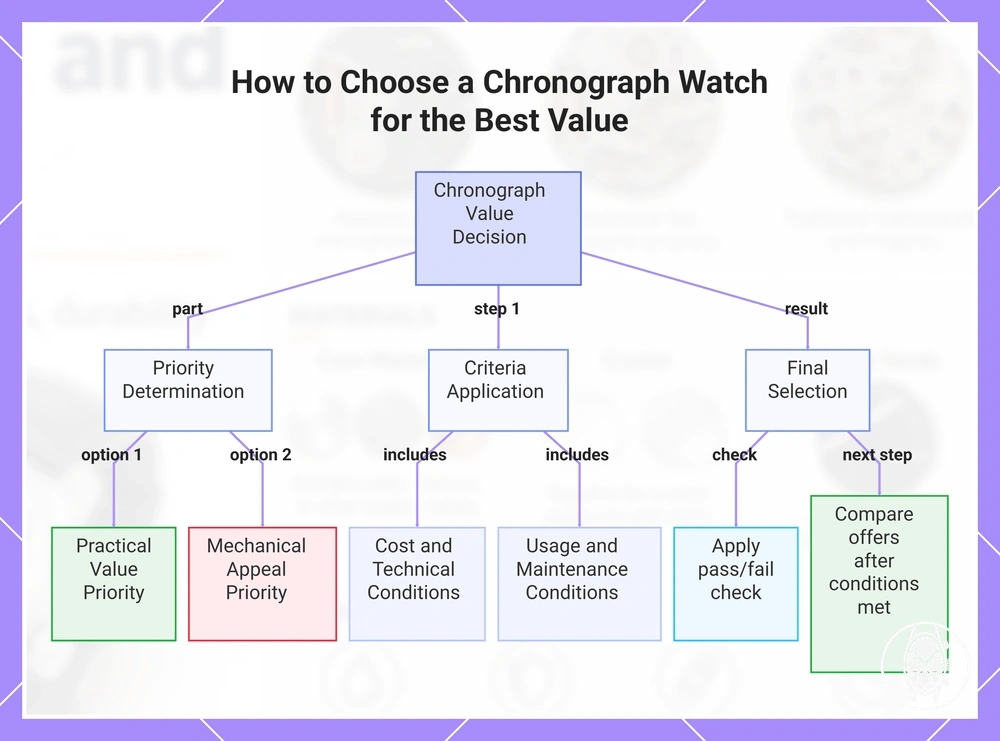
A men's chronograph watch selection has stronger value when the budget range, movement preference, material standard, maintenance tolerance and use case all meet the buyer's stated conditions before price becomes the deciding factor. Practical value should receive priority when function, durability and ownership cost matter most, while mechanical appeal should receive priority only when the buyer explicitly values the movement experience enough to accept its maintenance trade-off. :contentReference[oaicite:0]{index=0}
The acceptable buyer outcome is a chronograph that satisfies every required condition without relying on an unused specification or an unplanned ownership cost to justify its price.
Apply the criteria in sequence: set a maximum budget, select an acceptable movement category, define the required materials, set the maintenance condition you are willing to accept, and confirm the daily-use attributes. The acceptable buyer outcome is a chronograph that satisfies every required condition without relying on an unused specification or an unplanned ownership cost to justify its price.
- Budget range: set a maximum purchase-price ceiling and treat any watch above that amount as outside the acceptable condition unless another budget item is deliberately changed; the buyer outcome is controlled initial cost.
- Movement preference: define the acceptable category as quartz, solar-quartz or mechanical/automatic before comparing models; the buyer outcome is alignment between movement appeal and maintenance tolerance.
- Material standard: specify the minimum acceptable case, crystal and bracelet or strap materials for the intended wear condition; the buyer outcome is durability and comfort matched to actual use rather than to price alone.
- Maintenance tolerance: define whether battery replacement, periodic mechanical service and condition-specific repair are acceptable ownership events; the buyer outcome is fewer unexpected conflicts between purchase price and ownership cost.
- Daily-use needs: require only the fit, readability, water-resistance condition and chronograph functions used in the expected wearing context; the buyer outcome is practical value from attributes that receive regular use.
A buying checklist should treat these criteria as pass-or-fail conditions: if a chronograph exceeds the budget range, conflicts with the movement preference, falls below the material standard, exceeds the maintenance tolerance or misses a daily-use requirement, the selection no longer matches the intended buyer outcome.
For example, suppose a buyer sets an illustrative AUD 1,000 ceiling, wants quartz or solar-quartz operation, requires sapphire crystal and at least the water-resistance level appropriate to the intended daily exposure, and does not want periodic mechanical servicing; comparing best chronograph watches by need should then exclude any candidate that fails one of those conditions even if its headline price is attractive. The AUD 1,000 figure is illustrative rather than a market recommendation, but it shows how a budget value, movement condition, material standard and maintenance tolerance can be converted into a consistent decision sequence.
After those conditions are satisfied, checking chronograph watch offers becomes the final price comparison rather than the starting point.
After those conditions are satisfied, checking chronograph watch offers becomes the final price comparison rather than the starting point. A lower offer improves the buyer outcome only when the chronograph already meets the required budget range, movement preference, material standard, maintenance tolerance and use case.
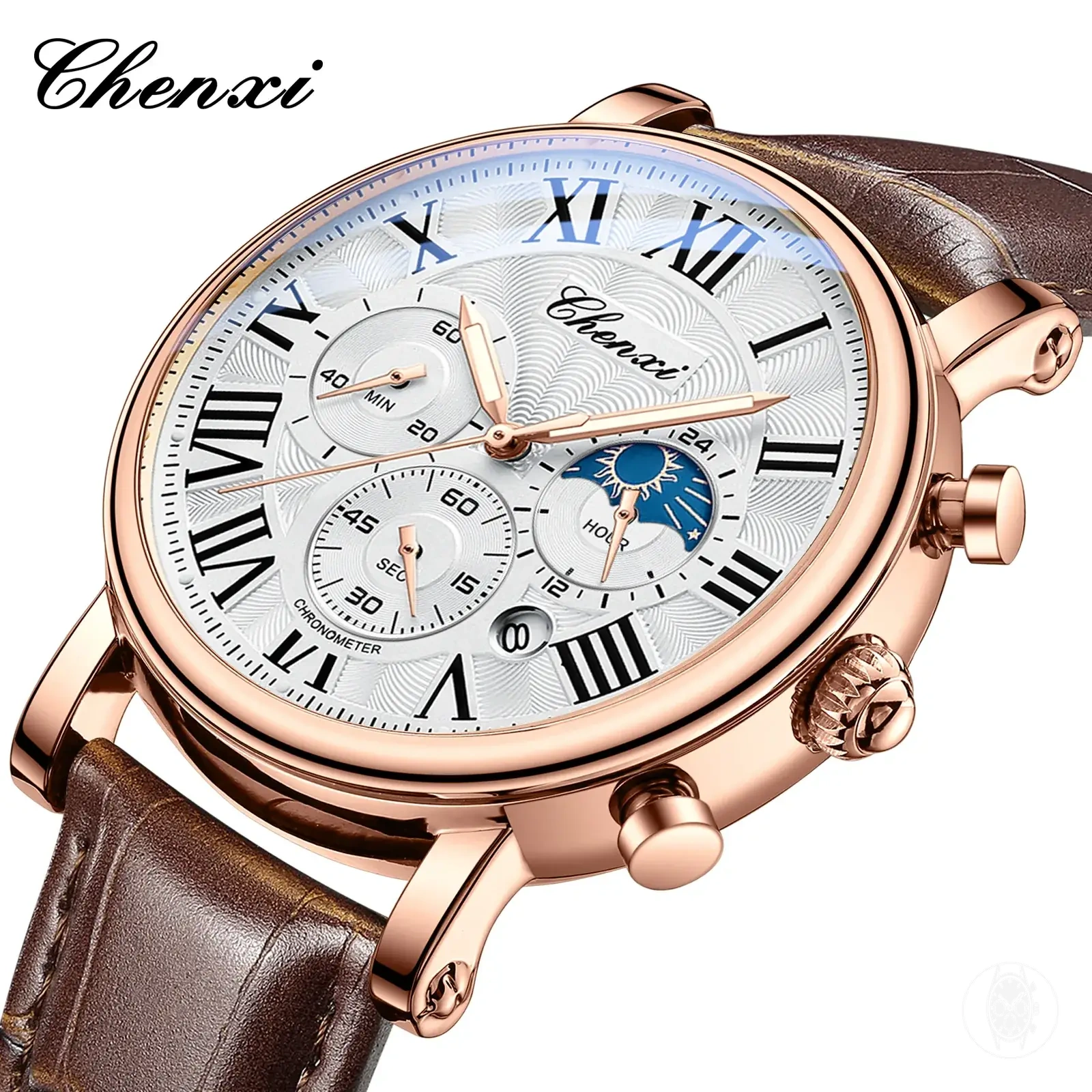
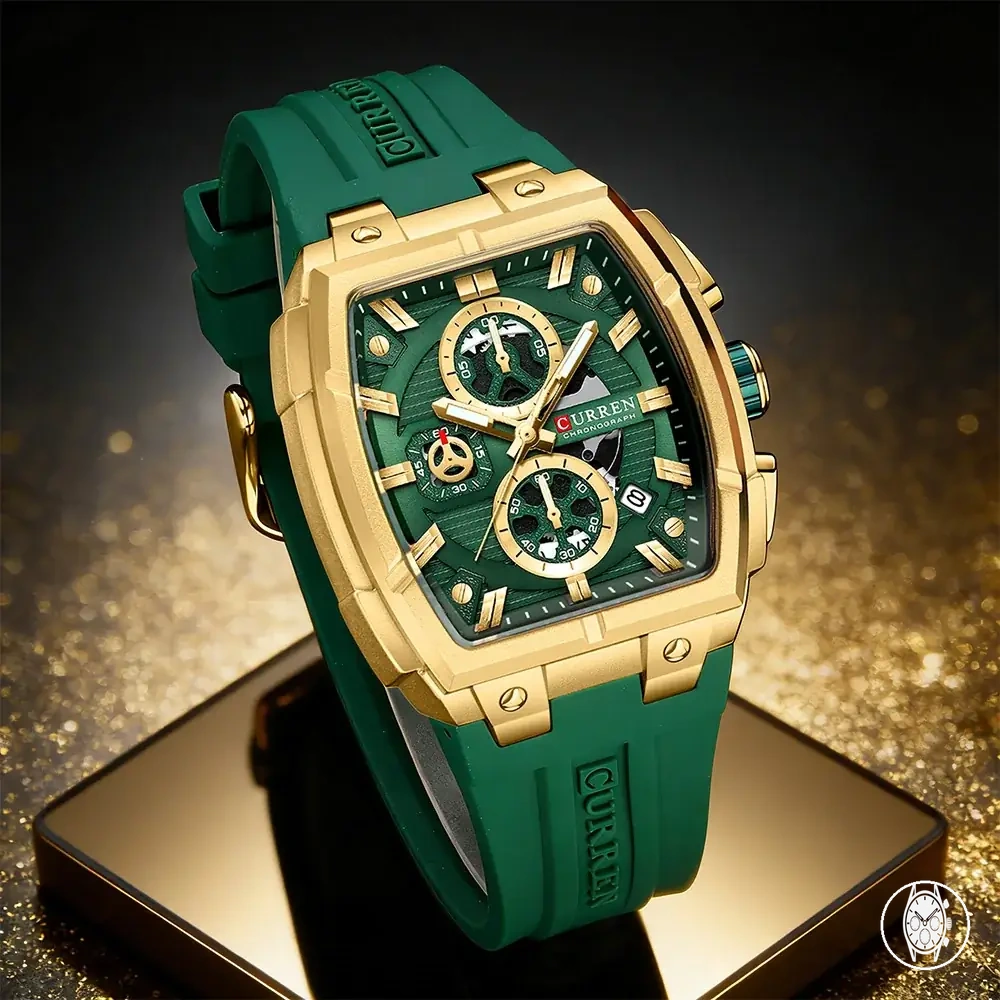
Here are product examples that may make comparison easier.
Here are product examples that may make comparison easier. Before buying, always review the compatibility criteria, essential features, and product details.
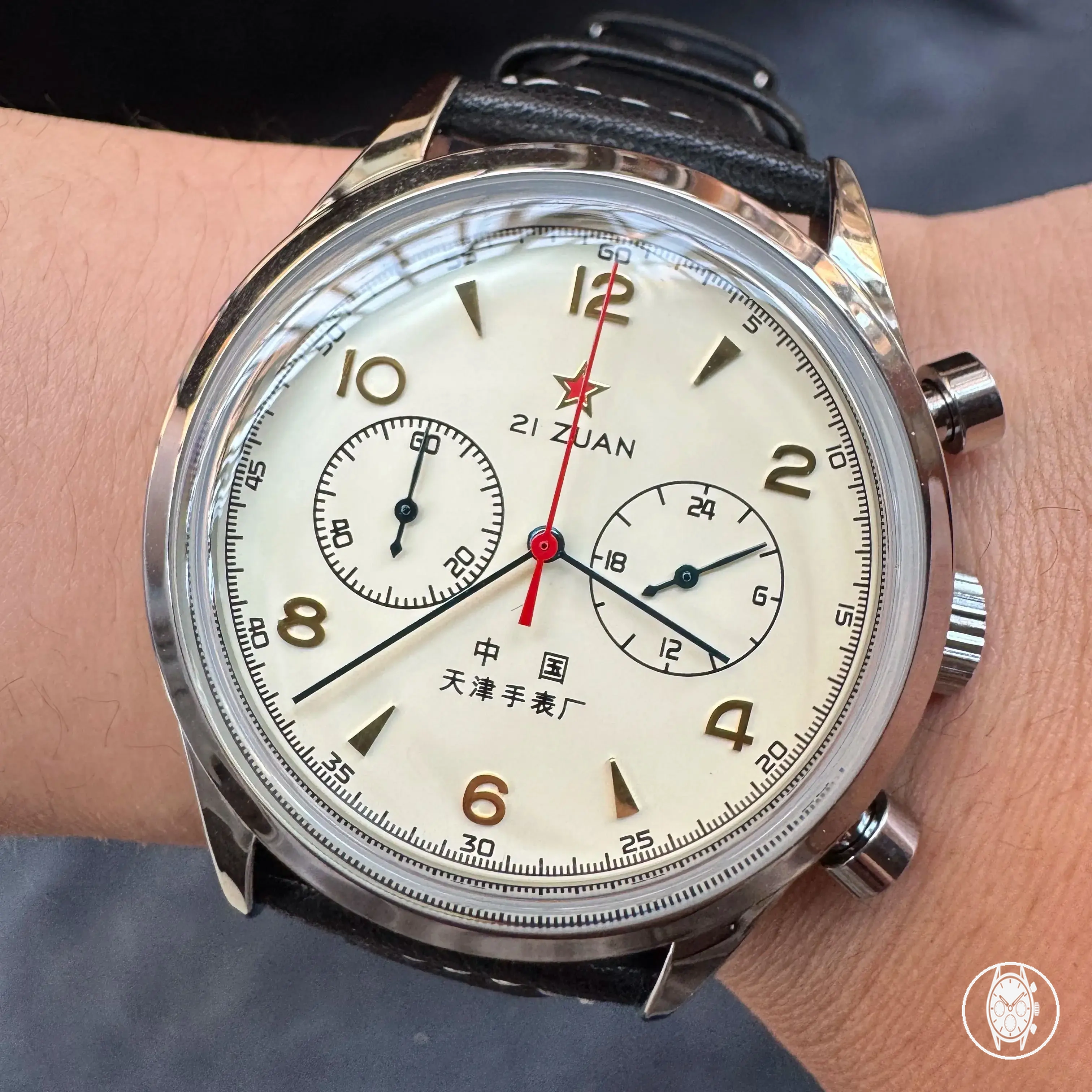
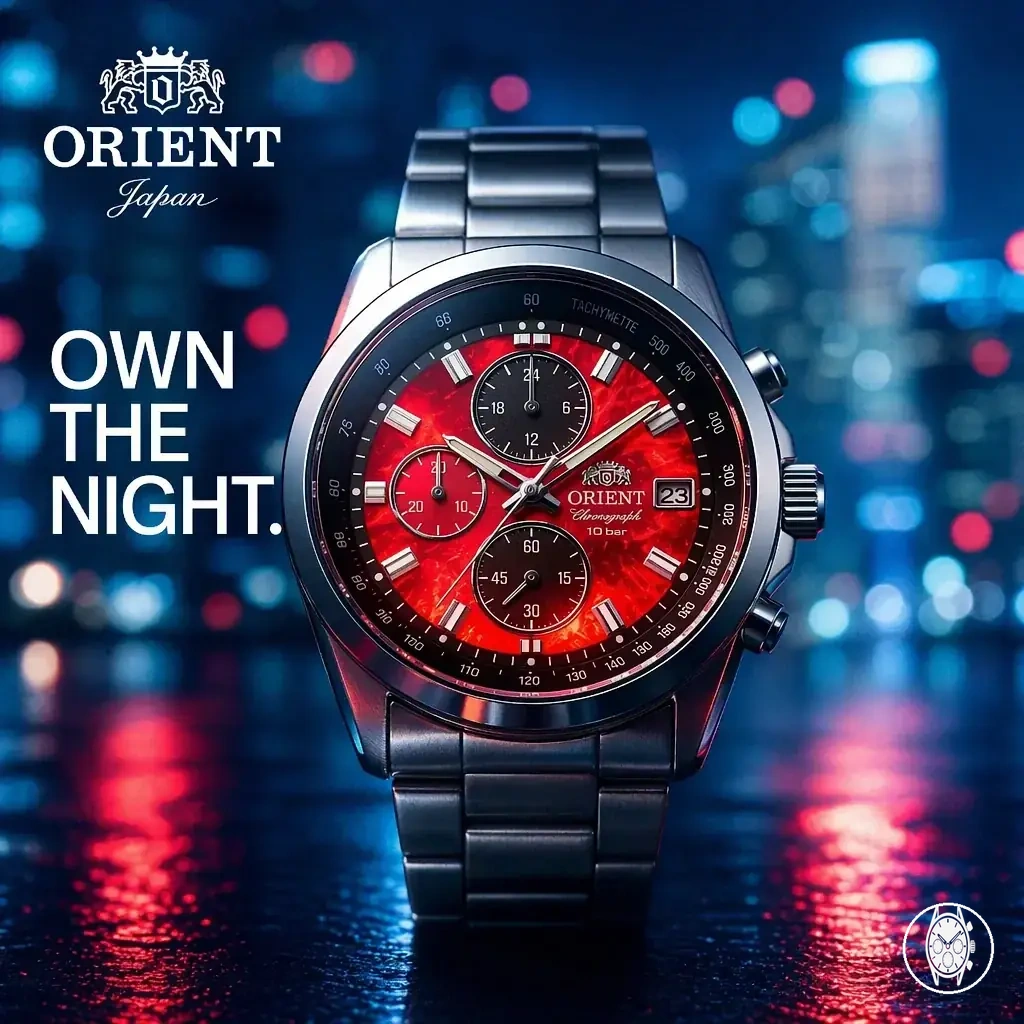
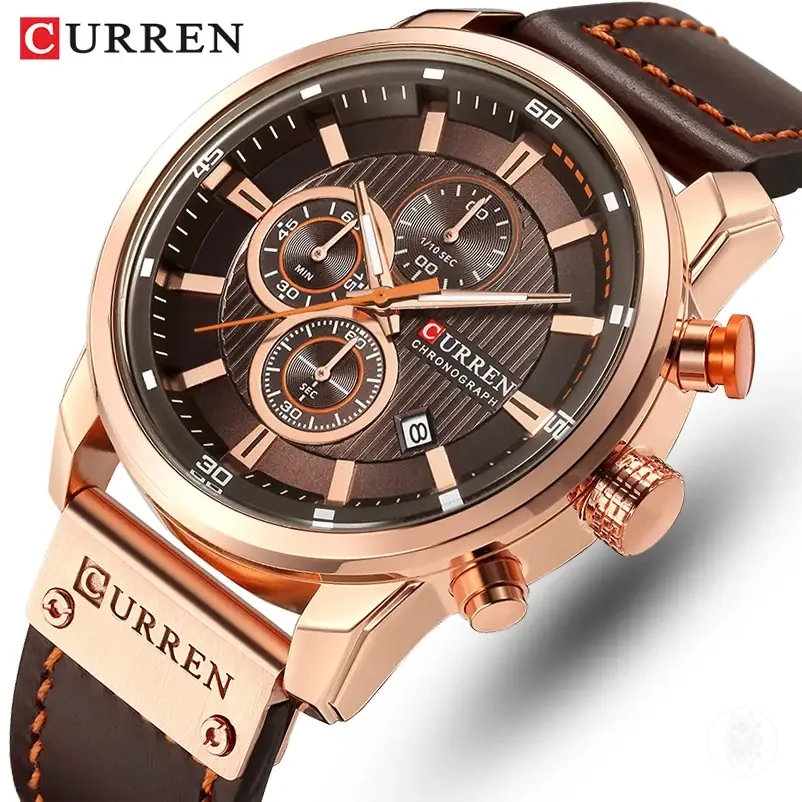
This chart shows the decision process for selecting a chronograph watch by determining priority, applying criteria in two groups, and making a final selection through pass/fail checks and price comparison.
When Paying More Is Worth It
Paying more for a chronograph watch is justified when the additional price buys a defined improvement in materials, movement execution, comfort, warranty support or long-term durability that the buyer will actually use. Mechanical complexity is also a valid value factor when it is an explicit ownership preference, but prestige alone does not establish a better cost-value outcome; the trade-off remains whether the upgrade offsets its higher purchase price and possible ownership cost. :contentReference[oaicite:0]{index=0}
- Materials: the upgrade has a clearer value outcome when the higher-priced watch moves to a specified case, crystal, bracelet or strap material that better matches the expected wear condition; where no comparable durability measurement is published, material type is the supported value and the exact wear-life improvement remains unspecified.
- Movement: additional cost is easier to justify when the movement provides a specified feature the buyer values, such as automatic operation, hand winding, longer stated power reserve or more complex chronograph construction; the movement should be judged against the buyer's maintenance tolerance rather than assumed to be superior because it is mechanical.
- Comfort: case dimensions, thickness, mass, bracelet adjustment and clasp construction become decision signals when they improve fit during frequent wear; no universal dimension or weight produces the same comfort outcome for every wrist.
- Warranty confidence: a longer or broader manufacturer-stated warranty can support the higher price when its duration and coverage are explicitly documented for the model and territory; if those terms are not published, the warranty benefit remains unquantified and should not be inferred from price.
- Long-term use and mechanical preference: stronger materials, comfort and movement characteristics justify more of their cost when the watch will be worn frequently, while mechanical complexity is preference-led value when the buyer accepts its service requirements as part of ownership.
For example, suppose one buyer plans to wear a chronograph on 250 days per year and another on 30 days per year: the frequent wearer would experience the upgraded crystal, bracelet comfort or movement characteristics about 8.3 times as often based on wear days alone. The figures are illustrative rather than product specifications, but they show why a higher price can be more defensible when the upgraded attribute delivers repeated practical benefit over the intended ownership period.
When a Budget Chronograph Is Enough
A budget chronograph can provide sufficient value when the buyer prioritises quartz reliability, casual use, acceptable materials, limited maintenance and functional durability over premium finishing or mechanical movement complexity. Seiko Boutique Australia specifies the SSB427P at AUD 450 with quartz Calibre 8T63, accuracy of ±15 seconds per month at 5°C to 60°C, a stated 3-year battery life, stainless-steel construction, Hardlex crystal and 100-metre water resistance, showing that a lower price can still provide explicit timing, material and durability values. The trade-off is that these specifications do not establish the same finishing, movement complexity or ownership experience as a higher-priced mechanical chronograph. :contentReference[oaicite:0]{index=0}
The trade-off is that these specifications do not establish the same finishing, movement complexity or ownership experience as a higher-priced mechanical chronograph.
For example, a buyer who wants reliable daily timekeeping, a 60-minute chronograph, 100-metre water resistance and predictable battery-based ownership cost can obtain those functions in the SSB427P without paying specifically for an automatic movement or premium finishing; Seiko Boutique Australia states that its chronograph measures in 1/5-second increments for up to 60 minutes. In that use case, functional value matters more than mechanical appeal, while a buyer who expects finer finishing, sapphire crystal or mechanical complexity would need a different material and movement condition rather than assuming the budget option is equivalent.
Budget Mistakes That Reduce Chronograph Watch Value
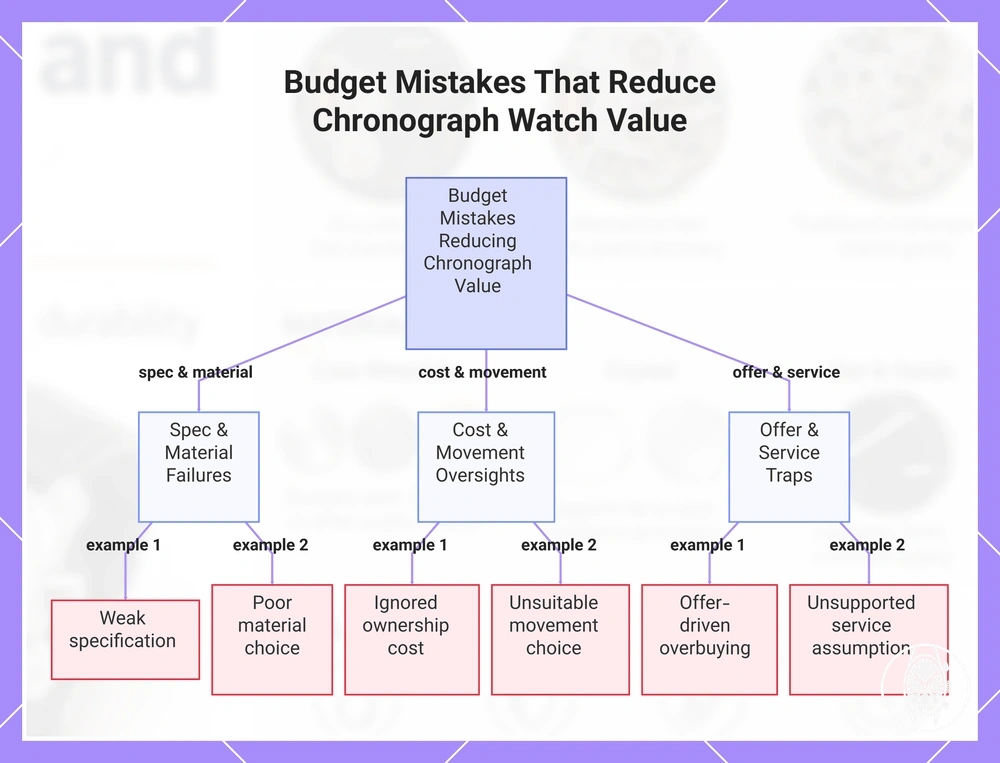
A chronograph watch budget mistake reduces long-term value when the purchase decision prioritises price or an offer over the required specification, material choice, ownership cost and movement choice. The main decision risk is accepting an attribute that does not meet the buyer's use condition, or paying for an attribute that adds cost without improving the intended outcome; the safer condition is that every required attribute passes its own check before price becomes decisive. :contentReference[oaicite:0]{index=0}
Use this mistake-prevention checklist to verify the affected attribute, the risky condition and the corrective decision signal before committing to a watch.
Use this mistake-prevention checklist to verify the affected attribute, the risky condition and the corrective decision signal before committing to a watch. The retained evidence supports treating specification fit, materials, maintenance expectations and purchase discipline as separate value checks rather than allowing one attractive price signal to override the rest. :contentReference[oaicite:1]{index=1}
- Weak specification: the affected attribute is functional suitability; the risky condition is accepting a watch that lacks a required accuracy, chronograph capacity, water-resistance, fit or other use-case specification. Safer check: define the required specification first and exclude any candidate that does not meet that stated condition.
- Poor material choice: the affected attributes are durability and comfort; the risky condition is selecting case, crystal, bracelet or strap materials that do not suit the expected wear environment. Safer check: verify each stated material and judge it against the intended daily or occasional use condition rather than inferring material quality from price.
- Ignored ownership cost: the affected attribute is total cost after purchase; the risky condition is budgeting only for the initial price while omitting applicable battery replacement, mechanical service, strap wear or condition-specific repair. Safer check: identify which maintenance events apply to the movement and materials, and use model-specific service or replacement figures where available.
- Unsuitable movement choice: the affected attribute is movement-to-use-case fit; the risky condition is selecting mechanical complexity when quartz convenience better matches the buyer's maintenance tolerance, or selecting quartz when mechanical ownership is itself a required preference. Safer check: define the acceptable movement category before comparing offers.
- Offer-driven overbuying: the affected attribute is feature relevance; the risky condition is allowing a discount to justify specifications, materials or movement complexity that were not part of the original requirements. Safer check: assess the offer only after the watch passes the specification, material, movement and ownership-cost checks.
- Unsupported service assumption: the affected attribute is ownership cost; the risky condition is treating a generic service interval or repair estimate as applicable to every chronograph. Safer check: use the manufacturer guidance, movement type and current condition for the specific watch, or treat the cost as unquantified until a model-specific figure is available.
For example, suppose an illustrative AUD 800 chronograph is discounted to AUD 650 but fails a required material or movement condition and later creates an illustrative AUD 250 ownership expense; the calculated cash outlay becomes AUD 900, so the AUD 150 discount does not preserve the original value advantage. These figures are hypothetical rather than market prices, but they show the trade-off: a lower offer cannot compensate for a specification mismatch or an ownership cost that the buyer did not plan to accept.
A lower price improves value only when those attributes already match the buyer's use case and durability expectations.
The final decision filter is to treat an offer as useful only after the chronograph satisfies the required specification, material choice, movement choice and ownership-cost condition. A lower price improves value only when those attributes already match the buyer's use case and durability expectations.
Before buying, always review the compatibility criteria, essential features, and product details.
Here are product examples that may make comparison easier. Before buying, always review the compatibility criteria, essential features, and product details.
This chart shows the six common budget mistakes that reduce a chronograph watch's long-term value, grouped by category.