Men's Chronograph Watch Buying Checklist
A men's chronograph watch should be chosen by matching its movement, size and fit, dial readability, materials, strap type, water resistance, intended use and value to the buyer's requirements; use this buying checklist as a decision filter rather than assuming one specification suits every wearer.
A chronograph watch is a wristwatch with a stopwatch-style function for measuring elapsed time while normal timekeeping continues.
A chronograph watch is a wristwatch with a stopwatch-style function for measuring elapsed time while normal timekeeping continues. Citizen's official movement documentation shows why the function itself is a selection criterion: the B620 movement displays elapsed time up to 59 minutes 59.8 seconds and stops after 60 minutes, while the 0510 movement displays up to 11 hours 59 minutes 59 seconds and can continue measuring beyond 12 hours until stopped. These model-specific limits show that function and wearability should be evaluated together rather than inferred from the chronograph label alone.
Use these needs to set the selection criteria before examining individual watches.
For daily wear, check wrist fit, dial readability and whether the strap type and case material suit the expected wearing conditions; for a gift, confirm the recipient's size and style preferences rather than treating them as fixed. Sport styling makes the stated water resistance and the manufacturer's conditions for the crown, pushers and seals relevant, while value comparison should account for movement, function and expected ownership requirements as well as purchase price. Use these needs to set the selection criteria before examining individual watches.
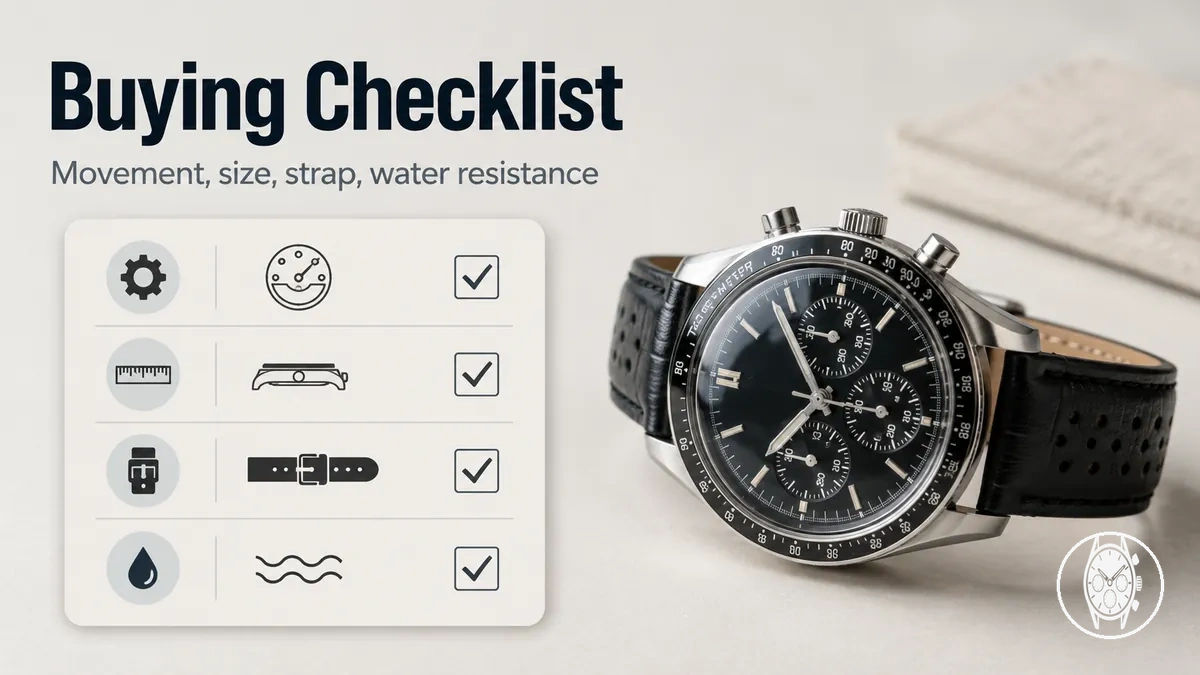
Buying checklist preview: Separate must-check specifications from preference-led choices before comparing individual men's chronograph watches.
Buying checklist preview: Separate must-check specifications from preference-led choices before comparing individual men's chronograph watches.
- Movement: identify the stated movement type, such as quartz, automatic or hand-wound mechanical, then check the manufacturer's accuracy and maintenance information for that specific movement rather than assigning one accuracy value to all chronographs.
- Size and fit: record the watch's case diameter, case thickness and lug-to-lug dimension in millimetres, then compare those measurements with the wearer's wrist and comfort requirements; there is no single case-size value established here as a universal fit for every wrist.
- Dial readability: check that the main time display remains visually distinguishable from the chronograph hands and subdials under the intended wearing conditions, with legible markers and sufficient contrast for the buyer's use.
- Strap type and materials: identify the stated case material and whether the watch uses a bracelet, leather strap, rubber strap or another specified construction, then match that configuration to the intended wearing context and maintenance preference.
- Water resistance: verify the manufacturer's stated rating and operating instructions for the exact watch or movement, including any conditions affecting the crown and pushers; Citizen's 0510 documentation, for example, instructs users of models with a screw-lock crown to secure it to maintain the watch's stated water resistance.
- Use case and value: decide whether the watch is primarily for daily wear, a gift, sport styling or another defined use, then compare the specifications that serve that purpose against the purchase price and expected ownership requirements rather than treating price alone as the value measure.
Table of Contents
Chronograph Watch Selection Basics
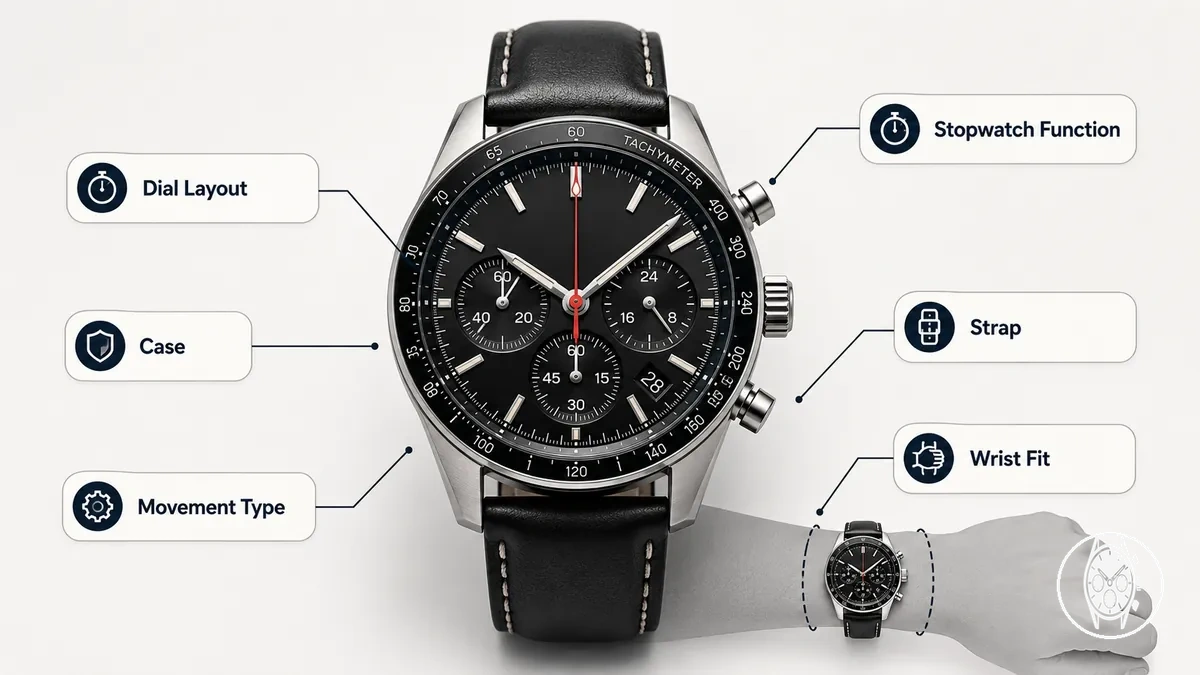
Chronograph watch selection basics start by checking whether a men's chronograph watch matches the buyer's buying intent across seven suitability criteria: stopwatch function, dial layout, case, movement type, strap, wrist fit and use condition. This first screening establishes whether the watch is suitable for the intended role before later sections evaluate movement accuracy, dimensions, materials and value in greater depth.
A chronograph adds an elapsed-time function to normal wristwatch timekeeping, so the buyer should verify the timing capacity and controls of the specific movement rather than infer them from the chronograph label. Citizen's official B620 instruction manual provides a model-specific numerical example: the movement measures elapsed time for up to 60 minutes, displays chronograph seconds in 0.2-second increments, and stops automatically after 60 minutes; its pushers provide start, stop and reset control. These specifications illustrate the selection boundary: this buying check verifies suitability and timing use rather than explaining every mechanism used across men's chronograph watches.
Mini-checklist: Apply these seven checks before comparing individual chronograph watches in greater detail.
Mini-checklist: Apply these seven checks before comparing individual chronograph watches in greater detail.
- Stopwatch function: verify the movement's stated timing limit, displayed increment and pusher controls; for the Citizen B620 example, Citizen specifies a 60-minute timing limit and 0.2-second chronograph-second increments.
- Dial layout: identify the model's main hands, chronograph hand or hands, subdials and pushers, then require the normal time display and elapsed-time indications to remain distinguishable for the intended timing task.
- Case: record the manufacturer's stated case diameter, thickness and lug-to-lug measurement in millimetres where those dimensions are published; no single case-size value establishes suitable wrist fit across all men's chronograph watches, so the relevant value is the specific model's dimensions assessed on the intended wrist.
- Movement type: identify the movement as quartz, automatic mechanical or hand-wound mechanical, then use that explicit category to direct later checks for accuracy, maintenance and ownership preference.
- Strap: identify the fitted configuration, such as a metal bracelet, leather strap or rubber strap, and assess that stated material and adjustment system against the intended use condition.
- Wrist fit: require a secure, comfortable adjustment in which the case position and strap setting allow the wearer to use the crown and chronograph pushers without the watch interfering with normal wrist movement; a universal numerical wrist-to-case fit threshold is not established for all chronograph models, so verify the specific case dimensions and available strap adjustment.
- Buying intent and use condition: classify the primary purpose as daily wear, gifting, sport-oriented wear or formal wear before comparison, so subsequent criteria are evaluated against one defined use rather than an unspecified preference.
Movement, Accuracy, and Ownership Preference
A men's chronograph watch movement should match four buying criteria: required accuracy, acceptable maintenance, preferred ownership feel, and budget. Quartz is the convenience-led path because its electronic time base supports accuracy stated on a monthly scale, while automatic or hand-wound mechanical movements use a mainspring and are normally evaluated on a daily rate; Citizen identifies a battery as the power source for conventional quartz watches and a spring as the power source for mechanical watches. The main buying paths are therefore quartz and automatic or hand-wound mechanical, with neither movement type universally preferable.
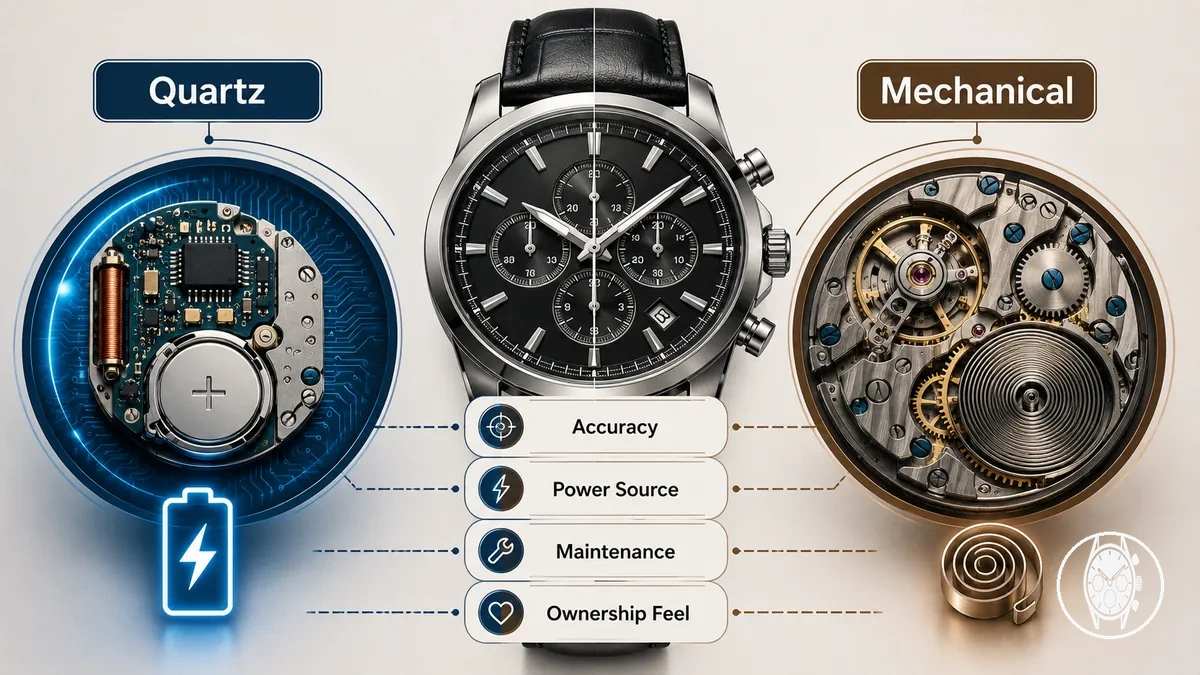
Movement choice affects daily convenience and potential long-term ownership cost because accuracy, power management, and servicing requirements differ by calibre. Citizen explains that an ordinary quartz oscillator operates at 32,768 Hz and that quartz accuracy is expressed monthly, whereas mechanical accuracy is expressed daily and is affected by mainspring state, temperature, position, and use; Seiko likewise advises assessing mechanical accuracy as a mean daily rate over actual wear rather than from one isolated day. For a numerical comparison, Citizen specifies ±15 seconds per month for its Calibre E365 quartz Eco-Drive, while Seiko specifies +25 to -15 seconds per day for its automatic Calibre 6R54 when worn at 5°C to 35°C; these manufacturer-specific figures illustrate the difference in accuracy scale rather than universal limits for all quartz or mechanical chronographs. A convenience-led or value-sensitive buyer can therefore favour quartz when monthly-scale accuracy and reduced routine interaction are priorities, while a mechanical-interest buyer can accept daily-rate accuracy in exchange for a spring-driven ownership experience.
Use accuracy scale, power source, service needs, ownership feel, and model-specific price as the criteria for narrowing the movement type choices .
Use accuracy scale, power source, service needs, ownership feel, and model-specific price as the criteria for narrowing the movement type choices. No single service interval, maintenance cost, or price premium applies across all men's chronograph watches, so verify those values for the specific calibre and watch being compared.
| Buying criterion | Quartz | Automatic or mechanical |
|---|---|---|
| Power source | Electrical power with a quartz oscillator; Citizen identifies a battery as the conventional quartz power source. | Mainspring power; automatic movements wind through wrist motion, while hand-wound movements require manual winding. |
| Accuracy reference | Monthly scale; Citizen specifies ±15 seconds per month for Calibre E365. | Daily scale; Seiko specifies +25 to -15 seconds per day for Calibre 6R54 when worn at 5°C to 35°C. |
| Power management and service | Calibre-specific; Citizen specifies approximately one year of operation from a full charge for the light-powered E365, so this value does not establish a universal quartz battery or service interval. | Requires mainspring winding through wrist motion or manual winding; a universal service interval is not established across mechanical chronograph calibres and must be checked in the manufacturer's documentation for the specific movement. |
| Ownership feel | Fits buyers prioritising monthly-scale accuracy and reduced routine interaction with the movement. | Fits buyers prioritising interaction with a spring-driven mechanical mechanism and accepting accuracy evaluated on a daily scale. |
| Price effect | No universal quartz price range or saving applies across men's chronograph watches; compare the actual watch price because calibre, case, finishing, and complications also contribute to cost. | No universal mechanical price premium applies across men's chronograph watches; compare the actual watch price and calibre-specific servicing requirements. |
| Buying outcome | Prioritise when convenience and monthly-scale accuracy are the primary criteria. | Prioritise when mechanical interaction and ownership feel justify daily-rate accuracy and calibre-specific maintenance. |
Quartz Chronographs for Accuracy and Convenience
A quartz chronograph is a practical movement choice for buyers who prioritise consistent timekeeping accuracy, battery-powered convenience, simpler routine maintenance, and an affordable ownership path. Seiko specifies its quartz Calibre 8T63 at ±15 seconds per month and approximately 3 years of battery life, providing a model-specific example of the accuracy and power interval available to a convenience-led buyer. These figures make the 8T63 a useful suitability example for practical ownership, but they are not universal specifications for every quartz chronograph.
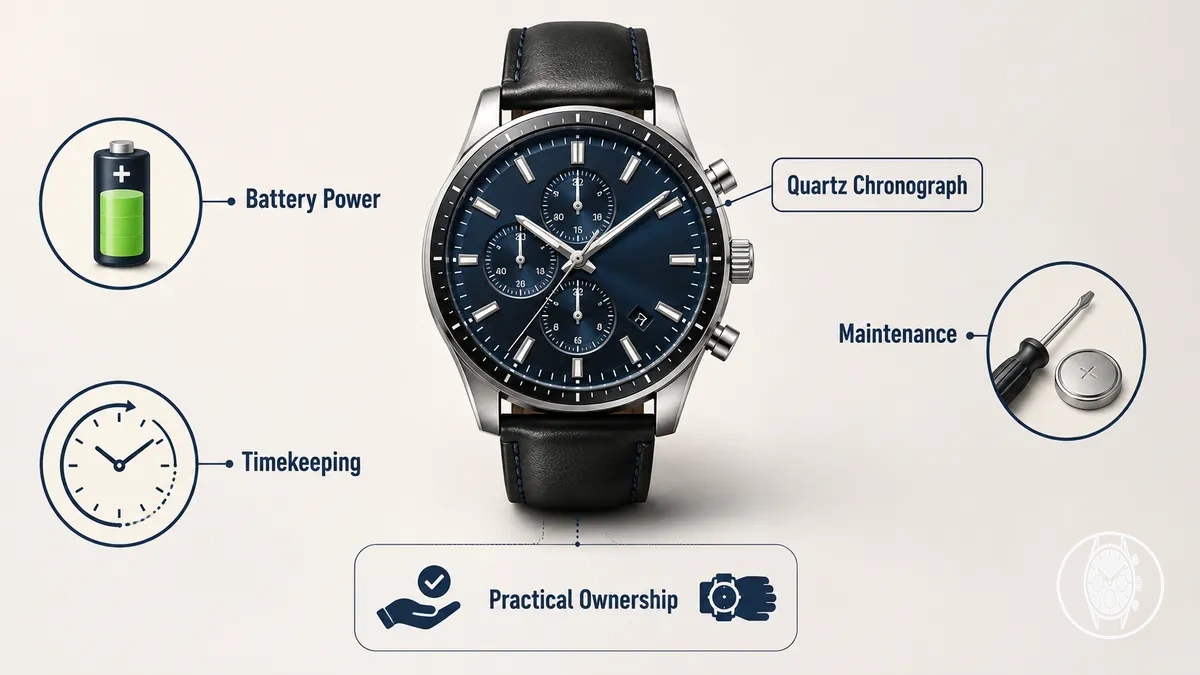
Battery power simplifies day-to-day operation but still creates a replacement requirement, so maintenance should be checked at calibre level rather than treated as absent. Citizen specifies approximately 2 years of battery life for its quartz Calibre 0580 when the alarm operates for 15 seconds per day and the chronograph for 12 hours per day, and specifies timekeeping accuracy of ±20 seconds per month between 5°C and 35°C; this shows how battery interval and accuracy remain tied to a particular movement and operating condition. For affordability, no universal price saving across men's quartz chronographs is established by the reviewed manufacturer specifications, so a value-sensitive buyer should compare the actual watch price alongside its stated accuracy, battery interval, and servicing requirements when applying the parent movement criteria.
Automatic and Mechanical Chronographs for Movement Preference
An automatic chronograph or mechanical chronograph fits buyers whose ownership interest prioritises movement character and traditional watchmaking and whose service expectations, accuracy tolerance, cost range, and wearing frequency accommodate mechanical ownership. Seiko specifies its automatic mechanical chronograph Calibre 8R48 with manual-winding capability, approximately 45 hours of power reserve, and a factory-adjusted accuracy of +25 to -15 seconds per day when worn on the wrist at temperatures from 5°C to 35°C. These model-specific conditions make the 8R48 a concrete example of preference-led decision fit, not evidence that mechanical chronographs provide universally better value.
These model-specific conditions make the 8R48 a concrete example of preference-led decision fit, not evidence that mechanical chronographs provide universally better value.
For buyers who wear an automatic chronograph frequently, wrist movement winds the mainspring, while manual winding provides another way to restore power after the watch has run down; Seiko states that actual mechanical accuracy is influenced by wearing time, arm movement, temperature, and the mainspring's winding condition. In the 8R48 instructions, Seiko also specifies that the chronograph cannot be used when the power-reserve indication is below 10 hours, giving wearing frequency and winding routine a practical consequence for chronograph use. A universal service interval or cost range is not established across automatic and mechanical chronographs by the reviewed manufacturer evidence, so buyers should verify the specific calibre's servicing requirements and the specific watch's price rather than treating mechanical movement as an inherent value advantage.
Case Size, Thickness, and Wrist Fit
A men's chronograph watch should be sized by checking wrist size against case diameter, lug-to-lug length, case thickness, strap adjustment, and visual proportion together rather than using diameter alone. Seiko's official specifications illustrate why: the SSB419 measures 39.5 mm in diameter, 46.6 mm lug-to-lug, and 11.6 mm thick, while the SSC941 measures 41.4 mm in diameter, 45.9 mm lug-to-lug, and 13.0 mm thick. The larger-diameter example therefore has a 0.7 mm shorter lug span, showing that no universal case-diameter value defines a perfect wrist fit.
The larger-diameter example therefore has a 0.7 mm shorter lug span, showing that no universal case-diameter value defines a perfect wrist fit.
For a smaller wrist, prioritise a case whose complete lug-to-lug span remains visually contained on the wrist and whose strap or bracelet can be adjusted securely; for a larger wrist, a wider case can provide more visual presence when those same fit conditions remain satisfied. Dress-oriented proportions can favour reduced thickness because a lower case occupies less vertical space, whereas sport-oriented chronographs can use greater thickness and dial density when the wearer accepts the added case presence. In the Seiko examples, the 11.6 mm-thick SSB419 is 1.4 mm thinner than the 13.0 mm-thick SSC941, providing a model-specific illustration of how two chronographs can differ in vertical presence without establishing a universal dress-versus-sport threshold. Comfort remains the buying signal: the case should sit securely, the lugs should not extend beyond the usable wrist surface, and the strap should reach a stable adjustment position without restricting normal wrist movement.
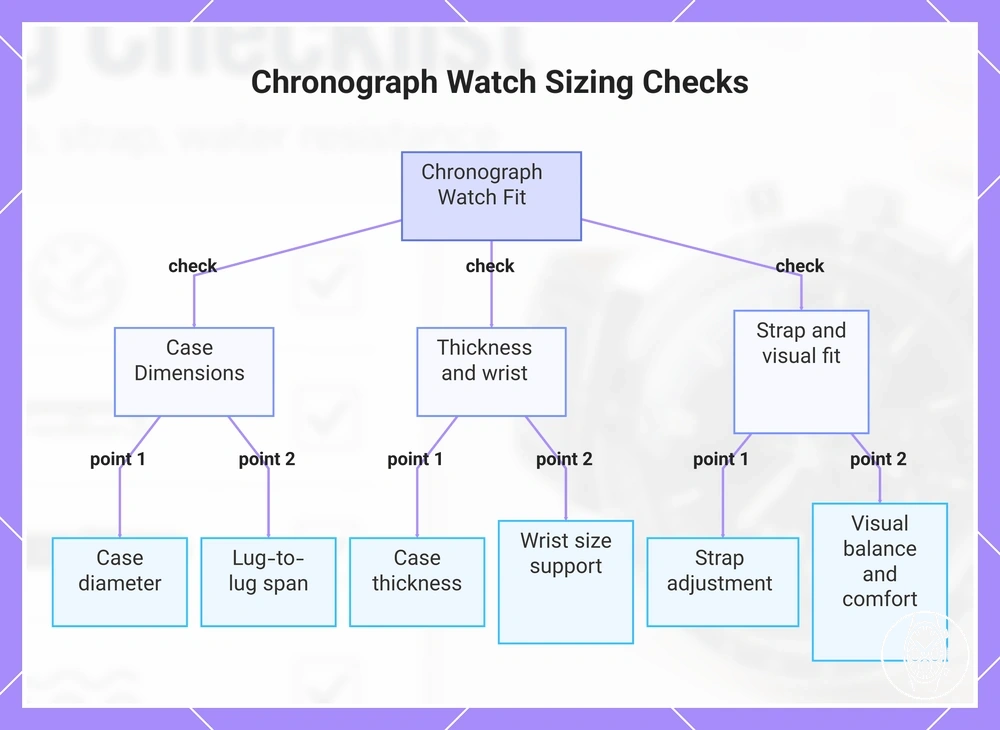
Use these checks to screen chronograph watch size and fit before purchase.
Use these checks to screen chronograph watch size and fit before purchase. Manufacturer-stated dimensions provide measurable values, but the reviewed official specifications do not establish one universal wrist-circumference-to-case-size ratio or strap-adjustment range for all men's chronograph watches.
- Case diameter: record the manufacturer's value in millimetres and treat it as one dimension rather than the complete fit rule; Seiko specifies 39.5 mm for the SSB419 and 41.4 mm for the SSC941.
- Lug-to-lug length: check the full case span across the wrist because diameter does not predict it exactly; Seiko specifies 46.6 mm for the 39.5 mm SSB419 and 45.9 mm for the 41.4 mm SSC941.
- Case thickness: compare vertical case presence with the intended wearing context; Seiko specifies 11.6 mm for the SSB419 and 13.0 mm for the SSC941, a model-specific difference of 1.4 mm.
- Wrist size: measure the intended wrist and judge whether the complete case footprint remains supported by the usable wrist surface; no universal numerical wrist-to-case threshold is established by the reviewed manufacturer specifications.
- Strap adjustment: verify the specific bracelet or strap's available adjustment against the wearer's wrist circumference because a universal adjustment range is not specified across chronograph models.
- Visual balance and comfort: accept the fit when case diameter, lug span, thickness, dial density, and strap position produce a stable watch that does not overhang the usable wrist surface or interfere with normal wrist movement.
This chart shows the key checks to perform when sizing a men's chronograph watch, covering case dimensions, thickness, wrist support, strap adjustment, and visual comfort.
Dial Layout, Subdials, and Readability
A men's chronograph watch dial should let the buyer distinguish the primary time display from chronograph information at a glance in the intended wearing context. The relevant attributes are subdial count and purpose, hand visibility, marker clarity, scale placement, date-window position, and visual contrast; readability is acceptable when these elements remain visually separable rather than competing for attention. Buyers should therefore assess the complete dial layout instead of treating a higher or lower subdial count as a universal readability rule.
Buyers should therefore assess the complete dial layout instead of treating a higher or lower subdial count as a universal readability rule.
A busy layout can increase displayed information while making the dial slower to interpret if the hands, scales, and subsidiary displays are difficult to separate. Seiko's official instructions for Calibre 8T63 provide a numerical example: the dial uses a 24-hour hand, hour and minute hands, a small seconds hand, a stopwatch minute hand, a central stopwatch 1/5-second hand, and a date display, while the stopwatch measures up to 60 minutes in 1/5-second increments. This model-specific arrangement shows that a chronograph can combine multiple indicators without establishing a universal ideal subdial count; an everyday buyer can prioritise rapid separation of normal time from secondary information, while a sport-style buyer can accept greater dial density when the timing indications remain easy to identify.
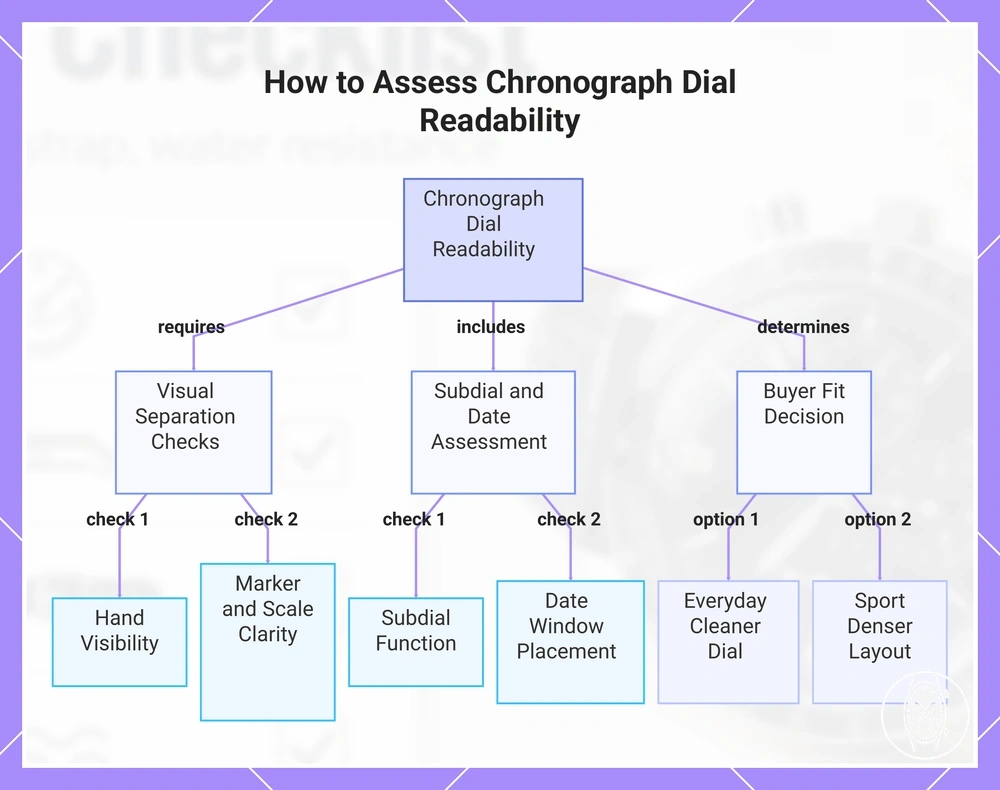
Use the following visual checks to decide whether the dial supports the intended wearing context before treating its complexity as an advantage or disadvantage.
Use the following visual checks to decide whether the dial supports the intended wearing context before treating its complexity as an advantage or disadvantage.
- Subdials: identify the exact number and function of each subsidiary display rather than judging readability by count alone; in Seiko's Calibre 8T63 layout, separate indications include small seconds, 24-hour time, and stopwatch minutes alongside the central stopwatch hand.
- Hand visibility: require the normal hour and minute hands to remain visually distinguishable from the chronograph hands through position, shape, width, or contrast; if the buyer cannot separate them quickly during a normal glance, the layout is a weaker fit for readability-led use.
- Markers and contrast: check that hour markers and printed scales remain distinct from the dial background and from nearby subdials; the practical value is clear visual separation rather than a universal numerical contrast threshold, because the reviewed manufacturer documentation does not specify one for chronograph readability.
- Scale placement: confirm that each timing scale is positioned where its corresponding hand can be followed without being confused with the primary time display; Seiko's Calibre 8T63, for example, pairs its stopwatch minute indication with a central hand that advances in 1/5-second increments for measurements up to 60 minutes.
- Date window: treat the date as present or absent and, when present, check whether its placement interrupts markers or timing scales that matter more for the intended use; Seiko's Calibre 8T63 includes a separate date display as part of its dial information set.
- Buyer fit: favour a cleaner everyday dial when rapid time reading is the priority, and accept a denser sport-style layout when its additional subdials, scales, and chronograph hands remain visually separable under the buyer's normal wearing conditions.
This chart shows the key visual checks and buyer fit considerations for evaluating chronograph dial readability.
Case Materials, Strap Type, and Wearing Context
A men's chronograph watch should match its case material, crystal type, and strap or bracelet to the buyer's durability needs, comfort preference, style, and exposure conditions. Stainless steel provides a metal case-and-bracelet option, while leather, rubber, and fabric represent distinct strap categories whose suitability changes with moisture, activity, and formality; crystal type adds a separate surface-wear consideration. The practical checks are therefore stainless-steel case construction, crystal specification, metal bracelet, leather strap, rubber strap, and fabric strap rather than appearance alone.
The suitable material combination is therefore conditional on the intended context, not inherently superior because of one case, crystal, or strap material.
For formal wear or gifting, leather can provide a more dress-oriented configuration when frequent water exposure is not expected; Citizen's World Chronograph A-T AT8110-02A provides a concrete example with a stainless-steel case, leather strap, sapphire crystal, and manufacturer-stated water resistance of 10 bar. For daily wear, a metal bracelet can prioritise an all-metal construction: Seiko specifies the Prospex Speedtimer SFJ001 with a stainless-steel case and bracelet, curved sapphire crystal, and 10 bar water resistance. For sport use, strap material should be selected against the watch manufacturer's exposure limits rather than assuming that rubber or fabric alone makes a chronograph suitable for water, because the complete watch's case, seals, crown, pushers, and stated water-resistance rating determine the permitted exposure. The suitable material combination is therefore conditional on the intended context, not inherently superior because of one case, crystal, or strap material.
Use the table to screen chronograph watch materials by durability, comfort, exposure, formality, and maintenance effect.
Use the table to screen chronograph watch materials by durability, comfort, exposure, formality, and maintenance effect. Where no universal measurable value is established across the category, verify the specific watch or strap manufacturer's material specification and care conditions rather than assigning one service life or performance threshold to all products.
| Material or component | Primary selection attribute | Wearing-context value | Maintenance or evidence boundary |
|---|---|---|---|
| Stainless-steel case | Case construction and durability | Suitable for daily, formal, or sport-oriented designs when the specific watch's weight, finish, and exposure rating match the intended use; Seiko specifies stainless steel for the SFJ001 case. | Case material does not establish water tolerance by itself; verify the complete watch's stated water-resistance rating and care instructions. |
| Metal bracelet | All-metal construction and adjustment | Provides a metal strap configuration for buyers prioritising a visually integrated case-and-bracelet design; Seiko specifies a stainless-steel bracelet on the SFJ001. | Verify link adjustment, clasp design, total watch weight, and cleaning requirements for the specific model rather than assuming one universal comfort level. |
| Leather strap | Formality and wrist feel | Fits formal, gift, or daily-wear contexts when frequent water exposure is not the primary use condition; Citizen specifies a leather strap on the AT8110-02A. | Leather care and moisture tolerance are construction-specific, so follow the strap manufacturer's stated exposure and maintenance instructions. |
| Rubber strap | Active-use and moisture-oriented selection | A practical category to consider for sport or frequent-moisture use when the specific rubber compound and complete watch are rated for the intended exposure. | No universal water, ultraviolet, chemical, or service-life threshold applies to every rubber watch strap; verify the material grade and manufacturer's care limits. |
| Fabric strap | Flexible casual or active-wear configuration | Suitable when the buyer prefers a fabric-based fastening system and the strap's width, hardware, drying characteristics, and construction match the intended use. | The reviewed evidence does not establish one universal durability, drying-time, or water-tolerance value for all fabric straps, so verify the specific strap specification. |
| Sapphire crystal | Crystal material and surface-wear resistance | Available on chronographs intended to provide a hard transparent watch crystal; Citizen specifies sapphire on the AT8110-02A, while Seiko specifies curved sapphire on the SFJ001. | Crystal material does not determine the durability of the complete watch; verify coatings, shape, replacement requirements, and model-specific care information. |
| Other crystal types | Crystal specification | Evaluate the exact manufacturer-stated crystal material rather than inferring performance from appearance or price. | No universal scratch-resistance value or replacement interval is established across all non-sapphire chronograph crystals, so use the specific model specification as the evidence boundary. |
Leather, Metal Bracelet, Rubber, and Fabric Strap Checks
Strap type should match the buyer's comfort, adjustment needs, expected water exposure, formality, and acceptable maintenance. A leather strap suits lower-moisture formal or everyday use, a metal bracelet suits buyers who prioritise durable link-based adjustment, a rubber strap suits active or moisture-prone use when the complete watch is rated for that exposure, and a fabric strap suits casual or active use where flexibility and straightforward drying are useful. The buying signal is the strap whose construction, fastening system, and care requirements match the intended wearing context.
- Leather strap: prioritise formality and a softer wrist feel when repeated moisture exposure is not expected. Hamilton Jewelers identifies leather as a comfortable strap material but notes that heat and humidity can make it feel sticky, so its maintenance burden includes keeping the material within the maker's moisture and care limits.
- Metal bracelet: prioritise durable construction and link-based adjustment when the wearer accepts the bracelet's additional metal weight. Hamilton Jewelers describes metal bracelets as sturdy, long-lasting options that can be sized by adjusting links; comfort and replacement practicality therefore depend on the specific link design, clasp, material, and available adjustment.
- Rubber strap: prioritise sport use, sweat, or regular water exposure only when the complete chronograph is also rated for the intended exposure. Hamilton Jewelers states that rubber straps dry quickly after becoming wet, giving rubber a practical moisture-handling advantage over leather without making the watch itself universally suitable for water use.
- Fabric strap: prioritise casual or active wear when flexibility, simple adjustment, and relatively quick drying support the intended use. Hamilton Jewelers describes nylon NATO-style fabric straps as easy to change and able to dry after getting wet, while also noting that repeated sun and water exposure can cause fading; maintenance therefore includes cleaning, drying, and checking the strap and hardware for wear.
- Final strap check: confirm that the leather strap, metal bracelet, rubber strap, or fabric strap reaches a secure adjustment position and matches the required balance of comfort, formality, water exposure, and maintenance. The reviewed evidence does not establish one universal comfort, durability, or service-life value across all strap constructions, so verify the specific manufacturer's fit range and care conditions before purchase.
Water Resistance and Chronograph Pusher Limits
Water resistance on a men's chronograph watch should be treated as a use-condition limit, not as a guarantee that every chronograph with the same rating can be used identically around water. ISO 22810:2010 establishes requirements, test methods, and marking provisions for water-resistant watches, while Citizen separates 3-atmosphere, 5-atmosphere, 10/20-atmosphere, and diver-rated watches by permitted activity. :contentReference[oaicite:0]{index=0} A buyer should therefore match the stated rating, crown and pusher instructions, case condition, strap material, and intended activity before water exposure.
A chronograph can retain a stated water-resistance rating yet become unsuitable for a particular activity if its controls or seals are used outside the manufacturer's conditions.
A chronograph can retain a stated water-resistance rating yet become unsuitable for a particular activity if its controls or seals are used outside the manufacturer's conditions. Citizen specifies that 5-atmosphere watches may be used for swimming but not skin diving, while 10/20-atmosphere watches may be used for skin diving or marine sports but not scuba or saturation diving; Citizen also marks crown or button operation while the watch is wet as prohibited for these categories. :contentReference[oaicite:1]{index=1} Seiko likewise states that water resistance is not permanently guaranteed because gasket ageing or deformation from accidental shock can reduce sealing performance, so the rating, crown position, pusher use, seal condition, age, and activity must all be checked before use. :contentReference[oaicite:2]{index=2}
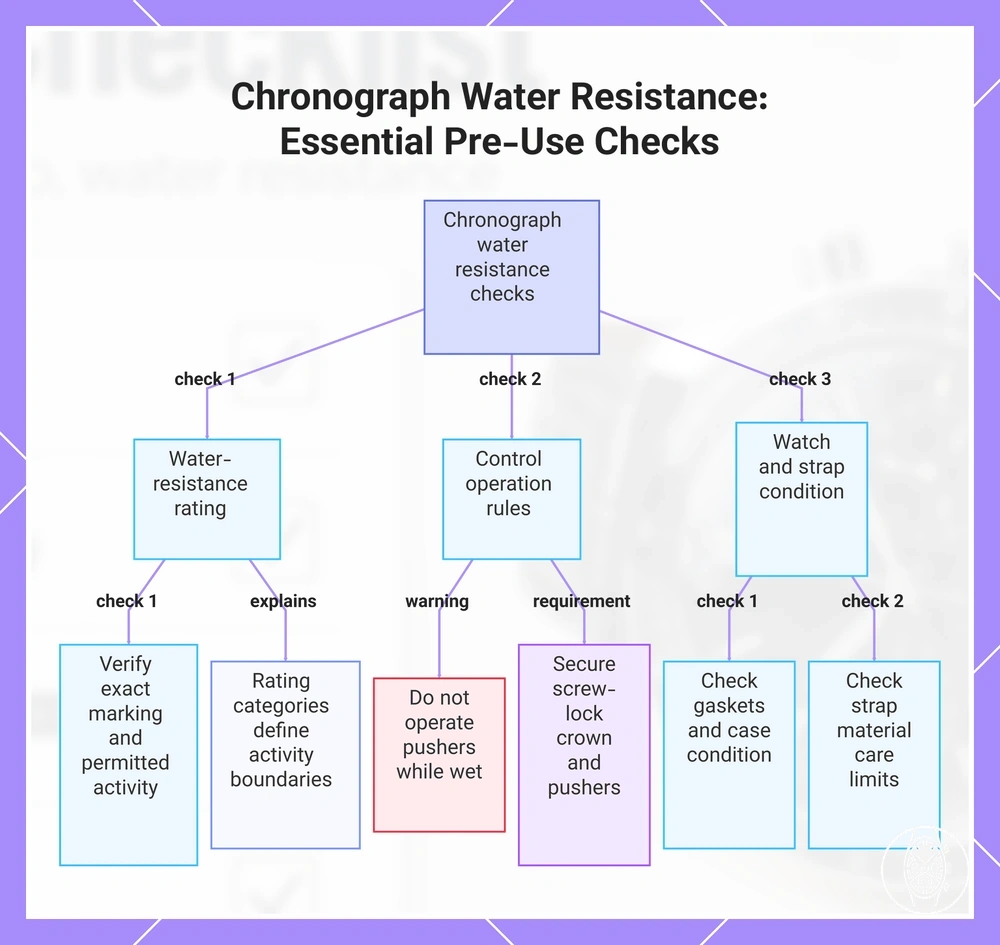
Use the following checks as the local safety screen, then use the dedicated chronograph water resistance guidance for deeper rating detail.
Use the following checks as the local safety screen, then use the dedicated chronograph water resistance guidance for deeper rating detail. The safe activity boundary is the manufacturer's stated combination of water-resistance rating, control condition, and current watch condition rather than the pressure number alone.
- Water-resistance rating: verify the exact marking and permitted activity. Citizen defines 3 atmospheres for occasional accidental splashing, 5 atmospheres for swimming but not skin diving, and 10 or 20 atmospheres for swimming plus skin diving or marine sports but not scuba or saturation diving. :contentReference[oaicite:3]{index=3}
- Chronograph pushers: do not operate the pushers while the watch is wet unless the manufacturer explicitly documents a different condition for that specific model. Citizen marks operation of the crown or buttons while wet as prohibited across its 5-, 10-, and 20-atmosphere usage categories, while Seiko similarly instructs users not to press buttons when a watch is wet. :contentReference[oaicite:4]{index=4}
- Crown and locking controls: secure any screw-lock crown and applicable screw-lock pushers before water exposure. Citizen's Calibre 0510 instructions state that its screw-lock crown must be applied to ensure the watch remains water-resistant and identify screw-lock buttons on applicable models. :contentReference[oaicite:5]{index=5}
- Gaskets and case condition: treat the original rating as conditional on the watch remaining properly sealed. Seiko states that gasket ageing and deformation caused by accidental shock can reduce water resistance and recommends regular water-resistance checks. :contentReference[oaicite:6]{index=6}
- Strap material: check strap care separately from the case rating because the watch's permitted water activity does not establish identical moisture tolerance for leather, rubber, fabric, or metal straps. The acceptable outcome is an activity that satisfies both the watch manufacturer's water-resistance conditions and the fitted strap's material-care limits.
- Activity check: before swimming, skin diving, or another water activity, verify the rating, locked controls, visible case and crystal condition, and manufacturer instructions, especially if the watch has been dropped, opened, damaged, or has ageing seals. A water-resistance marking alone does not establish permission to operate chronograph pushers underwater.
This chart shows the three main check categories—water-resistance rating, control operation rules, and watch and strap condition—that determine safe water use for a chronograph watch.
Style, Occasion, and Gift Suitability
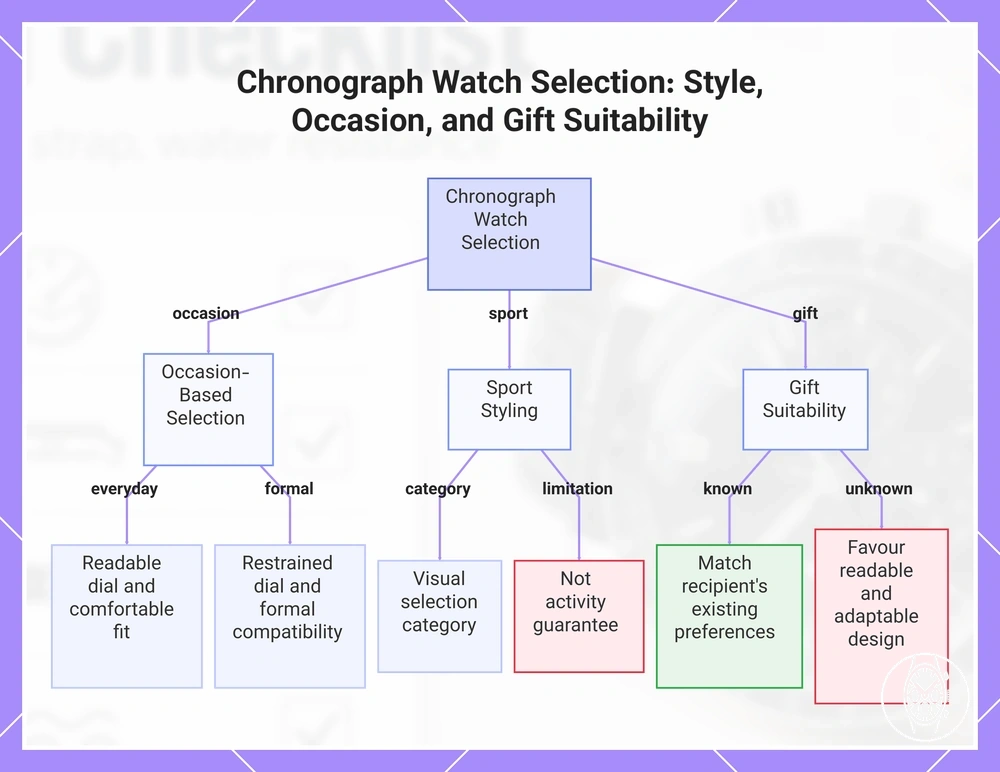
A men's chronograph watch should match where and how it will be worn: everyday use favours a readable dial and adaptable styling, formal use favours restrained visual complexity, and sport styling can accommodate a more technical dial or case when that appearance suits the wearer. Style suitability therefore depends on the occasion, dial style, strap material, case finish, case size, and the wearer's existing preferences rather than on one universal chronograph design.
Style suitability therefore depends on the occasion, dial style, strap material, case finish, case size, and the wearer's existing preferences rather than on one universal chronograph design.
For gifting, the lower-risk choice is a men's chronograph watch with readable time indications, proportions close to watches the recipient already wears comfortably, and a strap and case finish that work with the recipient's usual clothing and activities. If the recipient's wrist preference, preferred strap material, dial complexity, colour, or level of formality is unknown, treat those attributes as unresolved rather than assuming that a large case, busy sport dial, leather strap, or metal bracelet will suit them. Gift suitability improves when the buyer can match at least the recipient's usual watch size, normal wearing context, and preferred visual style; where those values are unknown, personal-preference risk remains.
After those preferences are defined, compare the best men's chronograph watches by the need that matters most rather than by style alone.
Use the scenarios below to convert occasion, outfit formality, wrist preference, dial style, strap material, and gifting context into a practical selection outcome. After those preferences are defined, compare the best men's chronograph watches by the need that matters most rather than by style alone.
- Everyday wear: prioritise a chronograph whose primary time display is easy to distinguish, whose case proportions match the wearer's established comfort preference, and whose strap material suits recurring daily conditions. The selection outcome is a watch that can move across the wearer's normal work, casual, and social settings without relying on a strongly specialised visual theme.
- Formal use: prioritise restrained dial complexity, a case finish that does not dominate formal clothing, and a leather strap or metal bracelet only when that material matches the wearer's preferred level of formality. The relevant value is visual compatibility with the event and outfit, not a universal requirement for one dial colour, strap type, or case size.
- Sport styling: accept a denser dial, contrasting scales, prominent pushers, rubber strap, fabric strap, or more technical case treatment when the wearer specifically prefers that appearance and the watch remains readable and comfortable. Sport styling is a visual-selection category and does not by itself establish water resistance, impact resistance, or suitability for a specific activity.
- Gift with known preferences: match the recipient's existing watch proportions, usual strap material, preferred dial complexity, typical occasions, and case-finish preference as closely as practical. Confirmed preferences reduce the chance that the chronograph conflicts with how the recipient normally dresses or wears watches.
- Gift with unknown preferences: favour a readable dial, adaptable case finish, and broadly wearable strap configuration while treating exact case size, colour, dial complexity, and strap material as unresolved preference variables. No universal men's chronograph size, material, or style can be treated as the safest gift for every recipient without recipient-specific information.
This chart guides the selection of a men's chronograph watch by occasion, sport styling, and gifting context, highlighting key criteria for each scenario.
Budget, Value, and Long-Term Cost Checks
A men's chronograph watch offers fair value when its price is justified by the movement, materials, readability, water resistance, service expectations, warranty context, durability signals, and the buyer's intended use rather than by price alone. A lower purchase price represents better value only when the watch still satisfies the required fit and specifications, while a higher price should correspond to attributes or ownership benefits the buyer will actually use. Compare purchase price, specification fit, expected maintenance, and warranty boundaries together.
Compare purchase price, specification fit, expected maintenance, and warranty boundaries together.
A low purchase price can conceal poor value when the chronograph has unsuitable dimensions, insufficient water resistance for its intended activity, unwanted maintenance requirements, or materials that do not match the buyer's durability priorities. Citizen Watches Australia currently lists the quartz Chronograph AN8175-55E at AUD 399 with a stainless-steel case and bracelet, mineral crystal, WR100/10 bar water resistance, and a stated 2-year battery life, while Seiko Australia lists the automatic Prospex Speedtimer SRQ053 at AUD 3,900 with Calibre 8R48, a super-hard-coated stainless-steel case, dual-curved sapphire crystal, 10 bar water resistance, and approximately 45 hours of power reserve. The calculated AUD 3,501 difference between these two Australian manufacturer-listed examples illustrates how movement and construction can accompany a large price difference, but it is not a universal quartz-versus-mechanical premium. The value risk is therefore either paying for specifications that do not improve the buyer's use case or saving money by accepting specifications that fail it.
Use the table to compare measurable specifications and ownership conditions before treating the listed price as the value outcome.
Use the table to compare measurable specifications and ownership conditions before treating the listed price as the value outcome. For deeper price-band and ownership-cost evaluation, use the budget and value criteria; the reviewed manufacturer evidence does not establish one universal men's chronograph price range or lifetime ownership cost.
| Value check | Explicit value or evidence boundary | Buying consequence |
|---|---|---|
| Purchase price | Citizen Watches Australia lists the AN8175-55E at AUD 399, while Seiko Australia lists the SRQ053 at AUD 3,900; both are model-specific Australian manufacturer-listed prices rather than category boundaries. | Compare the additional spend with attributes the buyer will use, such as movement construction, crystal material, case finishing, or chronograph capability. |
| Movement type | Citizen specifies quartz Calibre 0520 and a stated 2-year battery life for the AN8175-55E; Citizen also notes that factory-installed batteries may have been in use before purchase. Seiko specifies automatic-with-manual-winding Calibre 8R48 and approximately 45 hours of power reserve for the SRQ053. | Quartz can suit a convenience-led budget, while mechanical ownership adds winding and periodic servicing considerations to long-term cost. |
| Case and crystal | Citizen specifies stainless steel with mineral crystal for the AN8175-55E; Seiko specifies stainless steel with super-hard coating and dual-curved sapphire crystal for the SRQ053. | Treat these materials as construction and wear-resistance signals, not as guarantees of a fixed lifespan or scratch-free ownership. |
| Strap or bracelet | Both example models use stainless-steel bracelets; clasp design, link adjustment, comfort, replacement cost, and long-term wear remain specific to each bracelet and wearer. | A bracelet that cannot be adjusted comfortably reduces practical value even when the watch's other specifications are suitable. |
| Water resistance | Citizen specifies WR100/10 bar for the AN8175-55E, and Seiko specifies 10 bar for the SRQ053. | Use the manufacturer's operating conditions alongside the numerical rating because equal pressure ratings do not establish identical pusher-use rules, seal condition, or permitted activities. |
| Servicing | Seiko's official after-sales guidance recommends periodic inspection, adjustment, disassembly, and cleaning approximately once every 3 to 4 years to maintain long-term performance; the work required and service cost remain watch-specific. | A mechanical-interest buyer should include recurring professional maintenance in the ownership decision rather than comparing acquisition price alone. |
| Warranty context | Citizen Watches Australia provides a 5-year limited warranty for qualifying purchases from authorised retailers in its specified territories, subject to conditions and exclusions covering items including the power cell, case components, crystal, bracelet, strap, accidental damage, and specified maintenance-related issues. | Warranty duration should be valued together with coverage and exclusions because a 5-year term does not mean every future repair or component is covered. |
For a budget-sensitive buyer, the strongest value signal is specification sufficiency: prioritise the required movement, readable dial, comfortable fit, suitable water resistance, and acceptable materials before paying for features that will rarely be used. Citizen Watches Australia's AUD 399 AN8175-55E provides a model-specific example with quartz Calibre 0520, stainless-steel construction, mineral crystal, and WR100/10 bar water resistance; those specifications establish what that watch provides at its listed price, not the correct budget for every buyer.
For a durability-focused or gift-focused buyer, evaluate construction and warranty coverage separately because one does not substitute for the other.
For a durability-focused or gift-focused buyer, evaluate construction and warranty coverage separately because one does not substitute for the other. Citizen Watches Australia's 5-year limited warranty covers qualifying defects in material and workmanship but excludes specified components and circumstances, and its warranty conditions require water-resistant models to be tested and resealed every 2 to 3 years or whenever the battery is replaced on battery-operated models, whichever occurs first. A gift therefore has better long-term value when the recipient's fit, material, and use preferences are known and the warranty conditions suit the expected ownership pattern.
For a mechanical-interest buyer, a higher purchase price has value only when mechanical construction and its ownership routine are genuinely desired.
For a mechanical-interest buyer, a higher purchase price has value only when mechanical construction and its ownership routine are genuinely desired. Seiko Australia specifies the SRQ053 at AUD 3,900 with automatic Calibre 8R48, approximately 45 hours of power reserve, dual-curved sapphire crystal, a super-hard-coated stainless-steel case, and 10 bar water resistance, while Seiko's official service guidance recommends overhaul approximately every 3 to 4 years; Seiko does not state one universal service price for every mechanical chronograph. Long-term value is therefore the combination of purchase price, movement, materials, service expectations, warranty boundaries, durability signals, and actual buyer use rather than the lowest initial price.
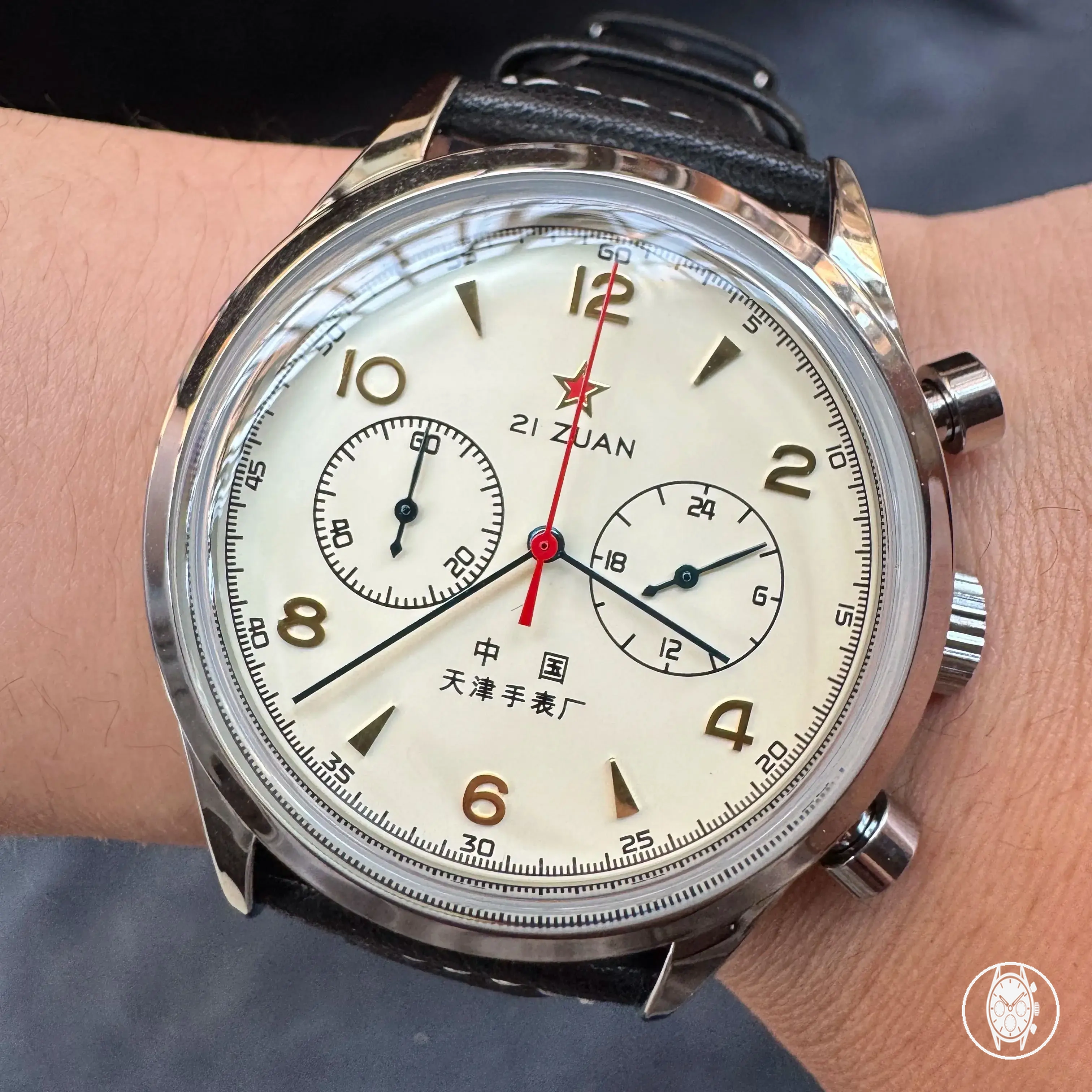
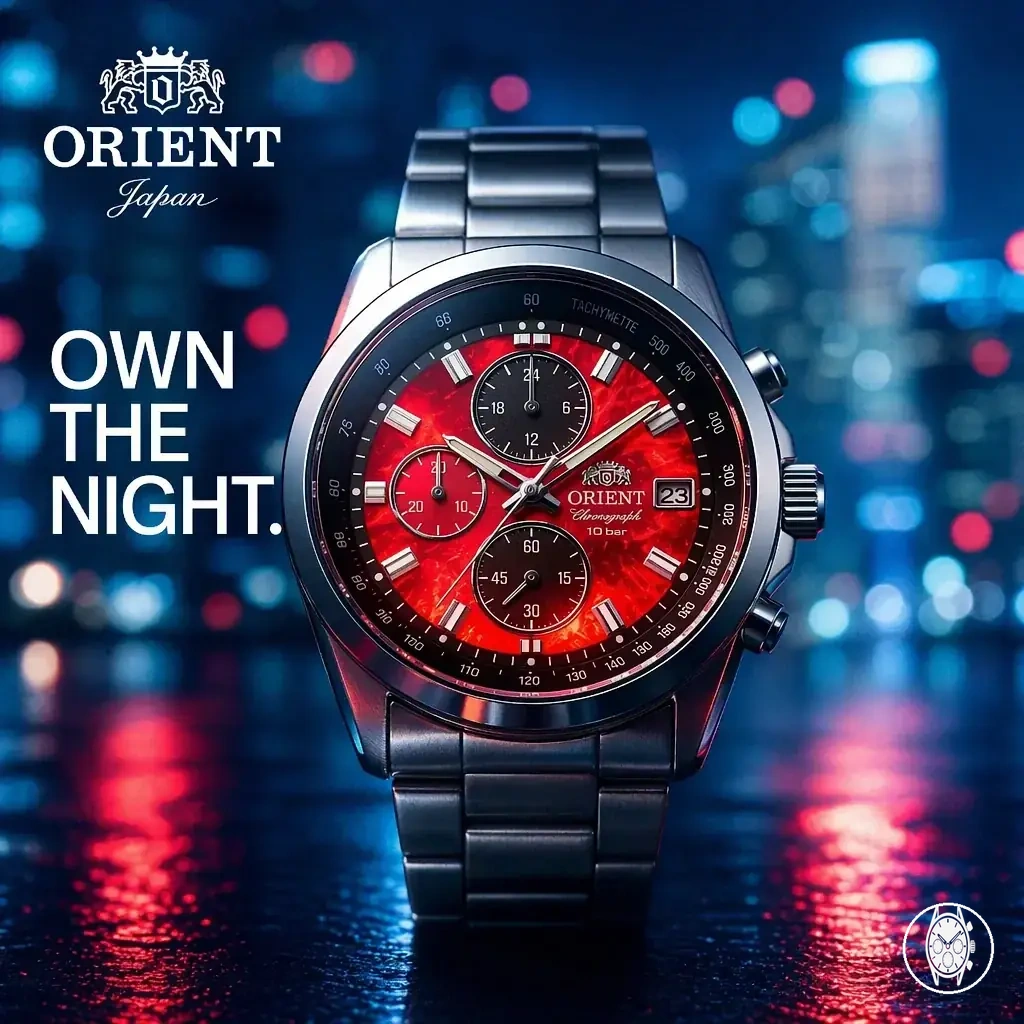
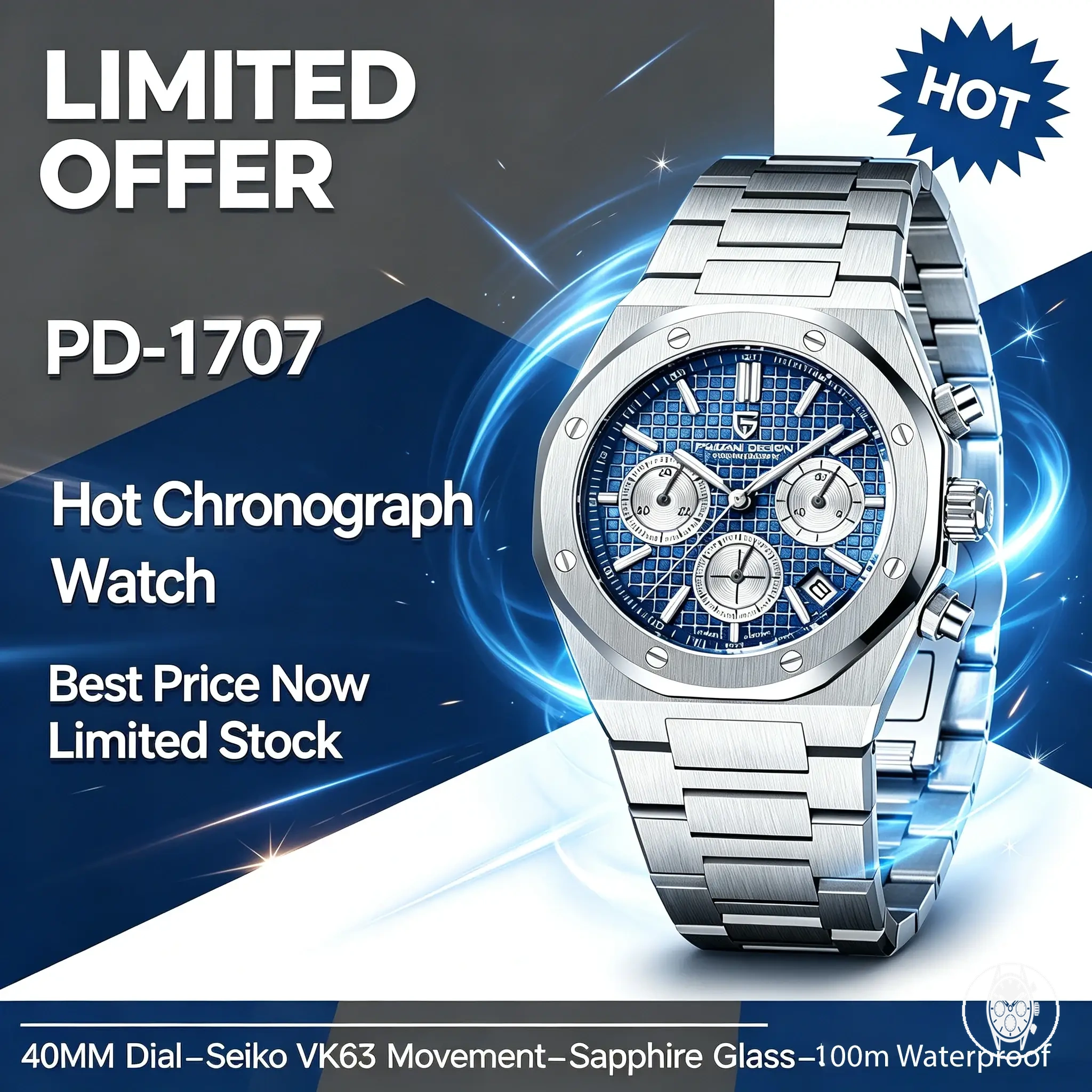
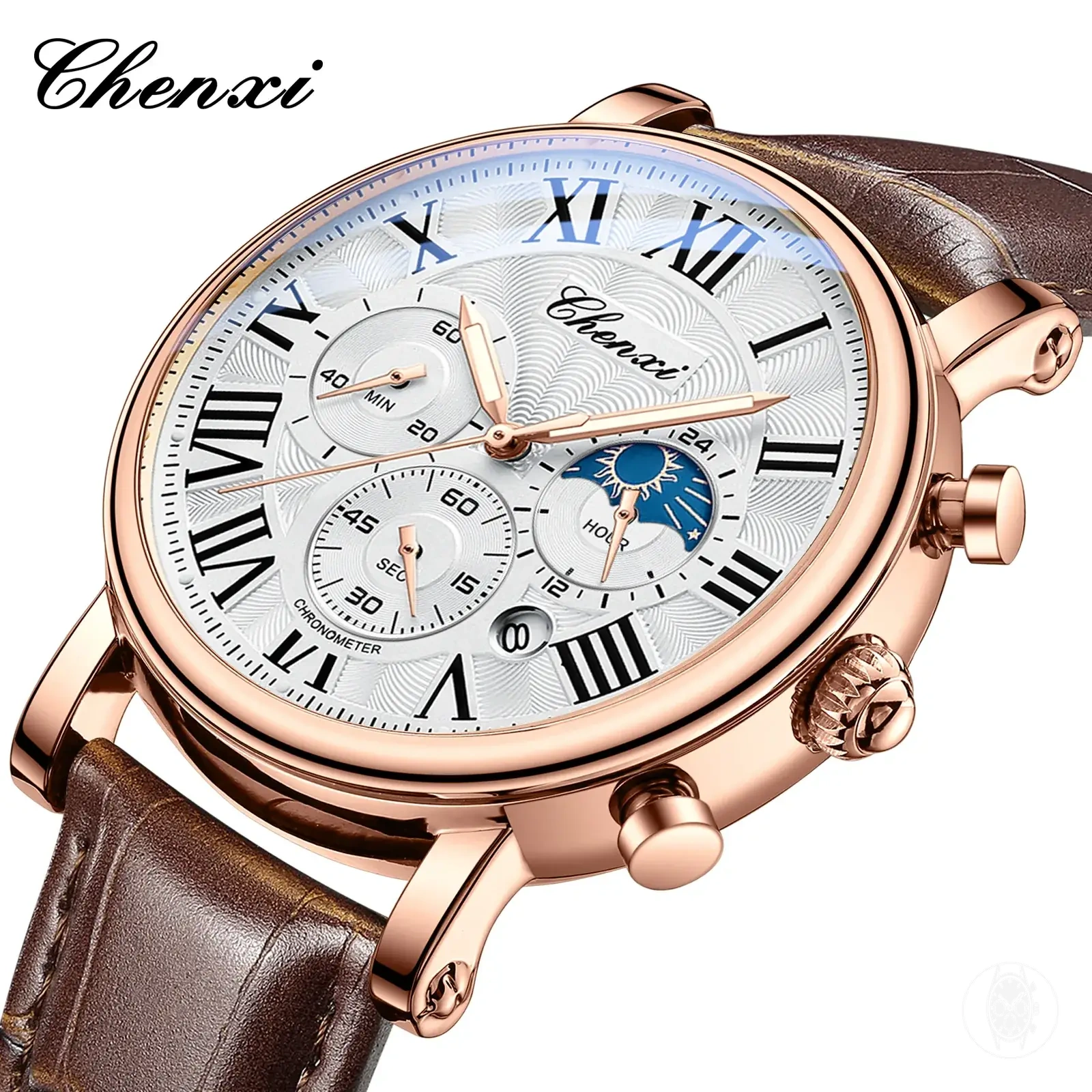
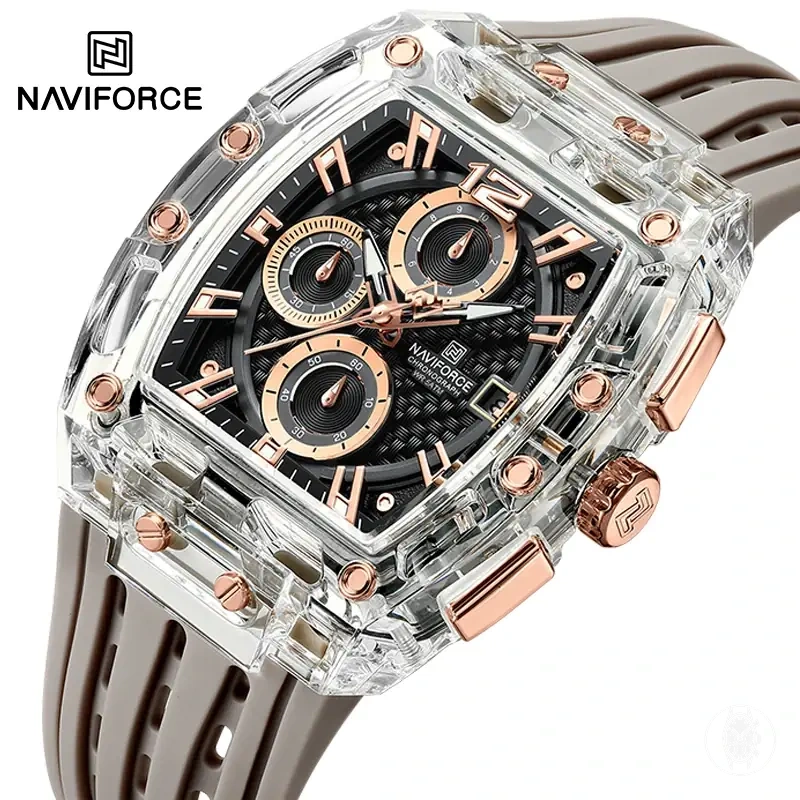
Here are product examples that may make comparison easier.
Here are product examples that may make comparison easier. Before buying, always review the compatibility criteria, essential features, and product details.
Buying Mistakes That Affect Chronograph Choice
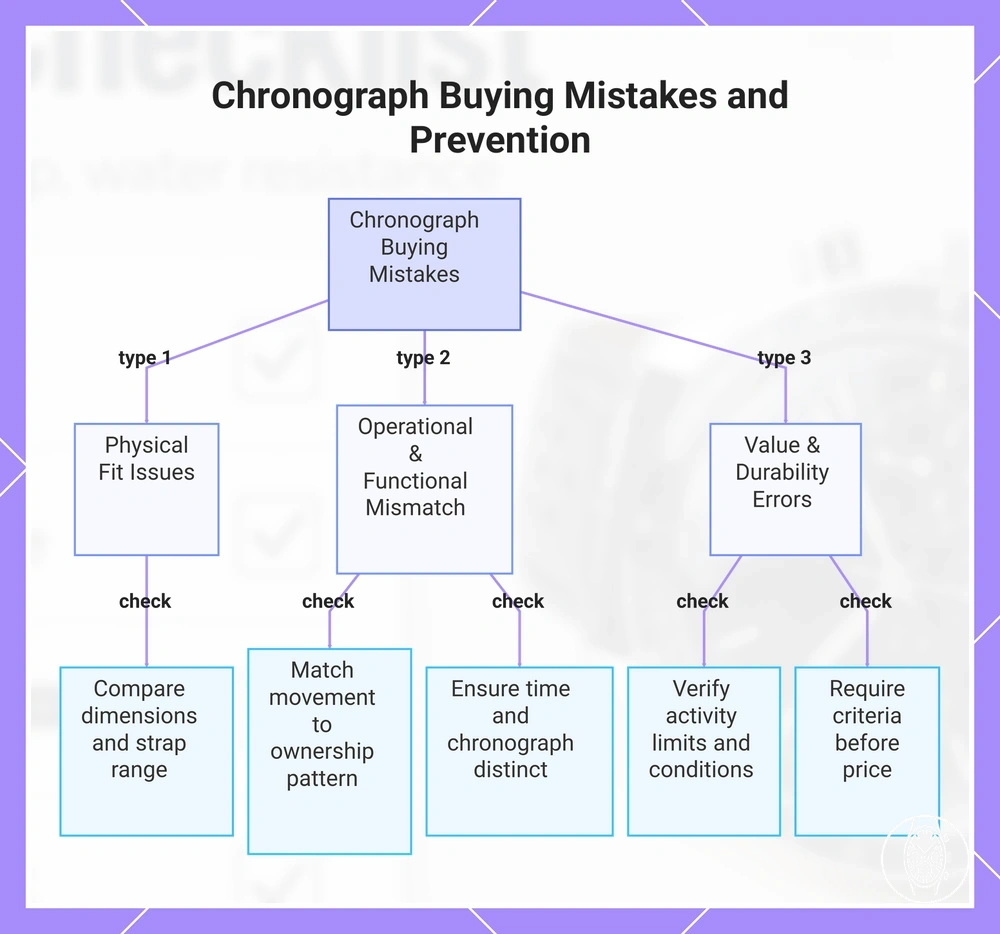
Most men's chronograph watch buying mistakes come from mismatched selection criteria rather than from one inherently bad feature. Poor fit, an unsuitable movement, weak dial readability, overestimated water resistance, or poor long-term value becomes a purchase problem when the watch's specification does not match the buyer's intended use. Prevent these errors by confirming fit, movement preference, readability, water-use conditions, and ownership expectations before cosmetic appeal becomes the deciding factor.
The main mistake pattern is allowing one attractive attribute to override another required criterion.
The main mistake pattern is allowing one attractive attribute to override another required criterion. A visually appealing case can still be unsuitable if its dimensions or strap adjustment do not fit the intended wrist; a technically impressive movement can be the wrong choice if its winding or servicing routine conflicts with the buyer's ownership preference; and a detailed chronograph dial can be a poor fit when the primary time display is difficult to distinguish. Water resistance creates the same mismatch when a pressure rating is treated as complete permission for an activity without checking crown, pusher, seal, and manufacturer-use conditions.
Use the checklist below to convert each warning sign into a safer selection decision.
Use the checklist below to convert each warning sign into a safer selection decision. Cosmetic appeal remains a valid preference, but it should only influence the final choice after the required practical criteria have been satisfied.
- Poor fit: Warning sign: the buyer likes the case design but has not confirmed case dimensions, lug span, thickness, or strap adjustment. Likely cause: appearance is being used as a substitute for wrist-fit verification. Safe check: compare the manufacturer's stated dimensions and strap range with the intended wrist and require a secure, comfortable wearing position. Safer outcome: reject the watch if its footprint or adjustment remains unsuitable even when the design is appealing.
- Wrong movement choice: Warning sign: the buyer cannot explain whether quartz, automatic, or hand-wound operation matches the desired accuracy, winding routine, maintenance expectation, and ownership experience. Likely cause: movement type is being treated as a prestige or style label rather than an operating condition. Safe check: match the movement category to the buyer's preferred level of interaction and maintenance. Safer outcome: select the movement whose operating requirements fit the intended ownership pattern.
- Weak readability: Warning sign: the hour and minute hands, chronograph hand, subdials, markers, or date compete visually during a normal glance. Likely cause: dial complexity is being prioritised over information separation. Safe check: confirm that normal time and chronograph indications remain visually distinct in the intended wearing conditions. Safer outcome: prefer the layout that can be read quickly even if a more complex dial appears more technical.
- Overestimated water resistance: Warning sign: the buyer knows the water-resistance rating but cannot confirm whether the crown or chronograph pushers may be operated when wet or whether the intended activity is permitted. Likely cause: the pressure rating is being interpreted without the manufacturer's operating and maintenance conditions. Safe check: verify the stated activity limit, crown and pusher instructions, gasket or service requirements, and current case condition. Safer outcome: treat the watch as unsuitable for the intended water activity until those conditions are explicitly satisfied.
- Poor long-term value: Warning sign: the purchase decision is based mainly on the lowest price or on costly features the buyer is unlikely to use. Likely cause: purchase price is being separated from movement, materials, readability, water resistance, servicing, warranty conditions, and expected use. Safe check: require the watch to satisfy the necessary fit, function, durability, and ownership criteria before comparing price. Safer outcome: choose the chronograph whose useful specifications justify its cost rather than treating the cheapest or most expensive option as automatically better.
This chart shows the main categories of chronograph buying mistakes and the safe checks to prevent each one.
Final Chronograph Watch Selection Checklist
The final men's chronograph watch checklist should confirm every must-have requirement before illustrative options are compared. A watch passes the final review only when its required fit, movement, readability, materials, water-use, style, value, and risk-tolerance conditions are confirmed; an unresolved must-have criterion remains a reason to keep comparing. Use each criterion as a pass, fail, or unresolved verification point.
Use each criterion as a pass, fail, or unresolved verification point.
For fit, confirm that the case footprint sits securely on the intended wrist, the strap or bracelet reaches a comfortable adjustment position, and the watch does not interfere with normal wrist movement; use the manufacturer's stated case diameter, thickness, lug-to-lug measurement, and adjustment information where published. For movement, confirm that quartz, automatic, or hand-wound mechanical operation matches the buyer's preferred accuracy scale, winding routine, maintenance expectations, and ownership experience. The watch passes these checks only when both its physical fit and movement requirements suit the intended wearer.
The watch passes these checks only when both its physical fit and movement requirements suit the intended wearer.
For readability, confirm that the primary hour and minute display remains distinguishable from chronograph hands, subdials, scales, and any date display under the intended wearing conditions. For materials and strap type, confirm that the stated case, crystal, leather strap, metal bracelet, rubber strap, or fabric strap matches the required balance of comfort, durability priorities, formality, moisture exposure, adjustment, and maintenance. A preferred material or dial design remains a nice-to-have feature when it does not affect a must-have wearing condition.
A preferred material or dial design remains a nice-to-have feature when it does not affect a must-have wearing condition.
For water use, confirm the manufacturer's stated water-resistance rating, permitted activity, crown condition, chronograph-pusher instructions, and relevant maintenance conditions before treating the watch as suitable for the intended exposure. For style and gift suitability, confirm that dial complexity, case finish, strap material, case proportions, and occasion match either the wearer's established preferences or the recipient information available to the buyer. If an essential recipient preference or water-use condition cannot be confirmed, classify that criterion as unresolved rather than assuming suitability.
Use the checklist below as the final pre-purchase verification.
Use the checklist below as the final pre-purchase verification. A must-have criterion receives a pass only when its acceptable condition is confirmed, while a nice-to-have preference can remain optional without making the watch unsuitable.
- Fit: Pass when the case dimensions and strap adjustment produce a secure, comfortable wrist position; fail when the case footprint, thickness, or adjustment conflicts with the intended wearer; unresolved when the required dimensions or fit information have not been checked.
- Movement: Pass when the movement type matches the desired accuracy, winding, maintenance, and ownership routine; fail when those requirements conflict with the buyer's preference; unresolved when the movement or servicing expectations are unknown.
- Readability: Pass when normal time and chronograph indications remain visually separable for the intended use; fail when required information is difficult to distinguish; unresolved when the dial has not been assessed under realistic viewing conditions.
- Materials and strap: Pass when the case, crystal, and strap or bracelet satisfy the required comfort, exposure, formality, adjustment, and maintenance conditions; fail when a material conflicts with a must-have wearing condition; unresolved when material specifications or care requirements are unknown.
- Water use: Pass when the manufacturer's rating, permitted activity, crown condition, pusher-use instructions, and current watch condition support the intended exposure; fail when the intended activity exceeds those conditions; unresolved when the instructions or sealing condition cannot be confirmed.
- Style or gift suitability: Pass when dial style, case finish, size, strap, and occasion match known wearer or recipient preferences; fail when a must-have preference is contradicted; unresolved when essential fit or style preferences are unknown.
- Value: Pass when the purchase price is acceptable to the buyer and the watch satisfies all required fit, movement, readability, material, water-use, and ownership criteria; fail when a lower or higher price is accompanied by a failed must-have requirement; unresolved when servicing, warranty, or expected ownership conditions have not been checked.
- Risk tolerance: Pass when no unresolved issue affects a must-have requirement; keep comparing when any unresolved point concerns fit, movement, readability, water use, ownership cost, or another non-negotiable condition.
The final decision rule is to separate requirements from preferences before comparing products: must-have criteria determine suitability, while nice-to-have details such as dial colour, decorative finish, or an optional complication should only distinguish watches that already pass the required checks. If two chronographs satisfy every must-have condition, compare the remaining preferences and value signals; if one fails a non-negotiable requirement, styling, price, or brand appeal should not override that failure.
Before buying, always review the compatibility criteria, essential features, and product details.
Here are product examples that may make comparison easier. Before buying, always review the compatibility criteria, essential features, and product details.