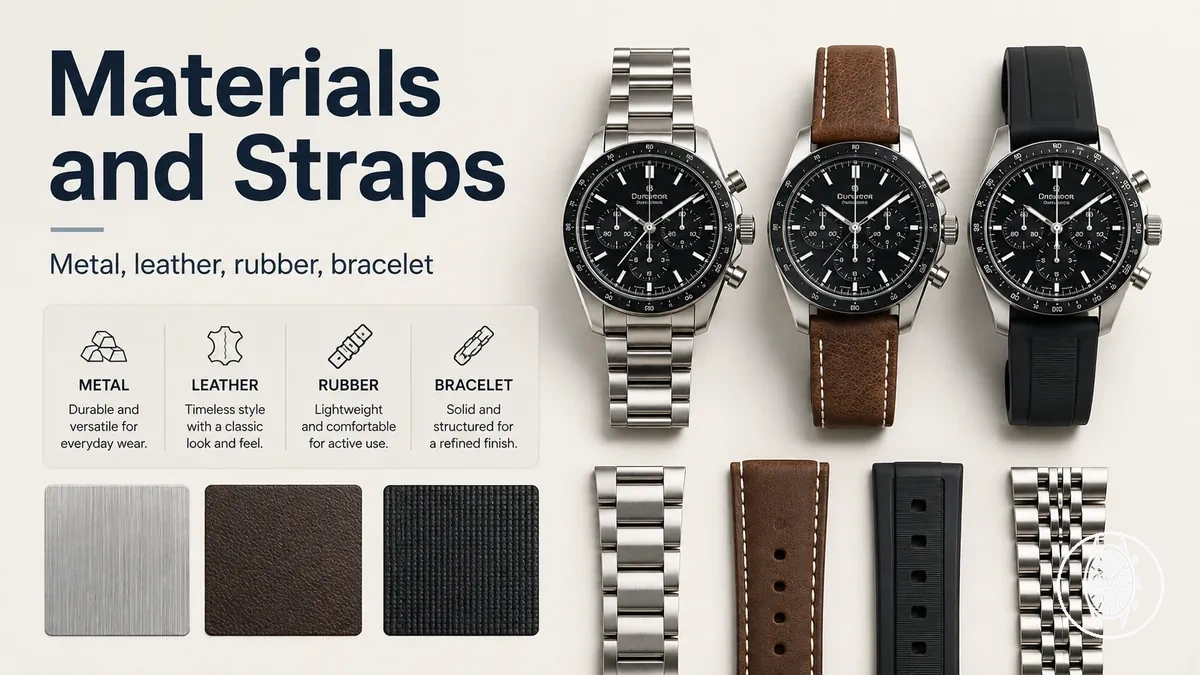
Men's Chronograph Watch Materials and Strap Choices
A men's chronograph watch should be evaluated by the materials used for its case, crystal, strap, and bracelet because each part contributes a different value to comfort, durability, scratch resistance, appearance, and long-term wear. The case material determines the main structural and surface characteristics, the crystal material determines the dial-covering trade-off between scratch resistance and impact behaviour, and the strap or bracelet material determines how the watch interacts with sweat, moisture, flexing, and wrist contact. Stainless steel, sapphire crystal, leather, rubber, silicone, and metal bracelets are distinct material categories, but no material name by itself establishes the complete watch's durability or suitability. The useful buying value comes from matching the part, material, construction, and wearing condition rather than treating one material combination as universally superior.
These material effects remain separate from movement type, watch size, and rated water resistance, which require their own evaluation.
For daily wear in heat, sweat, or moisture, strap and bracelet materials should be judged by their documented response to those conditions. Seiko states that leather bands are more susceptible than metal bracelets to discoloration and deterioration from moisture, sweat, and direct sunlight, while Citizen instructs users to wipe wet leather promptly and states that urethane bands can be washed with water and dried with a cloth. Citizen also states that sweat and dirt can damage the protective surface of a stainless steel band and contribute to rust, so stainless steel is corrosion-resistant rather than maintenance-free. These material effects remain separate from movement type, watch size, and rated water resistance, which require their own evaluation.
No single case, crystal, strap, and bracelet combination fits every men's chronograph watch buyer.
No single case, crystal, strap, and bracelet combination fits every men's chronograph watch buyer. A material-by-material evaluation should therefore prioritise sapphire crystal where scratch resistance is a primary requirement, assess stainless steel by its finish, construction, and resulting weight, and choose leather, rubber, silicone, or a metal bracelet according to expected moisture exposure, comfort, appearance, and care needs. Seiko's care guidance distinguishes leather, metal, and urethane bands by their different responses to moisture, sweat, sunlight, and cleaning, which provides a practical basis for comparing long-term wear conditions without turning one material into a universal recommendation.
Table of Contents
How Materials Affect a Men's Chronograph Watch
Materials affect how a men's chronograph watch wears, looks, resists damage, and fits a use case because the case material, crystal material, strap material, and bracelet each control different physical outcomes. Case material and finish influence weight and visible wear, crystal material controls the balance of scratch resistance and impact behaviour, and strap or bracelet construction changes flexibility, sweat exposure, comfort, and care needs. Material choice therefore changes the real wearing experience through part-specific conditions rather than through one universal measure of durability.
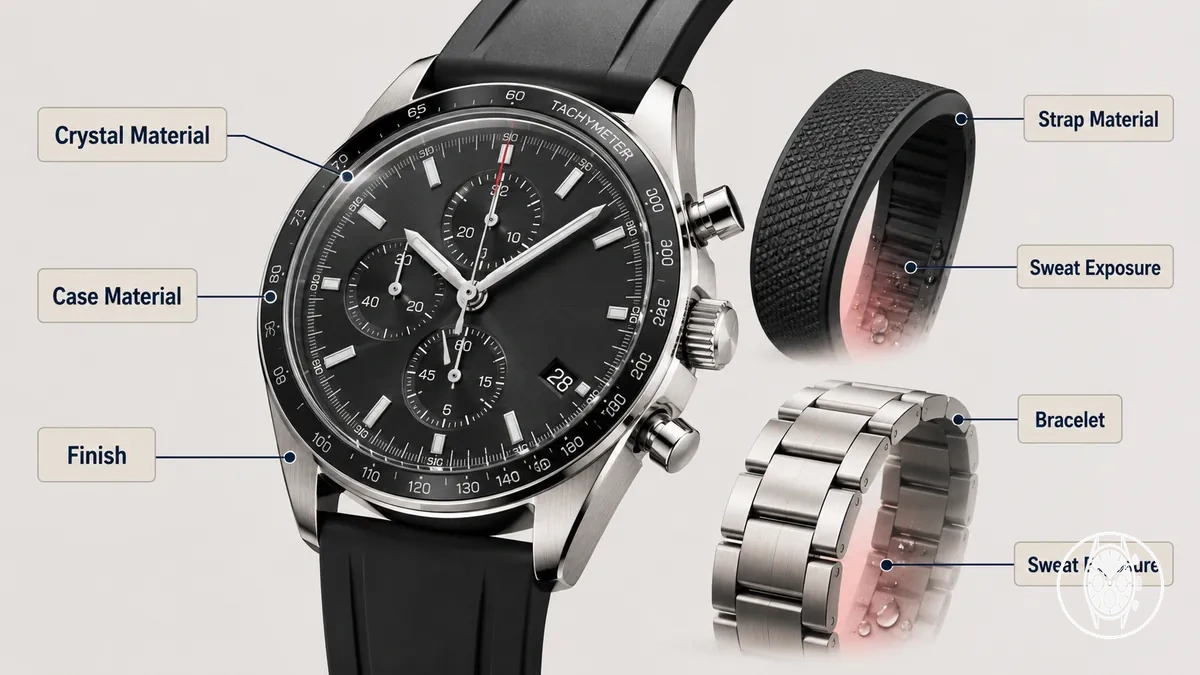
The case is the structural body around the watch components, so its material, coating, and finish determine the relevant values of weight, corrosion behaviour, and scratch visibility; the crystal is the transparent dial covering, so its material determines the relevant values of clarity, scratch resistance, and impact behaviour. The strap material supplies a flexible wrist connection, while a bracelet uses linked sections and a clasp, making sweat, moisture, flexibility, surface condition, and fit the relevant wearing conditions. Seiko reports that accumulated perspiration or dirt can contribute to corrosion even between stainless steel bracelet segments and that leather bands are more susceptible than metal bracelets to deterioration and discoloration from moisture, sweat, and direct sunlight. Seiko also recommends enough clearance for one finger between the band and wrist, giving a concrete fit condition for ventilation rather than treating comfort as a property of material alone.
Material choice is therefore one decision layer: movement, size, water resistance, and wearing style should be evaluated separately through the broader men's chronograph watch guide .
For daily wear, surface finish and scratch visibility affect how quickly use becomes visible; for formal wear, appearance and finish may carry more decision weight, while sport-adjacent and warm-weather conditions increase the relevance of sweat and moisture response. Citizen instructs users to wipe water or sweat from leather promptly and states that urethane bands can be washed with water and dried, so those materials have different care conditions under the same exposure. Material choice is therefore one decision layer: movement, size, water resistance, and wearing style should be evaluated separately through the broader men's chronograph watch guide.
Citizen instructs users to wipe water or sweat from leather promptly and states that urethane bands can be washed with water and dried, so those materials have different care conditions under the same exposure.
How materials affect a men's chronograph watch can be summarised by linking each physical part to the condition that changes its practical outcome:
- Case material: material, coating, finish, and construction set the relevant outcomes of weight, scratch visibility, corrosion behaviour, and appearance.
- Crystal material: sapphire, mineral glass, and other crystal categories provide different scratch-resistance, clarity, and impact trade-offs, so the useful value is the material-specific balance rather than damage immunity.
- Strap material: leather, rubber, silicone, and urethane provide different flexibility and moisture-response conditions; Seiko and Citizen identify sweat, water, sunlight, humidity, and chemical exposure as relevant deterioration factors for specific band materials.
- Bracelet: linked metal construction provides a different wrist feel from a flexible strap, while Seiko identifies accumulated perspiration and dirt between stainless steel bracelet segments as a corrosion condition that increases cleaning need.
- Use case: comfort is determined by material plus fit, durability by material plus construction and exposure, and appearance by material plus finish and accumulated wear.
Case Materials and Build Quality Signals
Case material is a build quality signal in a men's chronograph watch, but it does not prove overall quality or durability by itself. Stainless steel provides a corrosion-resistant material family, while finish consistency, coating condition, caseback fit, pusher alignment, and bracelet integration provide separate visible construction cues. World Stainless defines stainless steels as iron-based alloys containing at least 10.5% chromium and explains that their corrosion resistance comes from a chromium-rich passive surface film, while also noting that corrosion can still occur under particular environmental conditions.
Case material is a build quality signal in a men's chronograph watch, but it does not prove overall quality or durability by itself.
The watch case is the protective and visual body around the chronograph's internal components, so case material, surface finish, coating, caseback, pushers, and bracelet attachment should be evaluated as separate attributes. World Stainless identifies austenitic, ferritic, martensitic, and duplex stainless steels as distinct metallurgical families, which means a generic stainless steel description does not specify one fixed composition or level of corrosion resistance. A polished, brushed, coated, or mixed finish also changes scratch visibility and the way surface wear appears, while caseback alignment, pusher fit, and bracelet integration provide observable construction-quality signals rather than formal durability grades.
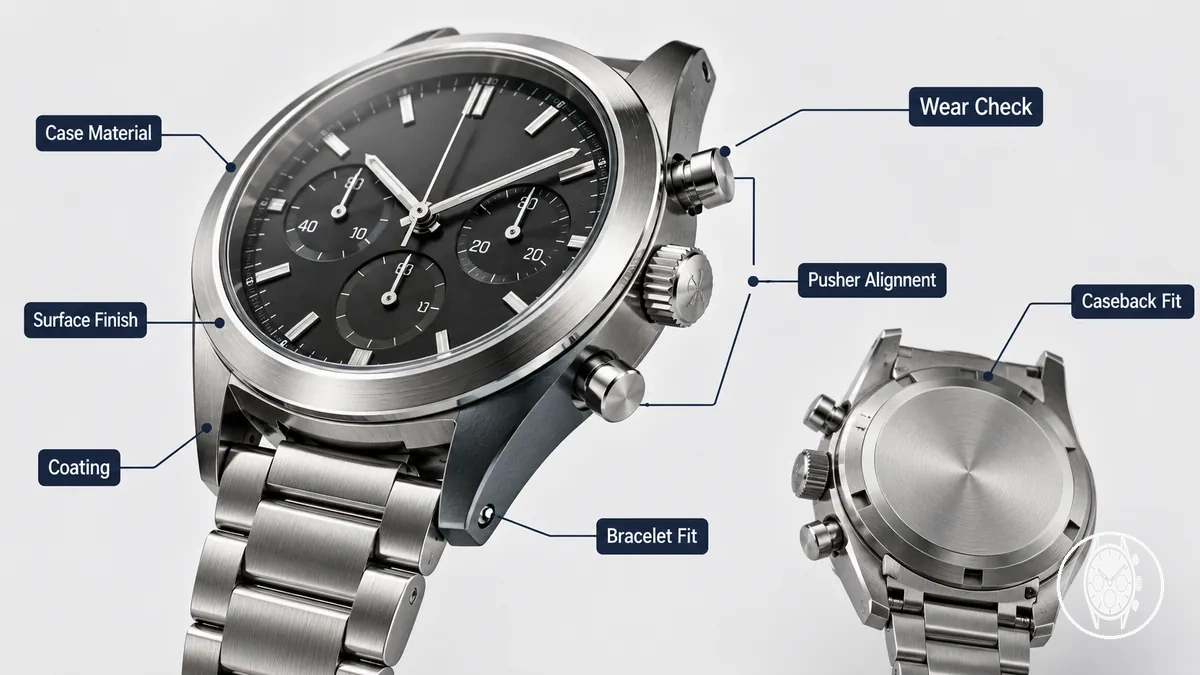
During daily wear, corrosion exposure, scratches, coating wear, and case weight affect appearance and comfort in different ways. World Stainless explains that stainless steel's passive film supports corrosion resistance but identifies mechanisms including crevice, pitting, galvanic, and stress-corrosion attack, so corrosion resistance remains conditional on alloy and environment rather than absolute. Scratches are judged visually against the existing finish, coating wear is judged by whether the underlying surface becomes exposed, and total case weight must be taken from the specification of the complete watch because material type alone does not provide a universal weight value. The table separates these case materials and build quality signals into observable criteria rather than product rankings.
| Entity/part | Attribute/criterion | Value/condition | Effect/risk/decision |
|---|---|---|---|
| Case material | Corrosion resistance | Stainless steel contains at least 10.5% chromium by mass; actual resistance remains alloy- and environment-dependent | Provides a corrosion-resistance durability signal without establishing corrosion immunity |
| Finish | Surface consistency | Polished, brushed, coated, or mixed surfaces should show intentional and consistent transitions | Consistent finishing supports a positive build quality judgment; irregular transitions warrant closer inspection |
| Coating | Surface condition | Intact coating covers the intended surface; worn areas may reveal the substrate beneath | Visible contrast at exposed areas indicates coating wear rather than a universal material-quality failure |
| Caseback | Fit and closure | Caseback should sit evenly according to its intended snap, screw, or other manufacturer-specified closure design | Consistent seating is a construction cue but does not establish sealing performance by inspection alone |
| Pushers | Alignment and action | Pushers should align consistently with the case and operate without obvious looseness, binding, or irregular seating during normal inspection | Consistent pusher fit is a positive construction cue but does not predict service life |
| Bracelet integration | End-link and lug fit | Attachment points should appear aligned, secure, and consistent with the intended case geometry | Controlled fit supports a positive construction judgment; conspicuous looseness or uneven alignment warrants closer inspection |
Visible build quality is therefore judged by combining material, finish, coating, caseback fit, pusher alignment, and bracelet integration rather than assigning quality from stainless steel alone. Seiko states that a watch's rated water resistance should be confirmed from the caseback marking and applicable specification, and that ageing gaskets or deformation from accidental shock can reduce that resistance over time. Caseback and pusher fit can support a visual construction judgment, but they cannot establish an exact water-resistance rating or durability outcome without the manufacturer's specification and test basis.
Stainless Steel Cases and Bracelets
Stainless steel is common for chronograph cases and bracelets because it provides corrosion resistance while accepting brushed, polished, and coated finishes that can produce sport-oriented or more reflective dress-oriented appearances. World Stainless defines stainless steels as iron-based alloys containing at least 10.5% chromium by mass and explains that this chromium supports formation of the passive surface film responsible for corrosion resistance. The material name does not establish one quality level because stainless steel grade, finish, coating, case construction, bracelet links, and clasp design can differ.
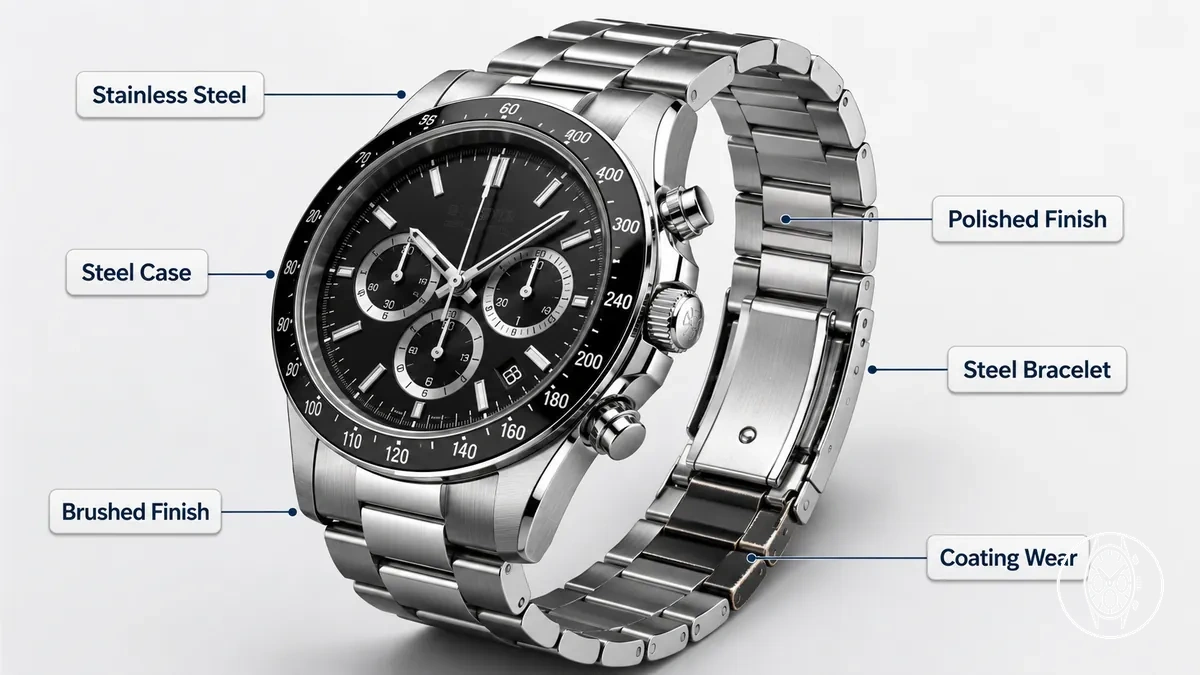
A stainless steel case is the rigid housing around the chronograph, while a stainless steel bracelet uses articulated links and a clasp around the wrist, so bracelet construction contributes separately to weight and comfort. Polished surfaces are reflective and make scratches visible through disruptions in that reflection, whereas brushed surfaces have a directional texture that changes scratch visibility; neither finish makes the steel scratch-proof, and a coating adds a separate surface condition that can show wear. There is no universal weight for a stainless steel chronograph: Seiko Australia, for example, specifies the stainless-steel Prospex Speedtimer SSC935 at 164.0 g with its bracelet, while the stainless-steel SSC943 is specified at 89.0 g, demonstrating that finished-watch weight is configuration-specific rather than a property of stainless steel alone.
World Stainless states that stainless steel can still undergo corrosion under particular conditions, including mechanisms such as pitting and crevice corrosion, despite its chromium-rich passive film.
For everyday wear, brushed areas generally retain a less reflective, sport-oriented appearance, while polished areas provide a more reflective visual effect and make changes in the surface reflection easier to notice; a coating should be assessed separately for visible surface wear. World Stainless states that stainless steel can still undergo corrosion under particular conditions, including mechanisms such as pitting and crevice corrosion, despite its chromium-rich passive film. Stainless steel therefore supports daily durability through corrosion resistance, but scratch visibility, appearance, coating wear, weight, and comfort remain conditional on the specific finish and case or bracelet construction.
Case Weight, Finish, and Everyday Durability
During everyday wear, a chronograph's case weight and thickness affect case feel and wrist comfort, while finish, coating, edge quality, and scratch visibility affect appearance and everyday durability. Seiko Australia specifies the Prospex Speedtimer SSC913 at 164.0 g and 13.0 mm thick, providing a model-specific reference rather than a universal comfort threshold. For active use or long periods of daily wear, the practical decision is whether that particular combination of mass, profile, and surface condition remains comfortable and acceptable to the wearer.
Seiko Australia specifies the Prospex Speedtimer SSC913 at 164.0 g and 13.0 mm thick, providing a model-specific reference rather than a universal comfort threshold.
A heavier or more polished chronograph case is not automatically better: case weight changes the mass carried on the wrist, while brushed, polished, and coated finishes create different surface appearances and wear signals. Seiko Australia, for example, specifies the Speedtimer SPB513 at 154.0 g and 12.0 mm thick, compared with 164.0 g and 13.0 mm for the SSC913; the 10.0 g and 1.0 mm differences are calculated from Seiko's model specifications and show that weight and thickness vary by configuration rather than defining one preferred case feel. Scratch visibility, coating wear, and edge quality should therefore be judged by observable surface condition, while wrist comfort and active-use suitability remain conditional on wearer preference and use context.
Scratch visibility, coating wear, and edge quality should therefore be judged by observable surface condition, while wrist comfort and active-use suitability remain conditional on wearer preference and use context.
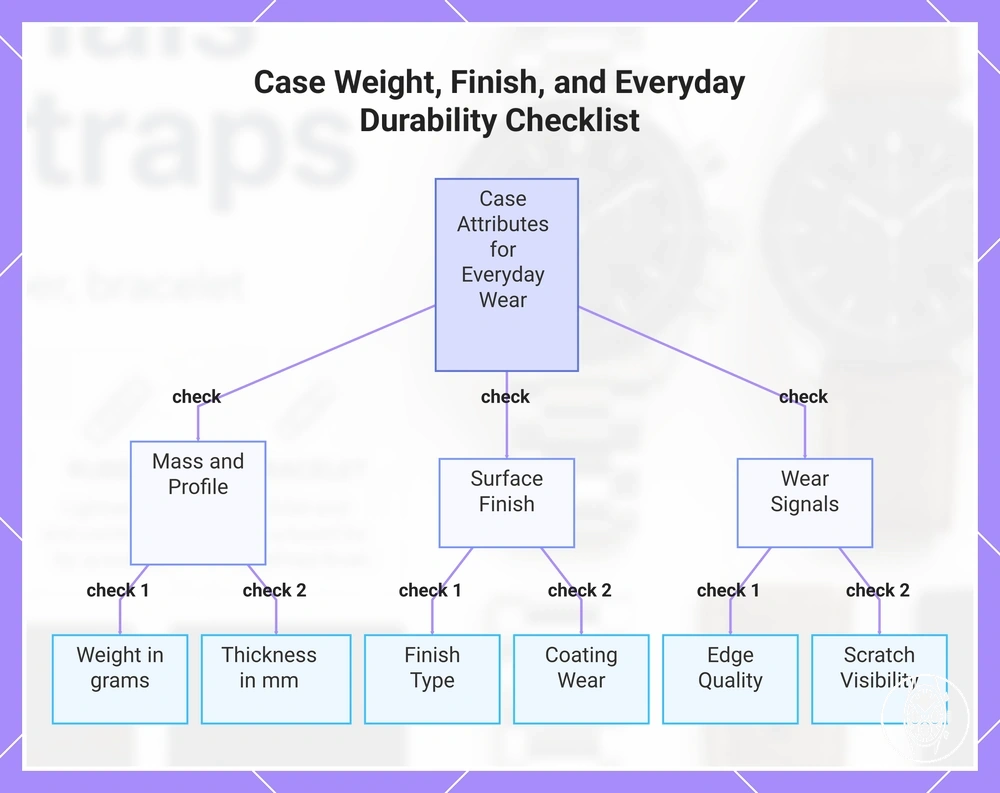
Case Weight, Finish, and Everyday Durability checklist: Use these attributes to evaluate practical case feel, appearance, and long-term wear signals without treating greater weight or a shinier finish as a quality ranking.
- Case weight: check the manufacturer-stated mass in grams; use the model-specific value to judge whether the case feel matches your wrist comfort preference.
- Thickness: check the manufacturer-stated depth in millimetres; a greater value means a taller case profile, which can change wearing comfort during daily wear and active use.
- Finish: identify brushed, polished, or mixed surfaces; directional and reflective finishes create different appearances and make accumulated surface marks visually different.
- Coating: inspect high-contact surfaces and edges for exposed or contrasting areas; visible coating loss is a wear-condition signal rather than proof of the remaining service life.
- Edge quality: check whether transitions between adjoining case surfaces remain clean and consistent; visibly irregular or damaged edges warrant closer inspection of condition.
- Scratch visibility: inspect the case under changing light; marks that interrupt a brushed texture or polished reflection indicate visible wear, with their practical importance determined by appearance expectations and active-use conditions.
This chart summarizes the key case attributes to evaluate for everyday wear comfort and durability, based on manufacturer specifications and observable surface condition.
Watch Crystal Materials and Scratch Resistance
The watch crystal is the transparent covering over a chronograph dial, and its material affects scratch resistance, clarity, impact tolerance, and everyday risk. Sapphire crystal, mineral glass, and acrylic are separate material categories with different surface and impact characteristics rather than equivalent levels of protection. Crystal material therefore influences how clearly the dial remains visible as wear accumulates, but no category guarantees freedom from damage.
Crystal material therefore influences how clearly the dial remains visible as wear accumulates, but no category guarantees freedom from damage.
Sapphire crystal is primarily valued for scratch resistance, mineral glass provides a harder glass-based alternative to acrylic, and acrylic prioritises flexibility, impact tolerance, and repairability of light surface marks. Tissot specifies scratch-resistant sapphire crystal with antireflective coating on its T-Race T141.417.37.061.01, showing that glare coating is a separate optical treatment rather than an inherent property of every sapphire crystal. Timex describes acrylic as a softer plastic crystal that is more prone to scratches but highly impact-resistant and capable of having scuffs polished out, while its product guidance identifies mineral crystal as a separate durability category and sapphire as the scratch-resistant option. Replacement cost remains configuration-specific because the reviewed manufacturer sources do not provide directly comparable replacement prices for sapphire crystal, mineral glass, and acrylic under the same model, labour, and market conditions.
Watch Crystal Materials and Scratch Resistance are best compared by these risk-and-use differences rather than by treating one material as universally superior.
For daily wear, contact with hard objects increases scratch risk, while knocks and drops make impact tolerance relevant; glare can also reduce apparent clarity even when the crystal surface remains intact. A sapphire crystal therefore suits a use case where limiting visible scratches is the primary concern, mineral glass represents a middle material trade-off, and acrylic is relevant where impact tolerance and the ability to polish light scratches matter more than maximum scratch resistance. Watch Crystal Materials and Scratch Resistance are best compared by these risk-and-use differences rather than by treating one material as universally superior.
| Crystal material | Strength | Trade-off | Best-fit condition |
|---|---|---|---|
| Sapphire crystal | High scratch resistance; Tissot specifies sapphire with a separate antireflective coating on the T-Race T141.417.37.061.01 | Impact behaviour, glare treatment, and replacement cost remain model- and construction-specific | Everyday use where minimising visible crystal scratches is the main priority |
| Mineral glass | Glass-based crystal positioned between softer acrylic and more scratch-resistant sapphire in manufacturer material guidance | Scratches and chips are not treated as polishable in the same way as acrylic, and replacement cost remains model-specific | Use where a balanced scratch, impact, and cost trade-off is acceptable |
| Acrylic | Timex describes acrylic as highly impact-resistant and says light scuffs can be polished because the material is relatively soft | Greater susceptibility to surface scratches than sapphire makes visible wear a more common everyday risk | Use where impact tolerance, polishability, or a vintage-style crystal profile is preferred |
Crystal material does not determine the chronograph's timing capability; it protects the dial and affects visibility and physical wear, while the movement and controls provide the timing function. Tissot's T-Race example separates these attributes explicitly by specifying a sapphire crystal with antireflective coating and a Swiss quartz chronograph movement as different components.
Sapphire Crystal and Mineral Glass Trade-Offs
Sapphire crystal usually offers stronger scratch resistance, while mineral glass commonly provides a more affordable material trade-off with greater flexibility under impact. Citizen Watch US describes mineral crystal as tempered silica glass that is more flexible and less prone to shattering than sapphire, so the practical choice remains conditional on scratch exposure, impact risk, budget, and construction.
Sapphire crystal usually offers stronger scratch resistance, while mineral glass commonly provides a more affordable material trade-off with greater flexibility under impact.
For daily use, sapphire reduces the likelihood of visible surface scratching, while mineral glass accepts more scratch risk in exchange for a different impact response and price signal. Rotary Watches describes mineral glass as a cost-effective option and sapphire crystal as a higher-positioned upgrade, while glare coating remains a separate specification that can alter reflected-light visibility for either crystal configuration. Repair implication is also measurable but market-specific: Rotary's UK service price guide lists replacement mineral glass at £50 and replacement sapphire glass at £80 before postage, a £30 difference under that service schedule, while excluding designated watch categories from the standard pricing. Sapphire Crystal and Mineral Glass Trade-Offs should therefore be weighed by use case, coating specification, replacement terms, and budget rather than by crystal name alone.
| Sapphire crystal | Mineral glass |
|---|---|
| Scratch resistance: Citizen Watch US identifies sapphire as the more scratch-resistant option, favouring use where visible surface marks are the main concern. | Scratch resistance: Mineral glass is scratch-resistant but more susceptible to surface marking than sapphire, making cosmetic wear a larger part of the trade-off. |
| Impact response: Sapphire is less flexible than mineral glass, so impact behaviour should be assessed separately from scratch resistance. | Impact response: Citizen Watch US identifies greater flexibility and lower susceptibility to shattering as relevant mineral-glass characteristics. |
| Glare coating: Antireflective treatment is model-specific and should be verified independently from the sapphire designation. | Glare coating: Reflection control likewise depends on the individual watch specification rather than mineral glass alone. |
| Price signal: Rotary positions sapphire as an upgrade, but the material does not establish one universal retail-price difference. | Price signal: Rotary describes mineral glass as cost-effective, supporting affordability as a typical advantage without assigning it to a fixed watch-price tier. |
| Repair implication: Rotary's UK guide lists sapphire-glass replacement at £80 before postage for watches covered by its standard schedule. | Repair implication: The same Rotary UK guide lists mineral-glass replacement at £50 before postage, while designated excluded watches require separate pricing. |
Mineral glass can remain a reasonable choice where impact response and replacement economics carry more weight, while sapphire crystal can remain preferable where limiting scratch visibility is the stronger priority. Coating quality, case construction, use conditions, and local repair pricing can change that trade-off, so neither crystal material establishes a universal durability or value verdict.
Main Strap and Bracelet Types for Chronograph Watches
Chronograph strap types and bracelet types are material families that change comfort, sweat handling, water tolerance, weight, formality, and daily practicality. The relevant families here are a leather strap, rubber strap, silicone strap, metal bracelet, nylon, canvas, and sailcloth, although lining, weave, coating, clasp, and attachment design can change the wearing outcome within each family. Material family therefore provides a practical decision signal rather than a universal comfort or durability ranking.
Material family therefore provides a practical decision signal rather than a universal comfort or durability ranking.
In sweat-heavy or wet conditions, a leather strap requires more moisture care: Seiko states that leather bands are more susceptible than metal bracelets to deterioration and discoloration from moisture, sweat, and direct sunlight, while Citizen advises wiping water or sweat from leather promptly. Citizen states that urethane bands can be washed with water and should be replaced when elasticity is lost or cracking develops, which provides a verified care model for rubber-like synthetic bands; silicone strap performance should still be checked from its specific construction because silicone and polyurethane are different materials. A metal bracelet adds links and a clasp that contribute to weight and structured wrist feel, and Seiko states that accumulated sweat, moisture, or dirt between metal bracelet parts can contribute to corrosion. Nylon, canvas, and sailcloth are fabric strap families, but the reviewed authoritative sources do not establish one universal breathability, water-tolerance, or care value across those labels, so fibre, weave, backing, coating, and hardware should be checked for the specific strap.
Main Strap and Bracelet Types for Chronograph Watches can be organised by material behaviour, use condition, comfort, and care need.
Main Strap and Bracelet Types for Chronograph Watches can be organised by material behaviour, use condition, comfort, and care need. The table keeps the comparison at family level so replacement ease and wearing outcome are not confused with model-specific construction.
| Strap or bracelet type | Key material behavior | Best-fit use | Care or comfort note |
|---|---|---|---|
| Leather strap | Flexible natural material with dress-oriented potential; Seiko identifies moisture, sweat, and direct sunlight as deterioration and discoloration conditions | Daily or more formal wear where repeated soaking can be avoided | Citizen advises prompt drying after water or sweat exposure; leather naturally wears, deforms, and discolours over time |
| Rubber or silicone strap | Flexible synthetic category suited to sweat handling and moisture-exposed use when the specific compound supports that condition | Active use and warm conditions where easy surface cleaning is useful | Citizen states that urethane bands can be washed with water and replaced after loss of elasticity or cracking; silicone care remains construction-specific |
| Metal bracelet | Linked metal construction with a clasp adds structured feel and contributes to total watch weight | Daily wear where a metal appearance and articulated bracelet are preferred | Seiko advises removing sweat, moisture, and dirt because accumulation between bracelet components can promote corrosion |
| Nylon | Flexible fabric construction that can use adjustable buckle or hook-and-loop arrangements; Citizen documents nylon straps in adjustable special-band configurations | Casual or active use where flexible adjustment is useful | Replacement ease is attachment-specific; Citizen states that quick-release spring-bar straps can be removed without special tools on applicable designs |
| Canvas | Fabric construction whose flexibility, breathability, and water tolerance are controlled by the actual fibre, weave, backing, and coating | Casual daily wear where a textile feel is preferred | No universal care or water-tolerance value is established for canvas as a category; follow the specific manufacturer's material instructions |
| Sailcloth | Fabric-style strap category whose practical behavior is determined by the actual textile, backing, coating, stitching, and hardware | Casual or active use where a structured textile strap is preferred | The reviewed authoritative sources do not establish one universal breathability, water-tolerance, or replacement interval for sailcloth straps |
Material behaviour should be established before appearance becomes the deciding factor; wearing style choices can then influence whether leather, metal, rubber, silicone, nylon, canvas, or sailcloth suits the intended presentation. Replacement ease remains attachment-specific: Citizen states that single-lever, double-lever, and button-release quick-change straps can be replaced without special tools on applicable watches, while other strap or bracelet constructions may require a retailer or authorised service centre.
Leather Straps for Dress and Everyday Wear
A leather strap suits men's chronograph watches particularly well for dress wear, office wear, smart-casual use, and everyday wear where a softer wrist feel and formal appearance are priorities. Seiko states that leather bands are more susceptible than metal bracelets to discoloration and deterioration from moisture, sweat, and direct sunlight, while Citizen states that wet leather can fade or suffer adhesive peeling; repeated water or heavy-sweat exposure therefore increases the care burden and can shorten usable condition.
A leather strap's useful quality signals are its grain, padding, stitching, lining, taper, and clasp construction rather than the leather label alone.
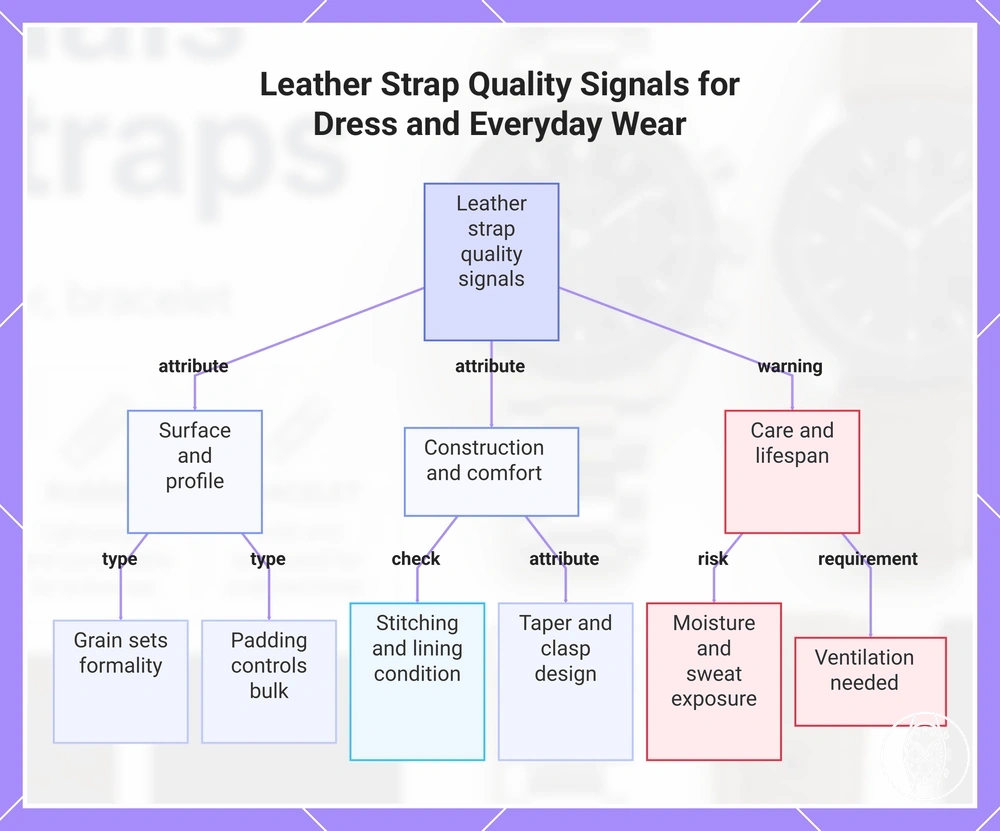
A leather strap's useful quality signals are its grain, padding, stitching, lining, taper, and clasp construction rather than the leather label alone. Grain sets the visible surface character, padding determines whether the strap has a flatter or more raised profile, stitching and lining provide observable structural and skin-contact condition, taper changes the transition from the watch head toward the clasp, and clasp style changes the fastening and repeated flex points. Citizen states that natural leather bands wear, deform, and discolour over time and advises leaving enough space between the band and skin for ventilation, so comfort and lifespan should be judged from both material condition and construction.
Leather quality signals: Use these details to separate comfort, formal appearance, and wear condition without treating one feature as a universal quality grade.
Leather quality signals: Use these details to separate comfort, formal appearance, and wear condition without treating one feature as a universal quality grade.
- Grain: a smoother, restrained grain gives a more formal appearance, while a more pronounced texture produces a more casual visual effect.
- Padding: flatter padding reduces visual bulk, while thicker padding creates a more raised strap profile and firmer initial case-to-strap transition.
- Stitching and lining: even stitching and an intact lining indicate consistent construction; fraying, separation, or lining damage are visible lifespan and comfort warnings.
- Taper: narrowing toward the clasp reduces visual mass at the underside of the wrist and can make the leather strap appear more refined in dress-oriented use.
- Clasp: buckle and deployant-style clasps create different fastening and flex patterns, so wrist comfort and long-term wear remain linked to clasp construction, strap thickness, and repeated bending.
This chart shows the main quality signals to evaluate when choosing a leather strap for dress and everyday wear, including surface character, construction details, and care considerations.
Rubber and Silicone Straps for Sport Use
A rubber strap or silicone strap supports sport use and warm-weather use through flexibility, water tolerance, and easier cleaning after sweat exposure. Rubber compounds and silicone remain distinct materials, so texture, softness, lint attraction, and durability should be judged from the specific strap construction rather than treated as identical properties. Strap material alone does not establish the chronograph's water resistance or suitability for swimming.
Strap material alone does not establish the chronograph's water resistance or suitability for swimming.
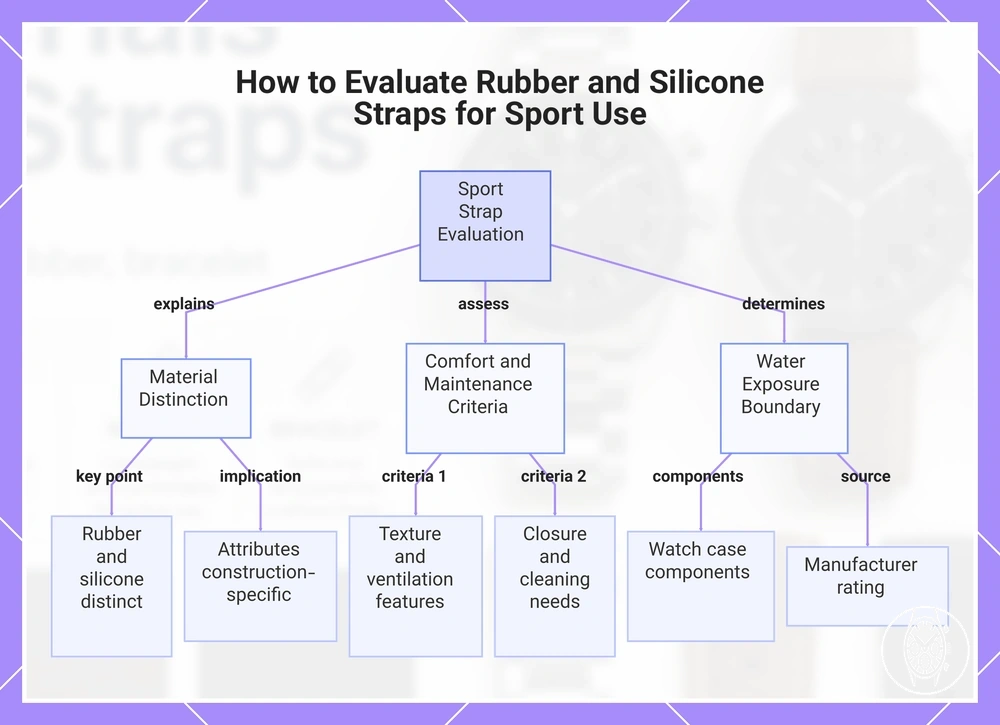
Sweat handling improves when a flexible strap can be cleaned after use and its construction limits prolonged moisture contact, while ventilation depends on openings, grooves, or other features in the specific strap rather than rubber or silicone alone. Apple specifies that its fluoroelastomer Nike Sport Band uses compression-moulded perforations for breathability, while its fluoroelastomer Sport Band uses a pin-and-tuck closure; these manufacturer examples show that ventilation and buckle design are separate construction attributes even within related sport-strap materials. Silicone straps can have a soft, grippy surface, but the reviewed evidence does not establish a universal numerical value for silicone softness, lint attraction, ventilation, or service life across formulations, so those attributes should be assessed from the specific strap and its care instructions. In warm-weather use, this makes surface texture, ventilation, closure design, and cleaning requirement more useful comfort and maintenance criteria than the material name alone.
Rubber and silicone both provide flexible, moisture-tolerant strap options, but their exact feel and durability remain compound- and construction-specific.
Rubber and silicone both provide flexible, moisture-tolerant strap options, but their exact feel and durability remain compound- and construction-specific. For water exposure, verify the complete watch's stated water resistance because the case, crown, pushers, seals, and manufacturer rating—not the rubber or silicone strap—set the relevant water-exposure boundary for the chronograph.
This chart shows the key factors to consider when evaluating rubber and silicone straps for sport use, including material differences, comfort criteria, and water resistance boundaries.
This chart shows the key factors to consider when evaluating rubber and silicone straps for sport use, including material differences, comfort criteria, and water resistance boundaries.
Metal Bracelets for Durability and Weight
A metal bracelet adds linked metal construction to a men's chronograph watch, increasing total weight while adding adjustable components that influence durability, security, and comfort. Bracelet-only weight does not have a universal gram value because manufacturers generally specify the mass of the complete watch rather than the bracelet as an isolated component, so weight should be checked at model level rather than treated as inherently positive or negative. Seiko also states that perspiration and dirt trapped between stainless-steel bracelet segments can contribute to corrosion, making cleaning and construction condition relevant durability factors.
Bracelet construction is defined by the links, end links, clasp, adjustment system, finishing, and taper.
Bracelet construction is defined by the links, end links, clasp, adjustment system, finishing, and taper. Solid links use individually formed link sections, while folded links use shaped metal sections; end links connect the bracelet to the case, and the clasp provides the primary closure and security point. Adjustability may come from removable links, sliding clasps, or micro-adjustment systems: Citizen documents sliding clasps, fold-over push-button deployment clasps, removable-link systems, and one-touch adjustment bracelets, while Seiko specifies that its easy-adjust clasp can extend an applicable bracelet by up to about 5 mm across 2 stages. Finishing and taper then affect visual weight and scratch visibility, while clasp construction and link articulation affect security, fit, and perceived build quality.
The checklist below keeps each construction signal tied to its practical effect.
Metal Bracelets for Durability and Weight are best inspected by separating the bracelet into the components that control fit, adjustment, surface wear, and security. The checklist below keeps each construction signal tied to its practical effect.
- Links: identify solid links or folded links and check for secure articulation, consistent movement, and excessive lateral play; link construction affects rigidity and perceived durability without guaranteeing service life.
- End links: inspect how evenly the end links meet the case and lugs; controlled alignment and limited unintended movement support a more integrated bracelet fit and appearance.
- Clasp: verify that the clasp closes and releases consistently; Citizen documents several clasp systems, including sliding and fold-over push-button types, so security and adjustment method are construction-specific.
- Micro-adjustment: check whether fine adjustment is present and its stated range; Seiko specifies up to about 5 mm of extension in 2 stages for its easy-adjust clasp, while other bracelet designs require their own manufacturer specification.
- Finishing and taper: inspect brushed, polished, or mixed surfaces for consistent transitions and scratch visibility, then check whether the bracelet narrows toward the clasp; both features change appearance and wrist feel without establishing durability by themselves.
Nylon, Canvas, and Sailcloth Strap Options
A nylon strap, canvas strap, or sailcloth strap can give a men's chronograph a casual appearance and sport-adjacent wearing option, with breathability, texture, water response, and drying behavior determined by the actual fabric construction. Seiko states that nylon and polyester fabric bands use a braided structure that can retain skin oil and dirt and can discolour through wet friction from sweat or rain, so weave density, moisture exposure, and drying conditions are practical comfort and maintenance signals rather than universal properties of every fabric strap.
These differences make fabric strap suitability conditional on texture, breathability, water exposure, drying behavior, and the condition of the stitching and hardware.
A nylon strap uses a textile construction whose flexibility and drying behavior are influenced by weave density and thickness, while a canvas strap is a separate textile category recognised by manufacturers such as Hamilton but does not have one universal weave, lining, or water-tolerance specification. Seiko instructs users to dry nylon or polyester bands in an airy place away from direct sunlight and notes that prolonged washing can alter fabric texture; Timex likewise instructs owners of its cloth and nylon straps to use mild soap, warm water, and air-drying when cleaning. A sailcloth strap also requires construction-level inspection because the name does not establish one standard composition: Artem specifies a sailcloth model with an embossed synthetic upper, leather structural layer, and natural-rubber underside, showing why lining, stitching, and buckle hardware must be checked on the individual strap. These differences make fabric strap suitability conditional on texture, breathability, water exposure, drying behavior, and the condition of the stitching and hardware.
- Nylon strap: inspect weave density, fraying, and drying behavior; Seiko identifies trapped skin oil and dirt, wet-friction discoloration, and prolonged washing as relevant conditions for nylon and polyester fabric bands.
- Canvas strap: inspect the weave, backing or lining, and stitching because the reviewed manufacturer sources identify canvas as a strap material but do not establish one universal breathability, drying-time, or water-tolerance value for the category.
- Sailcloth strap: verify the actual layer construction rather than relying on the name alone; Artem's documented example combines a synthetic upper, leather layer, and natural-rubber underside, so water exposure and drying behavior are construction-specific.
- Stitching and buckle hardware: intact stitching and secure buckle hardware support structural consistency, while fraying, loose stitching, corrosion, or distorted hardware indicate a maintenance or replacement need.
Leather Strap, Rubber Strap, or Metal Bracelet
A leather strap, rubber strap, or metal bracelet is the better option according to comfort, water exposure, formality, weight preference, care requirement, and daily use rather than material alone. A leather strap favours formal and office settings where moisture exposure is limited, a rubber strap favours sweat handling and water-tolerant use when its specific compound supports that exposure, and a metal bracelet favours adjustable linked construction where extra weight is acceptable. These criteria provide the main decision signals for comparing the three options.
These criteria provide the main decision signals for comparing the three options.
For dress wear and office wear, a leather strap provides the strongest formality signal, but Seiko states that leather bands are more susceptible than metal bracelets to deterioration and discoloration from moisture, sweat, and direct sunlight. For sport-adjacent use, a rubber strap is the more practical choice when its documented material and construction tolerate repeated sweat and surface water, while the complete watch still requires its own water-resistance rating. For daily use, a metal bracelet provides linked adjustability and a durable wearing structure, although Seiko states that perspiration and dirt trapped between stainless-steel bracelet segments can contribute to corrosion. The best-fit scenario therefore follows the dominant condition: controlled moisture and formality favour leather, frequent sweat exposure favours a suitable rubber construction, and adjustable metal construction favours users comfortable with its added mass and cleaning needs.
Leather Strap, Rubber Strap, or Metal Bracelet should be judged side by side by comfort, durability, care, and use condition rather than by material reputation.
Leather Strap, Rubber Strap, or Metal Bracelet should be judged side by side by comfort, durability, care, and use condition rather than by material reputation. The table compares these trade-offs directly, while broader dress and sport chronograph differences can refine the decision without replacing the strap-material criteria.
| Option | Comfort signal | Durability or care trade-off | Best-fit scenario |
|---|---|---|---|
| Leather strap | Flexible wrist feel with the strongest formal appearance of the three options; fit and ventilation affect comfort | Seiko identifies moisture, sweat, and direct sunlight as deterioration conditions, so care requires limiting prolonged wet exposure and drying the strap after moisture contact | Dress wear, office wear, or daily use where formality matters more than frequent sweat or water exposure |
| Rubber strap | Flexible construction that supports wrist movement; texture, ventilation, and buckle design determine the actual comfort level | Water tolerance, sweat handling, and durability are compound- and construction-specific, so the manufacturer's material and care guidance should define the usable exposure conditions | Sport use, warm-weather wear, or daily use involving frequent sweat where the specific rubber strap is designed for that environment |
| Metal bracelet | Linked construction distributes rigid metal around the wrist; articulation, clasp adjustment, and total watch weight determine comfort | Seiko states that perspiration and dirt between bracelet components can contribute to corrosion, so durability still requires periodic cleaning and inspection | Office wear or daily use where adjustable metal construction, visual strength, and additional weight are acceptable |
Choose a leather strap when formality and a softer feel outweigh its higher moisture-care requirement; choose a suitable rubber strap when sweat handling and water tolerance are more important than dress appearance; choose a metal bracelet when linked adjustability and a more substantial wrist feel match the intended daily use. No option is universally superior because comfort, durability, and care remain tied to the specific construction, exposure conditions, and wearer preference.
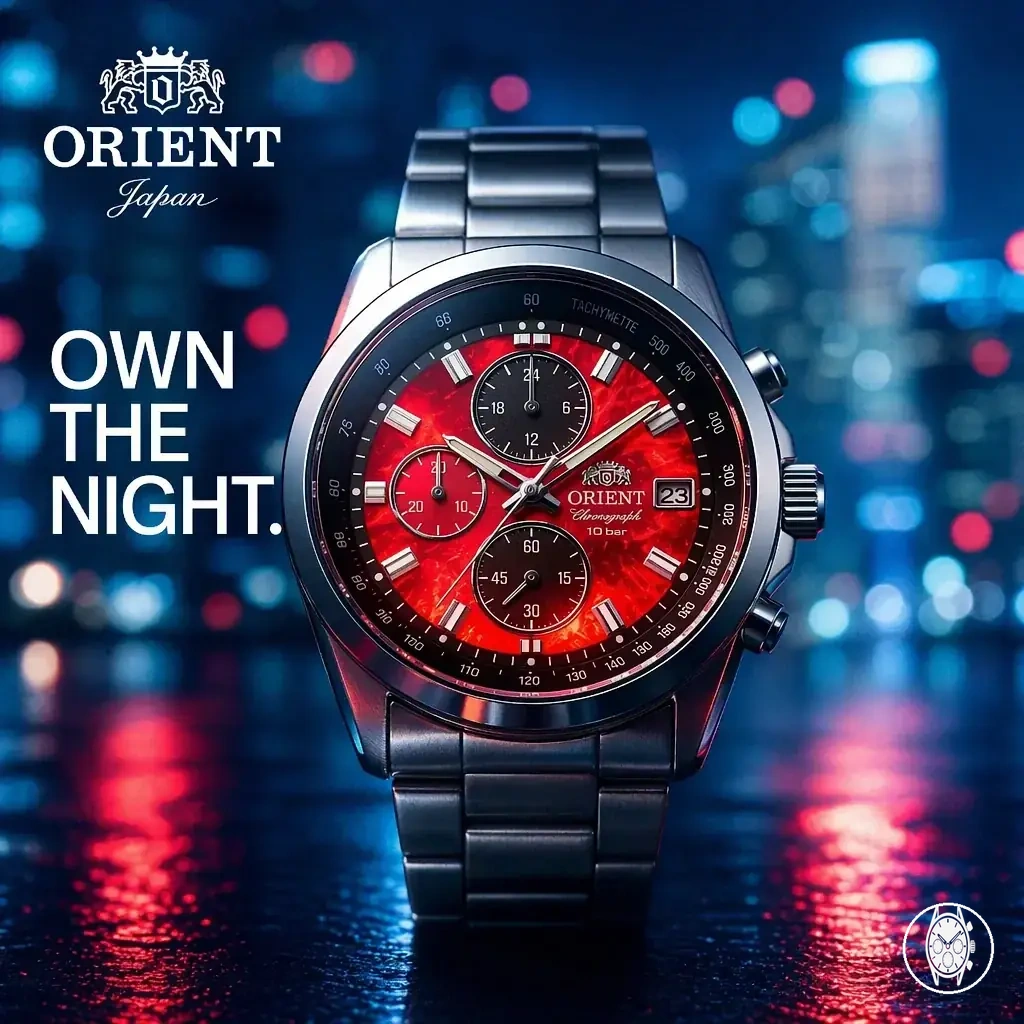
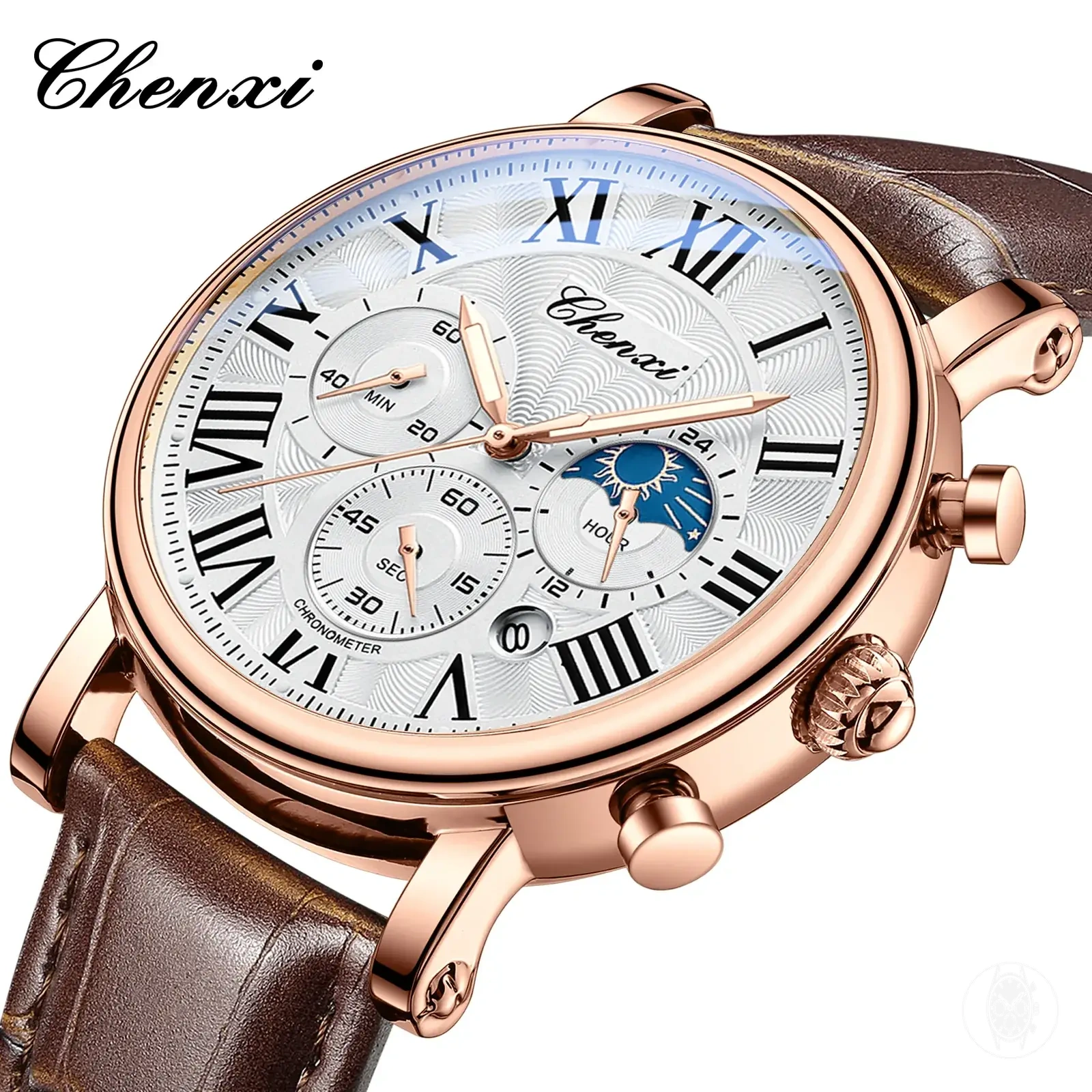
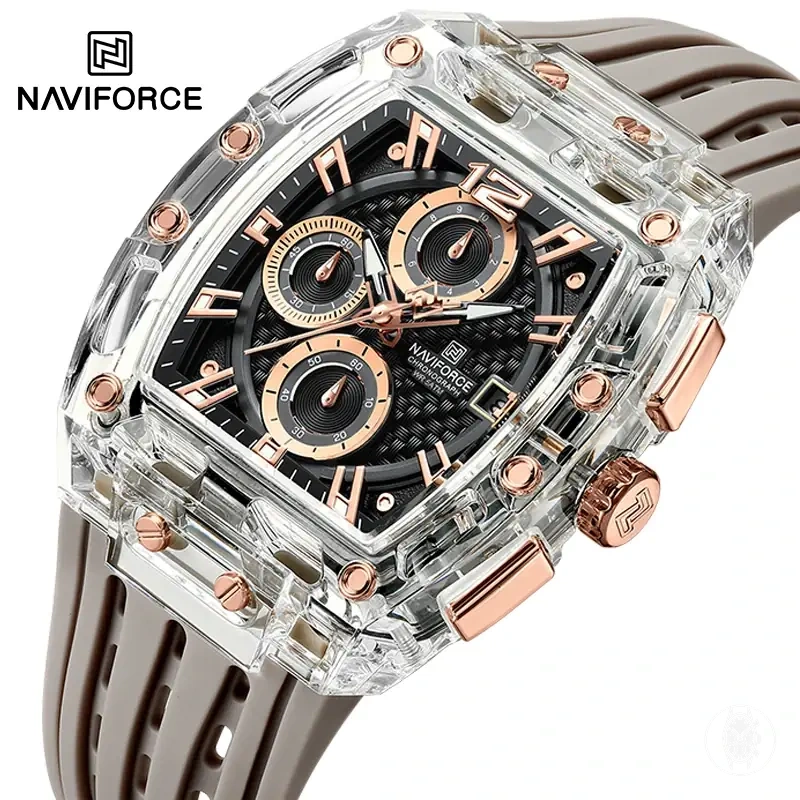
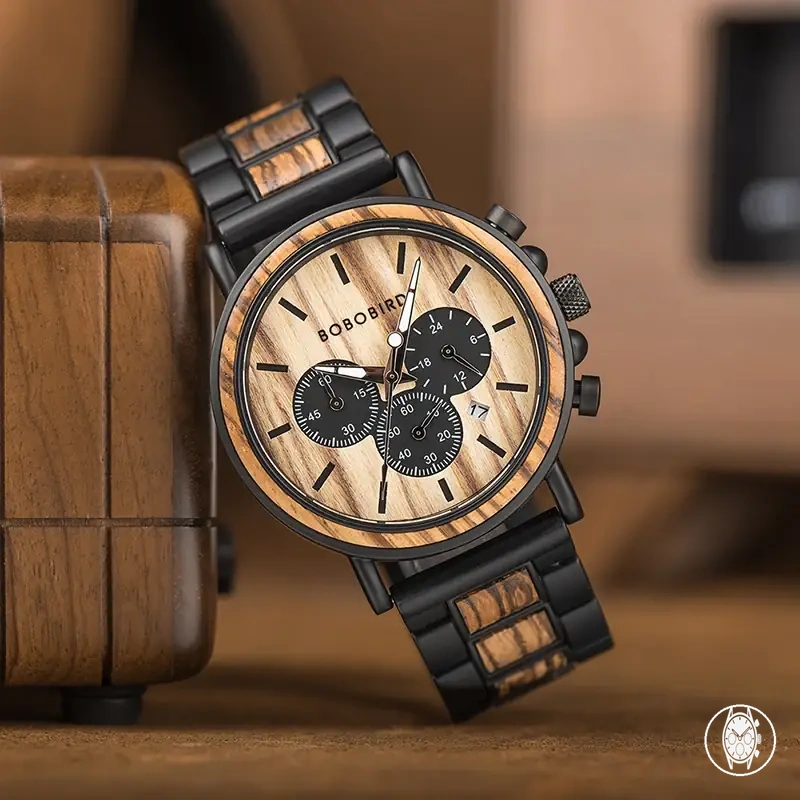
The products below are useful examples for comparing available options.
The products below are useful examples for comparing available options. Before buying, check that the compatibility criteria, key features, and product details match your needs.
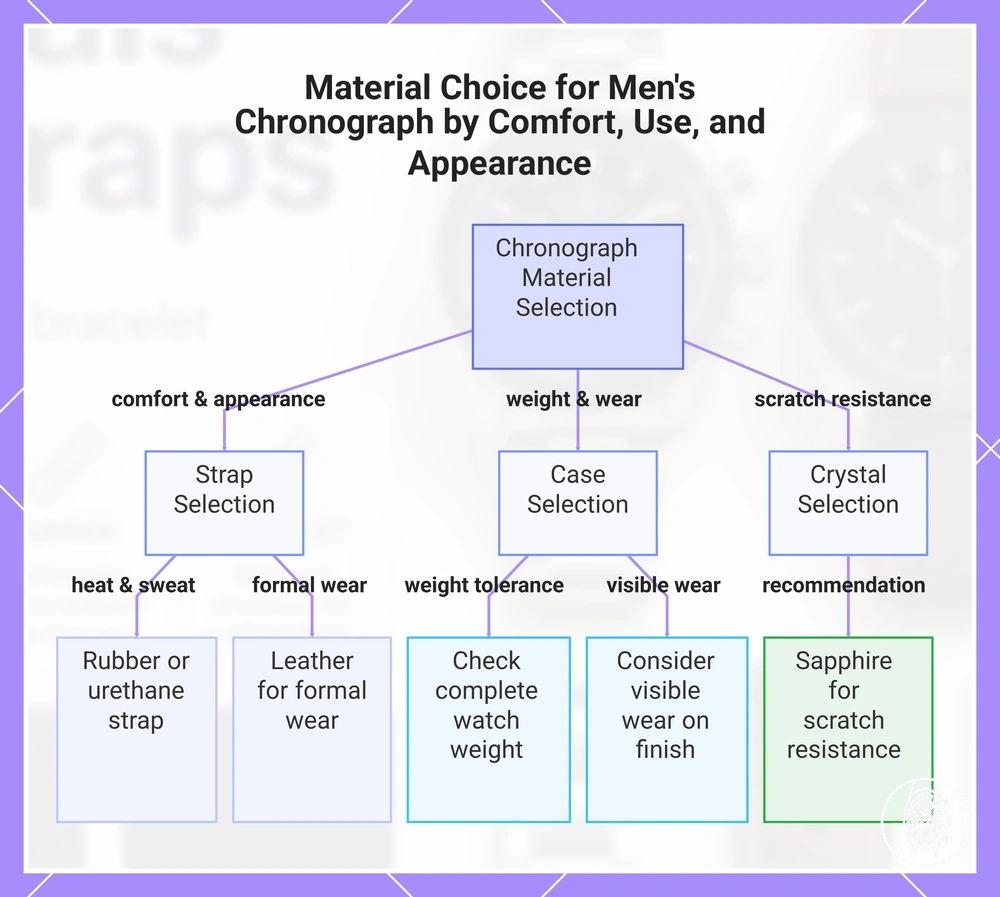
Material Choice by Comfort, Use, and Appearance
Material choice for a men's chronograph should match comfort, intended use, appearance, strap choice, case material, crystal material, weight tolerance, and expected care rather than follow one universal material hierarchy. A practical material combination should reflect the conditions the watch will face most often, including heat, sweat, formal wear, sport use, scratch risk, and daily use. The main selection criteria are therefore exposure conditions, desired appearance, wrist comfort, acceptable weight, and maintenance tolerance.
The main selection criteria are therefore exposure conditions, desired appearance, wrist comfort, acceptable weight, and maintenance tolerance.
For heat and frequent sweat, a moisture-tolerant strap direction such as an appropriately specified rubber or urethane band reduces the care burden compared with natural leather; Citizen states that urethane bands can be washed with water, while wet leather should be dried promptly. For office wear and formal wear, a leather strap provides a more formal appearance when repeated moisture exposure is limited, while a metal bracelet suits daily use where additional weight and periodic cleaning are acceptable; Seiko states that trapped sweat and dirt can contribute to corrosion between stainless-steel bracelet parts. Where scratch risk is a priority, crystal material should be selected separately, with sapphire providing the more scratch-resistant direction relative to softer watch-crystal categories. Weight tolerance should also be checked at complete-watch level because the case, movement, crystal, strap or bracelet, and dimensions all contribute to total wrist mass.
Use heat, sweat, formal wear, sport use, scratch risk, weight tolerance, and care requirement as the decision variables.
Material Choice by Comfort, Use, and Appearance can be converted into a short criteria-led checklist that connects each material attribute to a practical decision. Use heat, sweat, formal wear, sport use, scratch risk, weight tolerance, and care requirement as the decision variables.
- Heat and sweat: favour a strap choice with documented moisture tolerance and straightforward cleaning; rubber or urethane is the practical direction when frequent perspiration is expected, while leather is better reserved for controlled moisture exposure.
- Formal wear: favour a leather strap when appearance and formality have greater decision weight than repeated sweat or water exposure.
- Sport use: favour a moisture-tolerant rubber or urethane strap when the specific material is designed for sweat and surface-water exposure; strap material does not determine the complete watch's water-resistance rating.
- Scratch risk: favour a scratch-resistant crystal material such as sapphire when preserving the dial-covering surface is a priority, while judging case finish separately for visible wear.
- Weight tolerance: favour a strap over a metal bracelet when reducing wrist mass is a priority, but verify the complete watch weight because bracelet construction and case size can materially change the result.
- Daily mixed use: favour the material combination that handles the most frequent or demanding condition, then use appearance as the secondary filter.
A mixed-use buyer who wants one chronograph for office wear, formal occasions, warm weather, and occasional sport use should prioritise the conditions that create the greatest material stress. Frequent sweat or heat points toward a moisture-tolerant strap choice, while office or formal use can still be supported by an interchangeable leather option when the watch construction permits strap changes. Case material and crystal material should then be selected according to acceptable weight, visible-wear expectations, and scratch risk rather than inferred from the strap. After these material criteria are settled, the broader buying checklist can be used for non-material purchase criteria.
After these material criteria are settled, the broader buying checklist can be used for non-material purchase criteria.
Material-led selection works best by choosing the strap for comfort, sweat exposure, and appearance; the case material and finish for weight tolerance and visible wear; and the crystal material for the required scratch-resistance trade-off. These choices should remain conditional on daily use and care expectations rather than becoming a product ranking, while the men's chronograph watch guide provides the wider context for the remaining chronograph criteria.
Before buying, check that the compatibility criteria, key features, and product details match your needs.
The products below are useful examples for comparing available options. Before buying, check that the compatibility criteria, key features, and product details match your needs.
This chart shows the three main material categories to consider when selecting a men's chronograph, with practical recommendations based on exposure, appearance, and wear conditions.
Replacement Strap Compatibility and Long-Term Wear
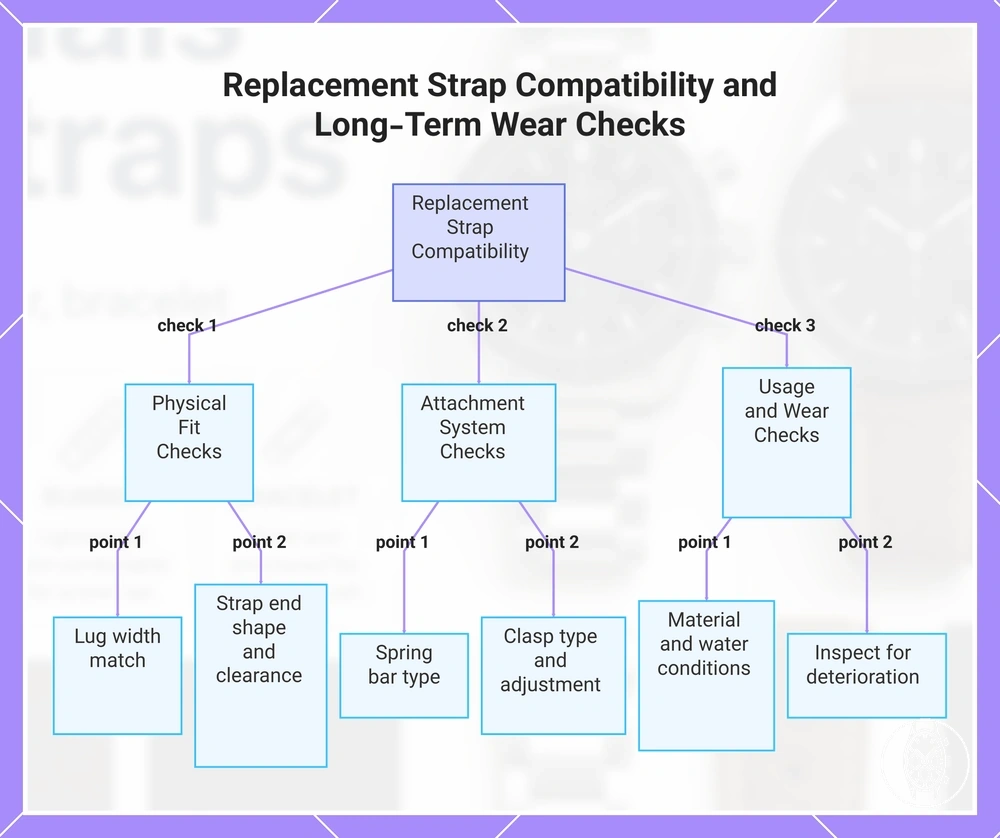
A replacement strap is compatible with a men's chronograph only when its fit points match the watch design, especially lug width, strap end shape, spring bars, case clearance, and attachment system. Correct compatibility can restore wrist comfort and support long-term wear without changing the watch itself, while a mismatch can cause poor seating, unwanted movement, or attachment risk. Compatibility should therefore be confirmed for the specific chronograph model rather than inferred from strap width or appearance alone.
Compatibility should therefore be confirmed for the specific chronograph model rather than inferred from strap width or appearance alone.
Lug width is the measured distance between the lugs where the replacement strap attaches, while strap end shape determines whether a straight, shaped, or curved end can seat against the case correctly. Seiko specifies its Prospex Speedtimer SSC813 chronograph with a 20 mm distance between lugs and a 13.3 mm case thickness, giving model-specific dimensions that can be checked before replacement; a 20 mm width alone does not establish compatibility with every strap because end geometry and attachment position still matter. :contentReference[oaicite:0]{index=0} Citizen documents single-lever quick-release spring bars, double-lever quick-release spring bars, and button-release strap mounts, confirming that spring bars and attachment systems are separate compatibility variables. :contentReference[oaicite:1]{index=1} Clasp type and material flexibility then affect closure range and wrist comfort, so a width match can still fail if the replacement strap conflicts with the case, mount, clasp arrangement, or required articulation.
The checklist verifies lug width, strap end shape, spring bars, case clearance, clasp type, material flexibility, and water exposure.
Replacement Strap Compatibility and Long-Term Wear should be checked by verifying the physical interfaces and expected use conditions before selecting a replacement band. The checklist verifies lug width, strap end shape, spring bars, case clearance, clasp type, material flexibility, and water exposure.
- Lug width: match the replacement strap to the manufacturer-stated lug width; for example, Seiko specifies 20 mm between the lugs for the SSC813 chronograph, so another stated width would not satisfy that model's basic width condition. :contentReference[oaicite:2]{index=2}
- Strap end shape: confirm whether the watch accepts a straight end or requires shaped or curved end geometry; curved end links must match the case contour and attachment position rather than nominal width alone.
- Spring bars: verify the attachment system used by the watch and replacement strap; Citizen documents single-lever, double-lever, and button-release systems as distinct mounting arrangements. :contentReference[oaicite:3]{index=3}
- Case thickness and clearance: check the model's case geometry where the strap or end link passes the case; Seiko specifies the SSC813 at 13.3 mm thick, but the reviewed specification does not provide a universal minimum strap-to-case clearance, so physical clearance remains model-specific. :contentReference[oaicite:4]{index=4}
- Clasp type: confirm that the buckle, deployant clasp, or bracelet closure provides a usable adjustment range for the intended wrist position; the required range is strap- and wearer-specific unless the manufacturer publishes exact adjustment values.
- Material flexibility: choose a replacement strap that can articulate around the wrist without forcing the case or attachment points into an uncomfortable position; no universal flexibility threshold is specified across leather, rubber, fabric, and metal constructions.
- Water exposure: select a strap material whose manufacturer guidance supports the expected moisture condition; Seiko states that moisture and sweat can accelerate deterioration of leather and that urethane bands should be dried after washing or prolonged wet exposure. :contentReference[oaicite:5]{index=5}
Curved end links and an integrated bracelet create higher compatibility risk because their geometry can be specific to the watch case, so the replacement decision should use model-confirmed dimensions and attachment information rather than lug width alone. For water-exposed straps and long-term wear, inspect for cracking, loss of elasticity, fraying, corrosion, or other material deterioration because Seiko states that accumulated sweat and dirt can damage bands and contribute to skin irritation or corrosion. :contentReference[oaicite:6]{index=6} These conditions can reduce wrist comfort even when the initial mechanical fit was correct. Brief cleaning and inspection boundaries are covered further in caring for a chronograph watch.
Brief cleaning and inspection boundaries are covered further in caring for a chronograph watch .
This chart shows the key checks for verifying replacement strap compatibility on a men's chronograph, covering physical fit, attachment system, and usage conditions.