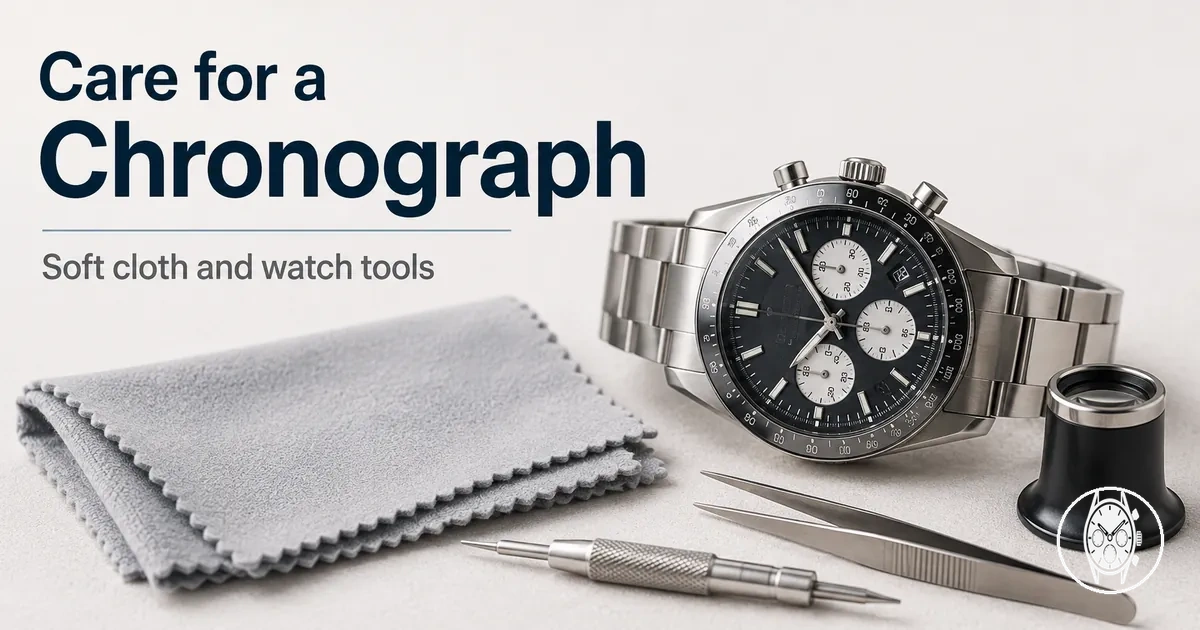
Men's Chronograph Watch Care and Maintenance
A men's chronograph watch needs gentle cleaning, dry storage, movement-appropriate service, and careful handling of the crown and pushers around moisture. Daniel Wellington advises wiping the case and bracelet with a soft microfiber cloth, drying the watch completely after water exposure, and avoiding crown or button operation while the watch is wet. These maintenance conditions protect exterior surfaces and reduce moisture-related risk without requiring the owner to open or repair the movement.
These maintenance conditions protect exterior surfaces and reduce moisture-related risk without requiring the owner to open or repair the movement.
Care and maintenance covers routine owner actions that protect the exterior, strap, controls, water resistance, and operating condition of men's chronograph watches, while internal servicing remains a watchmaker-level task. The cleaning method should match the material and exposure condition: Daniel Wellington specifies mild soapy water and a soft brush for suitable metal parts, while its leather-strap guidance calls for a soft cloth and avoidance of prolonged water or humidity. Before cleaning, check that the crown is secured as designed, the pushers operate normally, the strap material suits the intended method, and no visible moisture or impact damage is present.
The pushers, crown, seals, strap, and movement have different maintenance limits.
The pushers, crown, seals, strap, and movement have different maintenance limits. Daniel Wellington's automatic-watch guidance specifies professional servicing every 3–5 years for the automatic watches covered by that guidance, while its chronograph product guidance identifies examples rated to 3 ATM as suitable for splashes or light rain rather than showering or swimming. This 3–5-year interval and 3 ATM example are manufacturer-specific values, so a quartz or automatic chronograph with different construction or water-resistance specifications requires the interval and exposure limits stated by its own manufacturer.
Routine owner care should stop at exterior cleaning, drying, correct storage, and condition checks.
Routine owner care should stop at exterior cleaning, drying, correct storage, and condition checks. Persistent internal moisture, impact damage, a crown or pusher that sticks or fails to return normally, or continuing movement problems should move the watch from routine maintenance to professional inspection rather than force, case opening, or improvised repair.
Table of Contents
Chronograph Care Basics Before Cleaning or Servicing
Before cleaning or servicing a men's chronograph watch, check eight conditions: case condition, crown position, pusher condition, strap material, water-resistance rating, movement type, visible moisture, and recent impact. These care basics identify whether routine cleaning can proceed or should stop because moisture, damage, uncertain water resistance, or abnormal controls require further assessment.
A pre-cleaning check is a visual and functional condition inspection performed before applying moisture, cleaning pressure, or servicing actions.
A pre-cleaning check is a visual and functional condition inspection performed before applying moisture, cleaning pressure, or servicing actions. Seiko's watch-care guidance states that water resistance can deteriorate as gaskets age or after accidental shock, advises against operating the crown or buttons while a watch is wet, and instructs owners to check the water-resistance indication before deciding how the watch may be exposed to water.
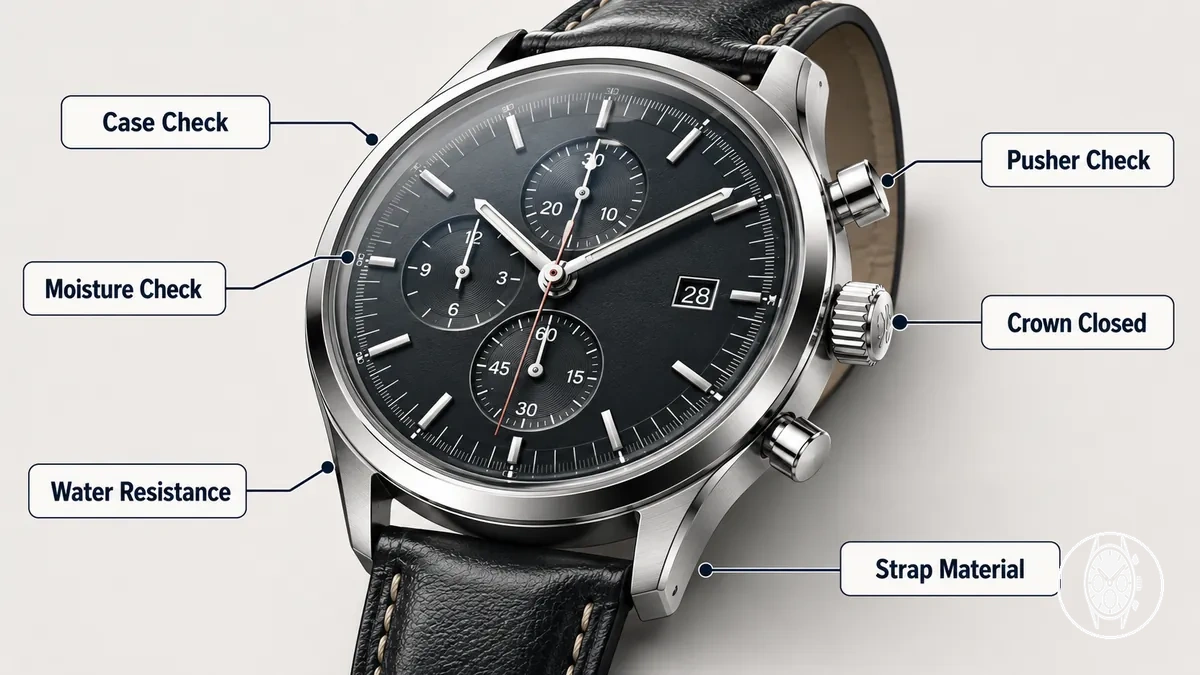
- Case: Check the case and crystal for cracks, deformation, or fresh impact marks. Seiko identifies accidental shock as a condition that can damage watch components and affect water resistance, so visible damage is a stop-signal before moisture-based cleaning.
- Crown: Confirm that the crown is fully closed or screw-locked when the chronograph uses a screw-lock design. Citizen specifies for applicable watches that the screw-lock crown should be securely locked after operation; leaving it unsecured increases the risk of water entering the watch.
- Pushers: Check the pushers for normal movement and return, and stop if they are stiff, stuck, loose, or surrounded by visible dirt. Citizen's watch-care guidance states that accumulated dirt around a crown or button can restrict operation, so forcing an abnormal pusher can add pressure without resolving the underlying condition.
- Strap material: Identify the strap as leather, metal, rubber, silicone, fabric, or another manufacturer-specified material before choosing a cleaning method. Moisture suitability differs by material; Seiko advises removing moisture from leather bands promptly because moisture and sweat can contribute to deterioration.
- Water resistance: Confirm the watch's marked or manufacturer-stated rating before using moisture. Seiko distinguishes examples including 3 BAR, 5 BAR, 10 BAR, 15 BAR, and 20 BAR and assigns different permitted water exposures to those ratings; an unreadable or uncertain rating therefore provides no verified basis for damp cleaning.
- Movement type: Confirm whether the chronograph is quartz, automatic, or another mechanical type before servicing. The movement type is a categorical condition that determines which internal servicing procedures apply; if the type is unknown, limit owner action to external inspection until the model documentation identifies it.
- Moisture: Inspect beneath the crystal for persistent condensation or visible water droplets. Seiko advises consulting the retailer or service facility when condensation remains for an extended period, because persistent internal moisture can indicate compromised water resistance.
- Recent impact: Check whether the chronograph has recently been dropped or subjected to a hard knock, even when exterior damage is not obvious. Seiko warns that strong shock can affect a precision watch, so a recent impact combined with abnormal operation, moisture, or case damage is a reason to stop before cleaning.
Routine inspection can reduce preventable wear, but it cannot diagnose damaged seals, internal moisture, impact-related faults, or an internal movement malfunction. If one of those stop-signals is present, professional diagnosis should come before further owner cleaning or servicing.
Safe Cleaning Tools and Products for Chronograph Watches
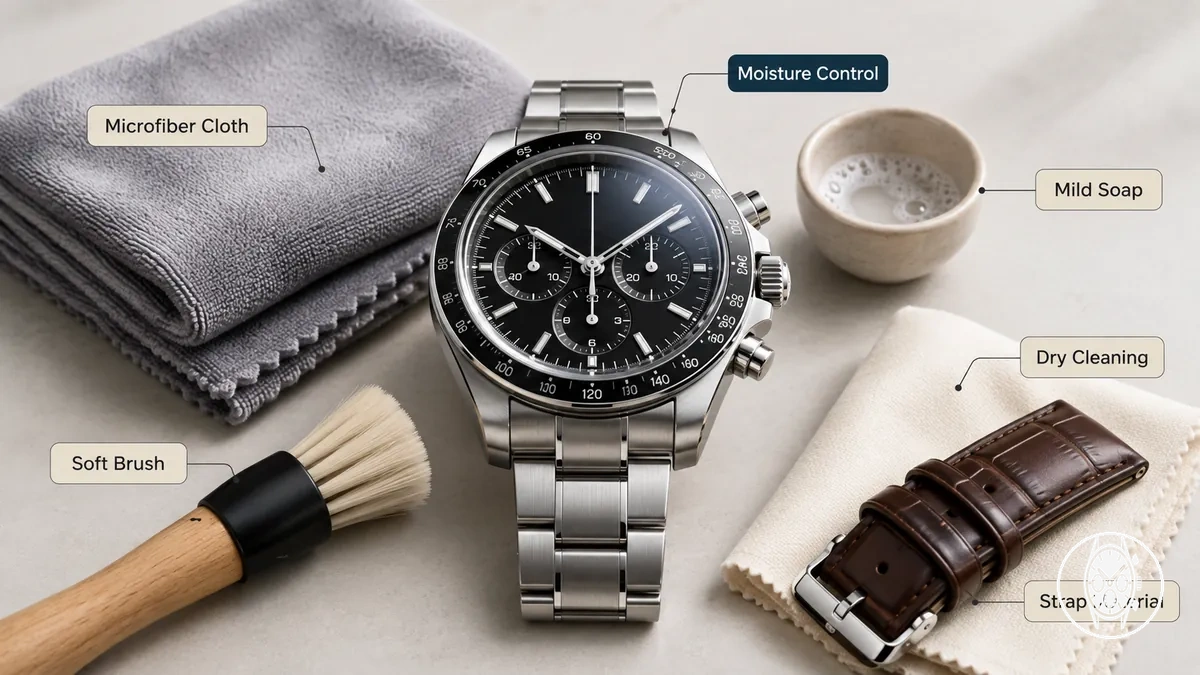
Safe cleaning tools for a men's chronograph watch should match three conditions: the material being cleaned, the watch's permitted water exposure, and the dirt level. A clean microfiber cloth or similarly soft cloth suits routine dry cleaning of the crystal and case finish; a soft brush suits accessible dirt where the manufacturer permits brushing; and mild soap or detergent is conditional on the specific material and moisture limits. CASIO's watch-care guidance specifies a soft cloth for wiping dirt, sweat, water, and other foreign matter, while Seiko specifies a toothbrush for heavy dirt in metal bracelet gaps, so neither method establishes one cleaning product as suitable for every chronograph surface.
Tool choice should follow material → product → risk.
Tool choice should follow material → product → risk. CASIO specifies a soft toothbrush with a weak solution of water and mild neutral detergent or soapy water for metal bands and resin bands with metal parts, followed by rinsing and drying with a soft absorbent cloth; its procedure also calls for protecting the watch case from contact with the cleaning solution. For leather straps, CASIO and Seiko instead specify wiping moisture or sweat with a soft cloth, which makes dry cleaning the more appropriate owner-care method under those manufacturers' instructions.
| Tool/product | Best suited for | Use condition | Main risk to avoid |
|---|---|---|---|
| Microfiber cloth or soft cloth | Crystal, case finish, and exterior moisture control | Use clean and dry for routine wiping. CASIO specifies a soft cloth for removing dirt, sweat, water, and other foreign matter. | Do not continue rubbing if visible grit remains on the surface; remove loose contamination before applying further pressure. |
| Soft brush or soft toothbrush | Accessible gaps in metal bracelets and other manufacturer-permitted areas | Use gently where brushing is permitted. Seiko specifies a toothbrush for heavy dirt accumulated in metal bracelet gaps. | Avoid forcing bristles around pushers, seals, damaged coatings, or openings because the cited bracelet-cleaning instruction does not establish those areas as brush-safe. |
| Mild soap or mild neutral detergent | Manufacturer-approved metal or resin-band cleaning | CASIO specifies a weak solution of water and mild neutral detergent or soapy water for metal bands and resin bands with metal parts, followed by rinsing and drying with a soft absorbent cloth. | Keep the solution away from the watch head when the manufacturer's procedure applies it to the band; residual soap or detergent should be rinsed from the permitted component. |
| Dry soft cloth | Leather straps and moisture-sensitive routine care | Use for moisture and sweat removal. Seiko specifies wiping leather bands with a soft dry cloth, while CASIO specifies wiping leather-band moisture and sweat with a soft cloth. | Avoid treating a leather strap with the metal-band washing method because Seiko identifies moisture and sweat as contributors to leather-band deterioration. |
| Water with soft absorbent cloth | Resin bands specifically covered by manufacturer washing instructions | CASIO specifies washing a resin band with water and then wiping it dry with a soft cloth. | Do not extend a band-specific water instruction to the chronograph case when its water resistance, seals, coating condition, or permitted cleaning method has not been confirmed. |
Mild soap, damp cleaning, and brushing are therefore condition-specific choices rather than default methods for every chronograph watch. If the seals, water-resistance condition, case coating, crystal treatment, or strap material cannot be verified as suitable for the intended cleaning product, keep routine owner care dry and non-abrasive until the applicable manufacturer instructions or a professional assessment establishes the permitted method; consumer cleaning tools do not replace internal servicing.
Cleaning Products to Use and Avoid
For a men's chronograph watch, use mild, non-abrasive cleaning products only when the case finish, strap material, permitted water exposure, and gasket condition support that method; otherwise use a clean, dry microfiber cloth. Clean water and mild soap are conditional rather than universal choices: Citizen permits a water-resistant 10 bar watch to be washed with water held in a container but says not to expose that example to direct tap flow.
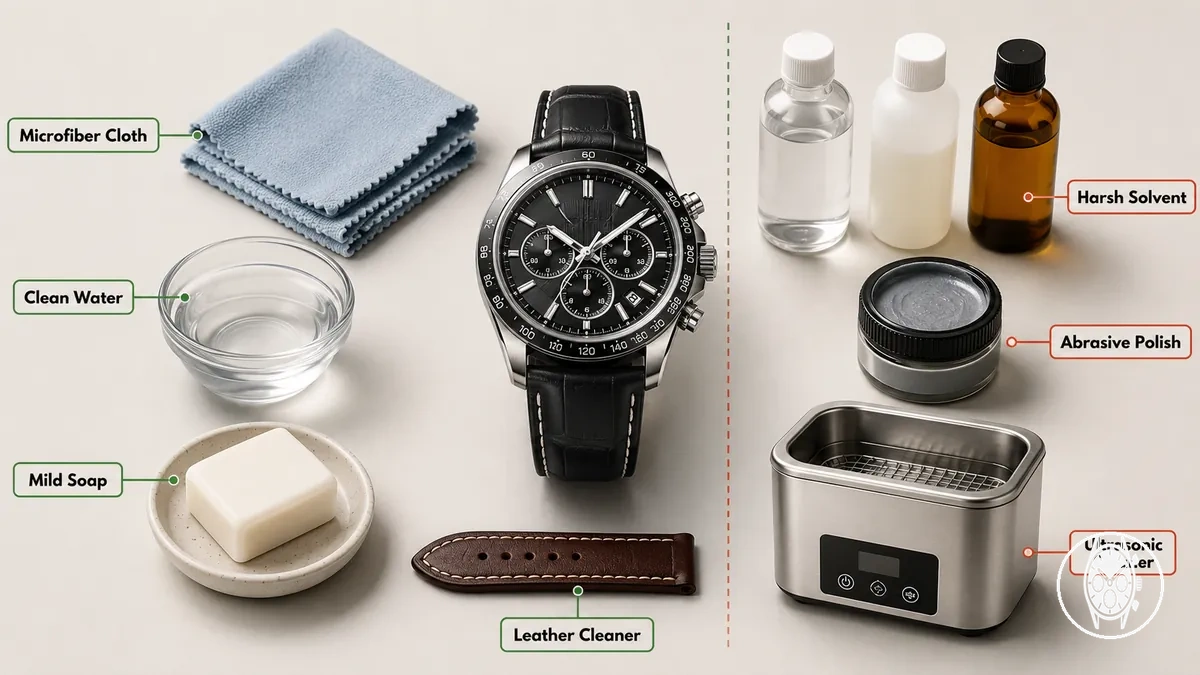
- Use: A clean microfiber cloth or comparably soft cloth for dry exterior cleaning and moisture removal. Citizen specifies a soft absorbent cloth for removing sweat from metal cases, while Seiko specifies a soft dry cloth for routine moisture removal from watch bands.
- Use conditionally: Clean water only when the manufacturer's water-exposure instructions permit it. Citizen's 10 bar example allows washing with container-held water but excludes direct tap flow, so that numerical example should not be extended to chronographs with another rating or an uncertain gasket condition.
- Use conditionally: Mild soap only for materials covered by the applicable manufacturer's cleaning procedure, with residue removed and the permitted component dried afterward. No reviewed manufacturer evidence establishes mild soap as suitable for every chronograph case finish, coating, crystal, seal, or strap material.
- Use conditionally: A leather cleaner only when the strap manufacturer's instructions permit that product for the specific leather. Citizen instead instructs owners to blot a wet leather band with a dry, soft cloth and warns that bleach, alcohol, and volatile substances can accelerate discoloration or deterioration.
- Avoid: Alcohol for ordinary owner cleaning unless the specific manufacturer permits it for the relevant material. Citizen identifies alcohol exposure as a cause of possible discoloration, deterioration, or damage to applicable plastic cases and bands and separately warns against alcohol on leather bands.
- Avoid: Bleach on the watch and leather strap during ordinary owner cleaning. Citizen specifically warns that substances containing bleach can cause leather-band discoloration, colour change, or earlier deterioration; the reviewed evidence does not establish bleach as an appropriate cleaner for chronograph case finishes, crystals, or seals.
- Avoid: Abrasive polish unless the manufacturer explicitly specifies a refinishing method for the particular surface. Citizen warns against strong rubbing because it can damage applicable watch surfaces, while the reviewed manufacturer guidance does not establish abrasive polish as a routine owner-cleaning product for chronograph crystals or case finishes.
- Avoid: Harsh solvent exposure. CASIO states that thinner, gasoline, solvents, and cleaners containing them can discolor or damage resin cases, resin bands, leather, and other watch parts.
- Avoid unless specifically approved: An ultrasonic cleaner for an assembled chronograph. Rolex documents ultrasonic cleaning as a professional service operation applied to disassembled components before drying and reassembly, not as a universal owner-cleaning method for a complete watch.
Wet products and stronger cleaning methods require a verified material and seal condition because the acceptable method changes with the watch's construction. If the manufacturer does not specify that clean water, mild soap, a leather cleaner, or ultrasonic cleaning is suitable for the particular watch or strap, keep owner cleaning dry and non-abrasive; alcohol, bleach, harsh solvents, and abrasive polish should remain outside routine owner cleaning where the cited manufacturer guidance identifies material damage or provides no supported use condition.
How to Clean the Case, Crystal, Crown, and Pushers
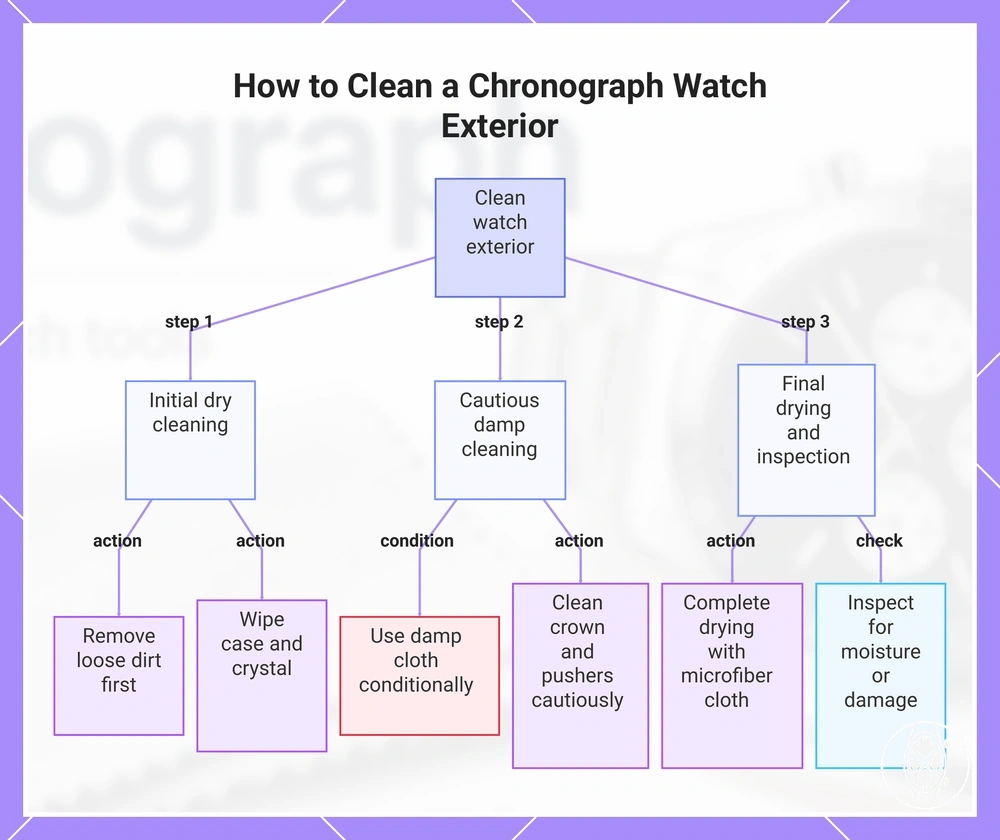
Clean the exterior of a men's chronograph watch with gentle, controlled actions: remove loose dirt, wipe the case and crystal with a microfiber cloth, use a soft brush for accessible residue, apply a damp cloth only when the watch's water-resistance condition permits moisture, then complete drying and inspection. Citizen specifies wiping dirt, perspiration, and moisture from the case and crystal with a soft cloth, while Seiko recommends keeping the watch exterior clean by wiping away moisture, sweat, and dirt with a soft cloth.
Citizen specifies wiping dirt, perspiration, and moisture from the case and crystal with a soft cloth, while Seiko recommends keeping the watch exterior clean by wiping away moisture, sweat, and dirt with a soft cloth.
Before damp cleaning, the crown should be in its normal closed position and a screw-lock crown should be secured as designed; moisture should be avoided when water resistance, gasket condition, or impact condition is uncertain. Citizen warns against operating the crown or buttons when a watch is wet because water can enter the watch, while Seiko states that water resistance can deteriorate through gasket ageing or deformation caused by accidental shock.
- Wipe the case and crystal. Use a clean, dry microfiber cloth to lift dust, fingerprints, perspiration, and smudges from the case and crystal with a gentle wipe. Removing loose contamination first reduces the need for stronger rubbing against the exterior finish.
- Loosen dirt in exterior gaps. Use a clean soft brush with light pressure where dry wiping cannot reach, keeping the brush movement controlled around exterior crevices. Seiko specifies a soft toothbrush for removing heavy dirt from accessible metal bracelet gaps; this supports gentle debris removal rather than increased pressure on resistant dirt.
- Use a damp cloth conditionally. Apply a lightly damp cloth to permitted exterior surfaces only when the manufacturer's instructions and the watch's present water-resistance condition support moisture exposure. Seiko advises against exposing even a water-resistant watch directly to running tap water because the pressure from a faucet can exceed the conditions represented by ordinary water-resistance use.
- Clean around the crown cautiously. Keep the crown in its closed position and gently wipe or brush visible exterior dirt without operating the crown while moisture is present. Citizen specifies that applicable screw-lock crowns should be securely locked and warns that crown operation while wet can allow water to enter the watch.
- Lift residue from around the pushers. Use the soft brush with gentle outward strokes to loosen visible dirt around pusher edges rather than applying pressure that drives residue farther into the gaps. For example, if dried residue surrounds a chronograph pusher, remove only residue that releases with gentle exterior brushing and stop if the pusher remains stuck or abnormal; Citizen reports that accumulated foreign matter around buttons can restrict their operation.
- Complete drying. Use a clean, dry microfiber cloth to remove remaining moisture from the case, crystal, crown area, and pusher area before operating the chronograph controls. Citizen and Seiko both instruct owners to remove moisture from watch exteriors after permitted exposure, so a visibly dry exterior is the completion condition for this step.
- Finish with inspection. Inspect the case and crystal for remaining moisture or damage and check the crown and pushers for visible residue or abnormal operation. Persistent moisture beneath the crystal, impact damage, or controls that remain stuck are stop conditions: Citizen advises service when moisture has entered the watch, while exterior cleaning cannot establish the condition of internal seals or movement components.
After drying and inspection, routine exterior cleaning is complete when the case and crystal are visibly clean and dry and no abnormal condition is apparent around the crown or pushers. Internal moisture, visible damage, or controls that remain abnormal require service rather than further owner cleaning.
Internal moisture, visible damage, or controls that remain abnormal require service rather than further owner cleaning.
This chart shows the step-by-step process for cleaning the exterior of a men's chronograph watch, including dry cleaning, cautious damp cleaning, and final drying and inspection.
Cleaning Around Chronograph Pushers Safely
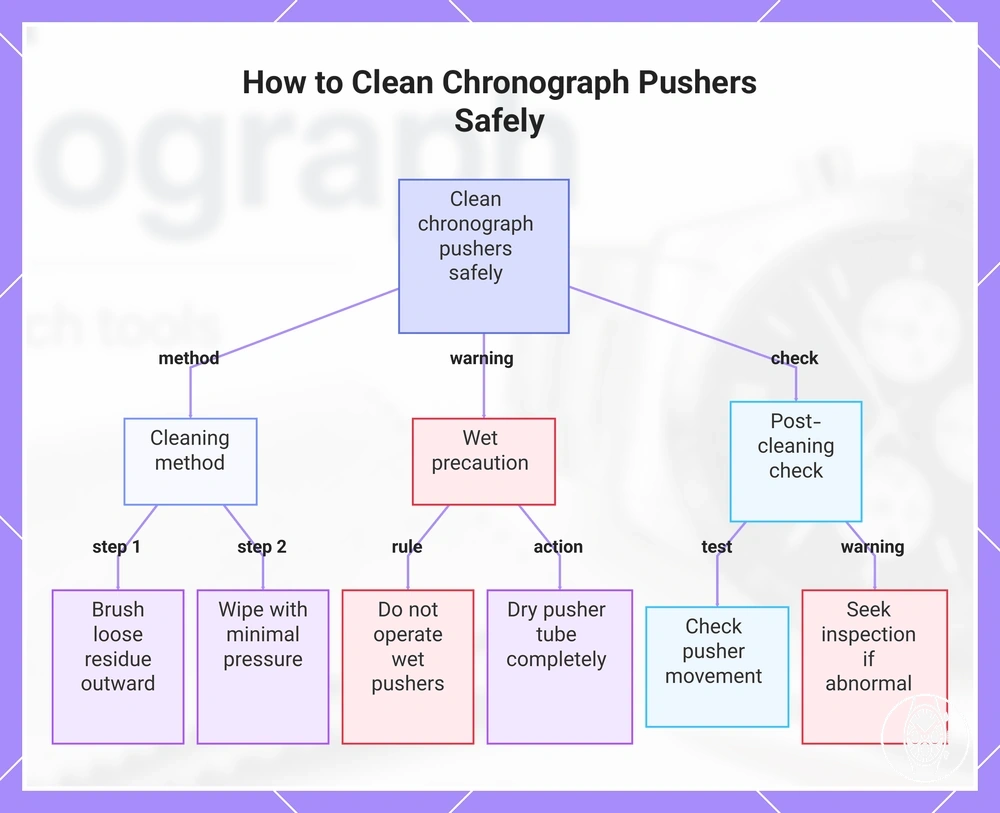
Chronograph pushers are more sensitive to cleaning than flat case surfaces because dirt and residue can collect around the pusher tube; use a soft brush and light wiping with minimal pressure. Citizen states that accumulated foreign matter around watch buttons can restrict their operation and that buttons should not be operated while the watch is wet because moisture can enter the case.
- Brush away loose residue. Keep the chronograph pushers at rest and use a clean, dry soft brush to lift visible dirt from the pusher edges and exposed pusher tube area. Brush residue outward rather than pressing it farther into the gap.
- Use light wiping. Wipe around each pusher with a clean, soft cloth and minimal pressure. If residue does not release with gentle brushing and wiping, stop increasing pressure.
- Keep wet pushers inactive. If permitted exterior cleaning leaves moisture around the pusher area, do not press the chronograph pushers while they are wet. Citizen specifies that operating watch buttons while wet can allow water to enter the watch.
- Complete drying around the pusher tube. Use a clean, dry cloth to remove visible moisture from the pusher edges, pusher tube area, and adjacent case surface. Wait until these exterior areas are visibly dry before operating the chronograph pushers.
- Check the stop condition. After drying, check for remaining residue and normal pusher movement. If a pusher shows stiffness, is loose, remains sticky, or does not return normally, stop the cleaning attempt and seek professional inspection rather than applying additional pressure.
This chart shows the safe cleaning method for chronograph pushers, including key precautions and post-cleaning checks.
Cleaning Straps and Bracelets by Material
Clean a chronograph strap or bracelet according to its material, water tolerance, sweat exposure, and attachment condition. Leather requires prompt moisture removal and drying rather than soaking; a metal bracelet can accept more targeted washing when its construction and the watch head permit it; rubber or silicone should be rinsed only under material-specific care guidance; and fabric should be cleaned according to its weave, coating, and hardware. Citizen instructs owners to blot water or sweat from leather with a dry, soft cloth, permits cleaning heavily soiled metal bands with neutral detergent or soapy water and a soft toothbrush, and specifies washing applicable urethane bands with water before drying them with a cloth.
Exposure changes the cleaning method and drying priority.
Exposure changes the cleaning method and drying priority. After daily sweat, remove moisture and residue before storage; after saltwater exposure, use only the cleaning method permitted for the strap and watch construction, then complete drying before long storage. Seiko states that sweat, moisture, and dirt can accumulate between metal bracelet segments and contribute to corrosion, while Citizen advises drying wet fabric bands thoroughly in a shaded, well-ventilated place. Cleaning decisions should therefore follow the specific materials and straps, including the condition of spring bars, clasp hardware, coatings, and moisture-sensitive surfaces.
| Material | Cleaning method | Main risk | Replace or inspect when |
|---|---|---|---|
| Leather | Blot sweat or water promptly with a clean, dry, soft cloth and allow thorough drying away from prolonged moisture. Citizen specifies blotting rather than rubbing wet leather, and Seiko advises keeping leather bands away from bathing, swimming, and other prolonged water exposure. | Leather can absorb moisture and perspiration, leading to discoloration, deformation, odor, surface wear, or cracking when repeatedly left damp. | Inspect for cracking, tearing, damaged stitching, severe staining, persistent odor, deformation, or loose spring-bar attachment. Citizen notes that natural leather wears, deforms, and discolors with use and requires periodic replacement when deterioration becomes significant. |
| Metal bracelet | Wipe sweat and moisture with a soft cloth. For heavy residue, Citizen specifies protecting the watch head and cleaning the bracelet with neutral detergent or soapy water and a soft toothbrush, followed by rinsing where permitted and thorough drying; Seiko likewise recommends brushing dirt from bracelet gaps and drying the bracelet. | Residue can collect between metal links, around the clasp, and near spring bars, increasing the risk of corrosion, staining, or restricted clasp movement. | Inspect when links, pins, spring bars, or the clasp show corrosion, looseness, protruding pins, abnormal movement, or persistent residue. Seiko warns that corroded adjustment pins can protrude or drop out, which can compromise the bracelet connection. |
| Rubber or silicone | Use clean water and a soft cloth when the manufacturer permits rinsing for that synthetic strap; mild soap remains conditional on the specific material, coating, hardware, and watch construction. Citizen specifies washing applicable urethane bands with water and drying them with a cloth. | Sweat, saltwater, soap residue, and incompatible solvents can contribute to odor, staining, loss of flexibility, or surface deterioration. | Inspect when cracks, permanent deformation, damaged adjustment holes, loss of elasticity, loose hardware, or persistent odor remains after permitted cleaning. Citizen specifically recommends replacement when a urethane band loses elasticity or develops cracks. |
| Fabric | Remove surface dirt gently and follow the manufacturer's moisture instructions for the particular textile, coating, and hardware. Citizen specifies gently wiping wet or sweaty fabric with a soft dry cloth and drying applicable coated fabric thoroughly in a shaded, well-ventilated place. | Fabric can retain sweat and moisture, develop staining or odor, transfer colour when wet, or deteriorate when a coating or weave not intended for washing is repeatedly saturated. | Inspect for fraying, torn stitching, permanent staining, material separation, persistent odor, damaged clasp hardware, or loose spring bars. Replace the strap when structural wear no longer holds the watch securely. |
Visible cracking, fraying, corrosion, damaged stitching, loose spring bars, or a clasp that no longer secures normally are replacement or professional-inspection cues rather than cleaning issues. Any strap or bracelet kept for long storage should be fully dry and free of visible residue before the watch is put away.
Leather Strap Care
A leather strap needs dry, low-moisture care: use dry wiping to remove moisture, sweat, and surface dirt promptly, then allow drying in a ventilated place away from direct heat. Citizen specifies blotting a wet leather band with a dry, soft cloth rather than rubbing it, while Seiko identifies moisture, sweat, and direct sunlight as causes of leather discoloration and deterioration.
- Do: Use dry wiping after wear and whenever the leather strap becomes damp with sweat or water. Seiko advises removing moisture and sweat promptly and allowing the strap to dry in a well-ventilated area, which also reduces the damp conditions associated with persistent odor.
- Do conditionally: Apply only light conditioning with a conditioner whose instructions identify it as suitable for the specific leather type and finish. The reviewed Citizen and Seiko guidance does not specify one conditioner, application quantity, or conditioning interval for all leather straps, so suede, coated leather, and other special finishes require their own care instructions.
- Avoid: Do not immerse the leather strap in water or use water-heavy cleaning. Seiko advises keeping leather bands away from bathing, swimming, and other prolonged water exposure even when the watch head has a stated water-resistance rating.
- Avoid: Keep the leather strap away from high heat and prolonged direct sunlight during drying. Seiko states that extended sunlight exposure can cause discoloration, deformation, or breakage, while Citizen identifies strong ultraviolet exposure as a cause of discoloration or deformation.
- Avoid: Keep alcohol, bleach, and other volatile chemicals away from the leather strap. Citizen states that these substances can cause discoloration, colour change, or earlier deterioration.
Cracking, marked stiffness, tearing, damaged stitching, persistent discoloration, or deformation are replacement or inspection signals rather than conditions that cleaning can restore. Citizen states that natural leather wears, deforms, and discolors over time but does not specify a fixed replacement interval, so replace or professionally inspect the leather strap when deterioration affects its structure or secure attachment.
Metal Bracelet Care
A metal bracelet can trap sweat, dust, skin oils, and residue between its links and around the clasp, so clean these contact points first with a microfiber cloth and then with a soft brush where wiping cannot reach. Seiko states that dirt, sweat, and moisture left between bracelet components can contribute to corrosion, while Citizen instructs owners to wipe water or perspiration from a metal band with a soft, dry cloth.
- Wipe the links and contact surfaces. Use a clean microfiber cloth to remove visible sweat, moisture, skin oils, and loose residue from the metal bracelet. Complete this dry wiping before introducing moisture so surface contamination is removed without unnecessary rubbing.
- Brush between the links and clasp. Use a soft brush or soft toothbrush to loosen residue trapped between bracelet links and around accessible clasp areas. Seiko specifies a toothbrush for heavy dirt in metal bracelet gaps; stop increasing pressure if residue does not release with gentle brushing.
- Use damp cleaning only when permitted. Citizen specifies that a heavily soiled metal band can be cleaned with neutral detergent or soapy water and a soft toothbrush while the watch head is protected from the cleaning solution. If the bracelet can be removed according to the model's instructions, separate cleaning keeps moisture away from the watch head; otherwise, use damp cleaning only when the watch's water resistance and current seal condition permit it.
- Remove cleaning residue and complete drying. Remove permitted soap or loosened dirt from the bracelet, then dry the links, gaps, contact surfaces, and clasp thoroughly with a soft cloth. Citizen specifies thorough rinsing after permitted soap cleaning, while Seiko advises drying the bracelet carefully so moisture does not remain between components.
- Inspect the clasp and bracelet hardware. Check the clasp, visible pins, links, and surrounding gaps for trapped residue, corrosion, looseness, protruding pins, or abnormal clasp operation. Seiko warns that corroded bracelet pins can protrude or drop out, so those conditions require professional inspection rather than further cleaning. Ultrasonic cleaning of an assembled watch should be used only when professional suitability has been confirmed for the specific watch, bracelet, seals, and construction.
Rubber, Silicone, and Fabric Strap Care
A rubber strap, silicone strap, and fabric strap may permit more moisture exposure than leather, but rinsing and mild soap use remain material-specific because coatings, weave, dyes, and hardware differ. Nixon specifies warm water with dish soap for its rubber and silicone strap cleaning method, followed by rinsing and complete drying; for a fabric strap, the reviewed evidence does not establish one equivalent wet-cleaning method across different weaves and finishes. After moisture exposure, dry the strap fully and check the lugs and other metal hardware for trapped moisture or hardware corrosion.
| Strap type | Care focus |
|---|---|
| Rubber or silicone strap | Nixon specifies wiping its rubber or silicone straps with a cloth dipped in warm soapy water and permits submersion when the strap has first been removed from the watch, followed by rinsing and complete drying with a cotton or microfiber cloth. Condor Straps specifies mild washing-up liquid and water for its silicone straps, followed by rinsing and natural air drying away from direct sunlight, and warns against coarse abrasive cleaning. These instructions support mild soap for the specified products, not a common chemical-tolerance limit for every rubber or silicone formulation. If odor or staining remains after the permitted method, follow the strap manufacturer's material-specific instructions rather than increasing chemical strength; dry around the lugs and inspect metal fittings after rinsing. |
| Fabric strap | The reviewed evidence does not specify one rinsing limit, soap concentration, wash duration, or chemical-tolerance threshold that applies across fabric strap weaves, dyes, coatings, and backings. Use the manufacturer's cleaning method for the particular textile strap, then dry the weave completely because retained moisture can sustain odor and remain trapped near the lugs. Inspect the fabric for staining and fraying after cleaning, and inspect buckles, spring bars, and other metal hardware for visible corrosion before continued wear. |
Protecting Water Resistance During Routine Care
Routine care should preserve a chronograph watch's water resistance rather than treat the watch as permanently waterproof. Water exposure is conditional on the manufacturer's stated rating and the watch's present seal condition, with the crown closed, applicable screw-lock parts secured, and chronograph pushers left unused while the watch is wet unless the manufacturer explicitly permits wet operation. Seiko states that water resistance can deteriorate as a gasket ages or after accidental shock deforms watch components, so a marked rating does not by itself confirm current seal integrity.
Routine care should preserve a chronograph watch's water resistance rather than treat the watch as permanently waterproof.
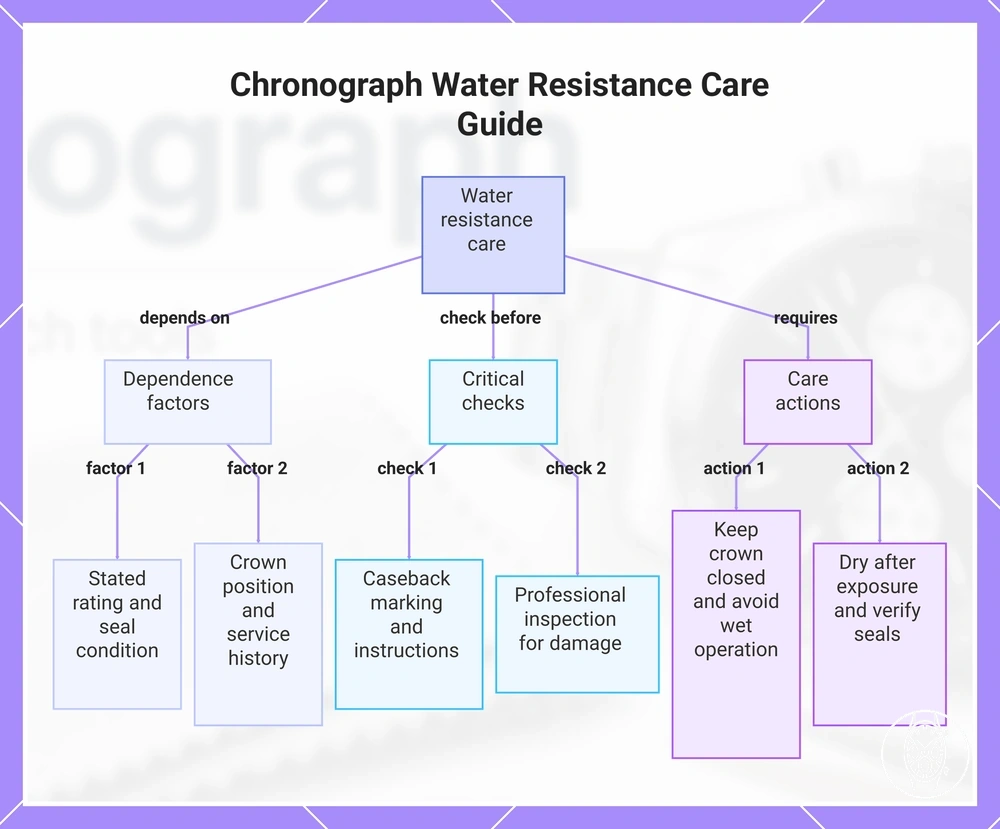
Water resistance depends on the stated rating, seals and gasket condition, crown position, pusher design, age, impact history, and service history. Seiko advises against washing a water-resistant watch with the crown pulled out and against operating the crown or buttons while the watch is wet; Citizen likewise instructs owners to keep applicable crowns fully secured and to avoid crown or button operation while wet. The caseback marking and manufacturer instructions should therefore be checked before cleaning with water; the water resistance guidance explains how rating and use conditions affect permitted exposure.
- Crown → closed condition → lower water-entry risk: Keep the crown in its normal closed position before permitted water exposure, and secure a screw-lock crown as designed. Citizen states that operating a wet crown can allow water to enter the watch.
- Pushers → wet operation → increased moisture risk: Do not press chronograph pushers while the watch is wet unless the specific manufacturer permits that action. Seiko's care guidance instructs users not to press watch buttons while a water-resistant watch is wet.
- Seals and gasket → ageing or impact → reduced water resistance: Treat seal condition as maintained rather than permanent. Seiko identifies gasket ageing and accidental deformation as conditions that can reduce water resistance.
- Caseback → rating identification → cleaning limit: Check the caseback marking and applicable instructions before introducing cleaning water. Seiko directs owners to the caseback indication to identify the watch's water-resistance category and permitted use conditions.
- Cleaning water → permitted method → moisture risk: Use water only when the manufacturer permits it for the watch's rating and present condition. Seiko advises avoiding direct running tap water during permitted washing because the cleaning method itself can impose conditions different from ordinary water exposure.
- Water exposure → retained moisture → drying requirement: After permitted exposure, dry the case, crown, pusher area, caseback, and strap or bracelet with a soft cloth. Seiko recommends removing moisture, sweat, and dirt from watch surfaces to limit deterioration around exterior components.
Moisture beneath the crystal, persistent fogging, suspected seal damage, caseback disturbance, or uncertainty after impact or service are conditions for professional inspection and pressure testing before further water exposure. Citizen advises professional inspection when water enters a watch or internal fogging persists, while Seiko recommends water-resistance checks because gasket ageing and accidental deformation can change seal integrity; the reviewed guidance does not establish one universal pressure-testing interval for every chronograph, so the applicable manufacturer or watchmaker service requirement should control that interval. Water resistance is a maintained condition, not a permanent waterproof property, so when the rating, gasket integrity, crown or pusher condition, caseback seal, or service history is uncertain, routine care should remain dry until water resistance has been verified.
This chart shows the key factors, checks, and actions for maintaining water resistance during routine chronograph care.
This chart shows the key factors, checks, and actions for maintaining water resistance during routine chronograph care.
Crowns, Pushers, Gaskets, and Water Exposure
The crown, pushers, and gaskets are seal points where water exposure requires specific precautions: keep a closed crown fully seated, secure a screw-down crown when the design uses one, and do not operate the crown or pushers while the chronograph watch is wet. Citizen specifies that applicable screw-lock crowns should be securely locked and that operating the crown or buttons while wet can allow water to enter the watch; Seiko states that gasket aging or deformation after accidental shock can reduce water resistance.
- Crown → closed position → seal protection: Keep the crown in its normal closed position during permitted water exposure. Citizen specifies a fully pushed-in crown and secure locking where a screw-lock mechanism is fitted; a pulled-out crown does not meet that closed-crown condition.
- Screw-down crown → secured state → moisture caution: If the chronograph has a screw-down crown, engage it as specified by its manufacturer before permitted moisture exposure. The locked position is an operating condition, not proof that the underlying gaskets or other seals remain watertight.
- Pushers → no wet operation → water-entry risk: Do not operate chronograph pushers during water exposure or while the watch remains wet unless the manufacturer explicitly specifies otherwise for that design. Citizen states that operating watch buttons while wet can allow water to enter the case, so exposure to splashes does not establish that pusher operation during submersion is permitted.
- Gaskets → aging or deformation → uncertain seal condition: Treat gasket aging and impact history as reasons for caution rather than relying on an exterior inspection. Seiko states that water resistance can deteriorate as gaskets age or watch parts become deformed by accidental shock; therefore, a visible inspection alone does not establish current seal integrity.
- Water exposure → permitted cleaning → complete drying: After permitted exposure, remove moisture from the watch with a soft cloth while keeping the crown closed and the pushers inactive. Seiko specifies fresh-water washing followed by thorough drying after permitted seawater exposure and advises using water held in a container rather than applying running tap water directly to the watch.
- Condensation or uncertain gaskets → stop water exposure → inspection: Stop further water exposure if condensation or droplets persist beneath the crystal, or if gasket condition is uncertain after aging, impact, or other suspected seal disturbance. Citizen advises inspection when water enters a watch or internal fogging persists, while Seiko identifies persistent condensation or droplets inside the watch as a condition requiring consultation rather than reliance on an exterior seal check.
Movement-Specific Maintenance for Quartz and Automatic Chronographs
Movement type changes the power and service needs of a chronograph: a quartz chronograph uses a battery, while an automatic chronograph uses a mechanically wound mainspring and requires winding plus movement lubrication during periodic service. Citizen instructs owners to replace an expired quartz battery promptly because leaving a depleted battery installed creates a leakage risk that can severely damage the watch, while Seiko states that mechanical movements require periodic cleaning and oiling because lubricant deteriorates with use.
Persistent accuracy symptoms, abnormal chronograph operation, leakage signs, or failure to run after the appropriate battery or winding check are decision signals for professional service.
Both movement types share routine exterior care for the case, crown, pushers, seals, and strap, but their internal maintenance risks differ; the chronograph movement types comparison clarifies those power-system differences. Seiko recommends mechanical-watch examination, cleaning, and oiling about every 3 years for its watches, while noting that service frequency is affected by usage conditions; quartz battery life is movement-specific, so no single replacement interval is established by the reviewed manufacturer guidance. Persistent accuracy symptoms, abnormal chronograph operation, leakage signs, or failure to run after the appropriate battery or winding check are decision signals for professional service.
| Movement type | Routine care focus | Risk signal | When to seek service |
|---|---|---|---|
| Quartz chronograph | Monitor battery-powered operation and arrange battery replacement when the movement indicates depletion or stops because of an expired battery. Citizen specifies prompt replacement of an expired battery; when the case is opened, the watch's seals and water-resistance condition also require appropriate service attention. | A depleted battery left installed creates a leakage risk. Citizen states that leakage from an expired battery can severely damage the watch; continued abnormal timing or chronograph operation after installation of the correct fresh battery points beyond routine battery maintenance. | Seek watchmaker service when leakage is suspected, a correct fresh battery does not restore normal running, accuracy symptoms persist, or the chronograph module operates abnormally. These conditions require diagnosis rather than repeated battery replacement. |
| Automatic chronograph | Maintain adequate winding through normal wear or the manufacturer's permitted manual-winding method, and follow the specified schedule for cleaning, lubrication, inspection, and regulation. Seiko recommends examination, cleaning, and oiling about every 3 years for its mechanical watches, while stating that actual service frequency is affected by usage conditions. | Stopping despite adequate winding, persistent accuracy symptoms, reduced running duration after a full wind, abnormal winding feel, or irregular chronograph operation can indicate a service-related condition. Seiko states that deteriorated lubricant can cause a mechanical watch to lose time or stop. | Seek watchmaker service when normal winding and usage habits do not restore expected operation or when accuracy, running duration, winding, or chronograph functions remain abnormal. Lubrication, regulation, worn-component inspection, and chronograph-module work are watchmaker-level service tasks. |
Quartz Chronograph Battery Replacement and Leakage Risk
A quartz chronograph battery should be replaced promptly when it reaches end of life because delayed battery replacement creates a leakage risk that can damage the movement. Citizen specifies that a depleted non-rechargeable battery should be replaced as soon as possible because leaving it in the watch can cause leakage and severe damage; stopped hands, abnormal chronograph functions, or the model's documented weak battery indication are therefore signals to arrange battery replacement rather than continue using or storing the watch with the failed cell.
Battery replacement also affects seal integrity because case opening can disturb the original water-resistant sealing condition.
Battery replacement also affects seal integrity because case opening can disturb the original water-resistant sealing condition. Citizen does not recommend owner battery replacement because removing the caseback can admit dust and cause incomplete water sealing, while Seiko specifies water-resistance testing after battery replacement for applicable water-resistant watches. The reviewed manufacturer guidance does not establish one battery-life interval for every quartz chronograph, so replacement timing should follow the specific movement's battery-life indication or manufacturer instructions.
- Weak battery → service signal: Treat stopped hands, abnormal chronograph functions, or a manufacturer-documented low-battery indication as a reason to arrange battery replacement. For example, Seiko documents one movement whose end-of-life warning indicates that the watch may stop within 2 to 3 days; that value is specific to the referenced Seiko movement and is not a universal quartz chronograph threshold.
- Expired battery → leakage risk: Do not leave a depleted battery installed after its service life has ended. Citizen states that an expired battery left inside the watch can leak and severely damage the watch, making prompt replacement the relevant maintenance condition.
- Case opening → seal integrity risk: Battery replacement requires access through the caseback, and the previous water-sealing condition cannot simply be assumed afterward. Citizen states that caseback removal during owner battery replacement can permit dust intrusion and incomplete water sealing.
- Battery replacement → water-resistance testing: After replacement, use the water-resistance testing specified for the particular watch when its manufacturer requires it. Seiko states that opening and reclosing the caseback can reduce the watch's original water-resistant quality and instructs owners to request an appropriate water-resistance test after battery replacement.
- Fresh battery → continued failure → inspection: If installation of the correct fresh battery does not restore normal running or chronograph operation, treat the condition as more than routine battery maintenance. Seiko states for applicable battery-powered models that a watch stopping soon after a new battery is fitted requires further service rather than another routine battery change.
- Leakage or uncertain sealing → professional-service boundary: Suspected electrolyte leakage, corrosion around the battery area, abnormal functions after replacement, or uncertain seal integrity after case opening requires professional inspection. These conditions involve movement damage or water-resistance verification rather than routine owner battery care.
Automatic Chronograph Winding and Service Needs
An automatic chronograph needs sufficient winding for consistent running and periodic professional service for lubrication, inspection, and movement wear. Wearing frequency affects stored power, while manual winding should follow the specific movement's instructions; Seiko states that a mechanical watch is more stable when its mainspring is sufficiently wound and recommends periodic examination, cleaning, and oiling because lubricant deteriorates with use.
An automatic chronograph needs sufficient winding for consistent running and periodic professional service for lubrication, inspection, and movement wear.
Power reserve and accuracy changes are maintenance signals only when they are compared with the specification and normal behaviour of the particular automatic chronograph. For example, Longines specifies a power reserve of up to 59 hours for the Conquest Chronograph L3.835.4.32.6 and up to 66 hours for the Spirit Chronograph L3.820.4.53.0, showing why a generic power-reserve threshold should not be applied across movements; persistent shortening of the documented reserve, unexpected stopping, or sustained accuracy changes after adequate winding support professional inspection.
- Wearing frequency → winding consistency: Regular wrist movement replenishes the mainspring of a self-winding movement, while infrequent wear can leave less stored energy. Seiko recommends wearing applicable mechanical watches for more than 8 hours per day when seeking a sufficiently wound state for stable accuracy; that duration is Seiko guidance rather than a universal automatic-chronograph requirement.
- Manual winding → movement-specific care: If the automatic chronograph permits manual winding, wind it according to its manufacturer instructions and stop if the crown develops abnormal resistance. Seiko recommends winding a mechanical watch sufficiently before wear because reduced mainspring energy can make accuracy more susceptible to operating conditions, but the reviewed evidence does not establish one winding-turn count for every automatic chronograph.
- Lubrication → periodic service: Lubrication is an internal service need rather than owner maintenance. Seiko states that movement oil deteriorates after years of use and can contribute to time loss or stopping; Seiko recommends service about every 3 years for its watches while also stating that climate and usage conditions affect actual service timing, so this is not a fixed service interval for every automatic chronograph.
- Shock → accuracy or movement risk: Avoid strong impacts and dropping the watch. Seiko states that strong shock can affect mechanical-watch accuracy and that dropping the watch can cause damage, so a new accuracy change, abnormal winding feel, or chronograph-mechanism symptom after impact is a reason for inspection.
- Chronograph mechanism → abnormal function: Treat persistent failure of the chronograph mechanism to start, stop, reset, or operate normally as a watchmaker-level symptom rather than something owner winding can correct. The reviewed manufacturer evidence does not provide one universal diagnostic threshold for chronograph-module faults, so the applicable movement's service documentation should control diagnosis.
- Power reserve or accuracy changes → conditional service: Compare running duration and timekeeping with the watch's own specification and established normal behaviour. If adequate winding and normal usage habits no longer produce the documented power reserve, the watch stops unexpectedly, accuracy changes persist, or chronograph functions remain abnormal, professional service is appropriate because user-level care cannot establish or correct internal lubrication, wear, or chronograph-mechanism condition.
Service Intervals and Signs a Chronograph Needs Attention
Chronograph service intervals should be based on movement type, use, water exposure, age, service history, and warning signs rather than one universal schedule. Seiko recommends examination, cleaning, and oiling about every 3 years for its mechanical watches but states that climate and usage conditions affect actual service timing, so symptoms such as stopped movement, recurring moisture, abnormal controls, or persistent accuracy changes can justify inspection before that manufacturer-specific interval.
Chronograph service intervals should be based on movement type, use, water exposure, age, service history, and warning signs rather than one universal schedule.
Monitor-at-home signs are conditions that can first be compared with the watch's own documented behaviour, such as a weak battery indication, normal power reserve, or stated timing tolerance. Stop using the relevant function or stop water exposure when condensation persists, recurring moisture appears, pushers remain stiff after gentle exterior cleaning, or structural strap or bracelet damage threatens secure attachment; Seiko states that persistent condensation or water droplets require consultation, while Citizen documents that battery and chronograph-hand symptoms can have movement-specific causes rather than one certain diagnosis.
| Symptom | Likely area to check | What it may indicate | Suggested response |
|---|---|---|---|
| Stopped movement | Battery condition or stored mechanical power | For a quartz chronograph, a depleted battery is one possible cause; for an automatic chronograph, insufficient winding or a service-related movement condition can produce the same visible sign. Citizen instructs owners to replace an expired non-rechargeable battery promptly, while Seiko states that deteriorated lubrication can contribute to a mechanical watch losing time or stopping. | Check the model's documented battery or winding condition first. If the watch remains stopped after the appropriate routine check, arrange inspection rather than assuming the internal cause. |
| Weak battery indication | Quartz battery and model-specific warning system | A weak battery warning can precede complete stoppage, but the display and remaining operating time are movement-specific. Seiko, for example, documents a 2-to-3-day remaining period after the end-of-life indication on one specified movement; that value is not a universal quartz chronograph threshold. | Confirm the warning in the model instructions and arrange battery replacement. Citizen warns that leaving an expired battery installed can result in leakage and severe watch damage. |
| Condensation or recurring moisture | Gaskets, crown, pushers, crystal, and caseback seals | Persistent condensation or droplets may indicate moisture ingress or deteriorated water resistance. Seiko states that gasket aging or deformation can reduce water resistance and advises consultation when condensation or water droplets remain inside the watch. | Stop further water exposure and arrange inspection. Recurring moisture is a service signal rather than a condition to continue monitoring during wet use. |
| Stiff pushers | Pusher area, exterior residue, seals, or chronograph controls | Stiffness may result from accumulated residue or a mechanical condition that routine exterior care cannot diagnose. Citizen states that foreign matter around buttons can restrict their operation. | Remove only accessible exterior residue with gentle cleaning. If stiffness remains, stop forcing the pusher and arrange inspection. |
| Inaccurate timing | Movement, winding state, battery condition, shock history, or regulation | Mechanical accuracy changes can reflect winding state, temperature, position, arm movement, or shock rather than one specific fault. Seiko states that mechanical accuracy should be assessed against the movement's stated specification and over actual wearing conditions rather than from a single day's result. | Compare performance with the manufacturer's stated accuracy specification under normal use. Persistent deviation outside that specification warrants service inspection. |
| Misaligned chronograph hands | Chronograph zero or reference position | Misaligned hands can result from a reference-position shift without proving internal damage. Citizen provides movement-specific reference-position correction for applicable chronographs and notes that strong impact can shift chronograph-hand position on certain models. | Use only the authorised correction described for the specific movement. If the hands remain misaligned or chronograph operation is abnormal afterward, arrange service. |
| Unusual noise | Movement or chronograph mechanism | A new grinding, scraping, or persistent rattling sound is an abnormal operating sign, but sound alone does not identify the failed component. The reviewed manufacturer evidence does not establish one universal noise threshold or diagnosis for chronographs. | Stop repeatedly operating the chronograph mechanism if the noise accompanies abnormal function, timing, or winding, and arrange professional inspection. |
| Poor power reserve | Winding state, automatic winding system, lubrication, or movement condition | A mechanical chronograph that runs materially less than its own documented power reserve despite adequate winding has a service signal, but there is no universal reserve threshold for all models. Longines, for example, specifies up to 59 hours for the Conquest Chronograph L3.835.4.32.6 and up to 66 hours for the Spirit Chronograph L3.820.4.53.0, illustrating why the model's own specification must be the comparison value. | Confirm adequate winding and normal wearing habits first. If running duration remains below the watch's documented reserve under comparable conditions, arrange inspection. |
| Strap or bracelet failure | Strap material, clasp, spring bars, bracelet pins, or links | Cracking, tearing, severe corrosion, protruding pins, or a clasp that no longer secures normally can compromise attachment. Seiko states that corroded bracelet pins can protrude or fall out and advises stopping wear when this occurs. | Stop wearing the watch until the attachment is repaired or replaced. Structural attachment failure requires action rather than observation. |
Service timing should therefore move from observation to inspection when a symptom persists after the appropriate routine check, when moisture is recurring, or when structural or control damage is present. For symptom-specific diagnostic context beyond routine maintenance, see chronograph problems and fixes; the watch manufacturer's service guidance should still determine the qualified service recommendation for the particular movement and condition.
Storage and Daily Habits That Reduce Wear
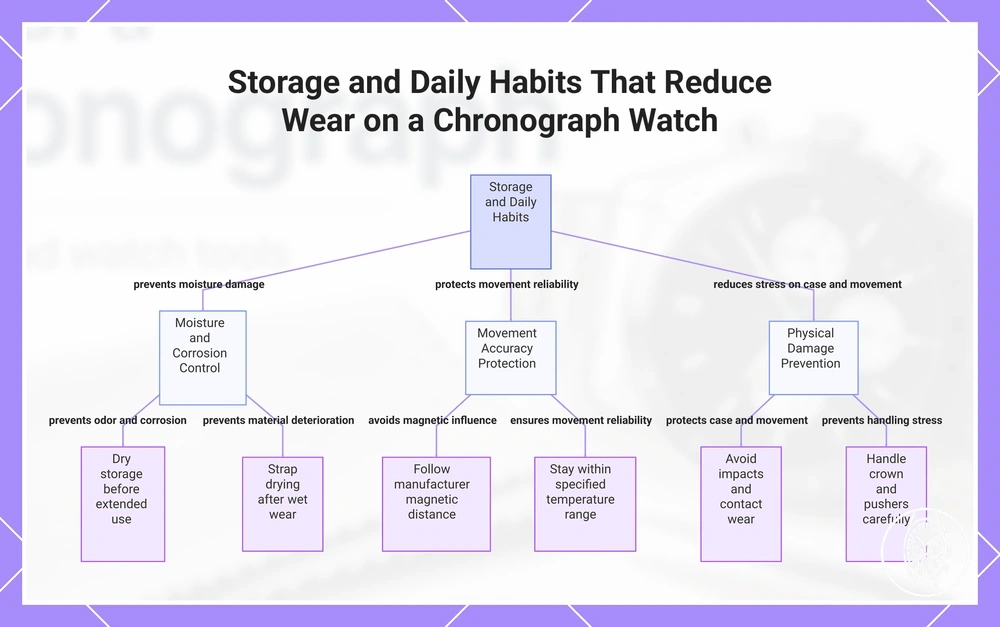
Storage and daily habits reduce avoidable wear on a men's chronograph watch when they keep the watch dry, limit exposure to damaging conditions, and reduce unnecessary stress on the case, crystal, strap, crown, pushers, and movement. Citizen instructs owners to remove perspiration, dirt, and moisture before extended storage and to avoid excessive heat, cold, and high humidity; these habits reduce exposure-related risks but do not replace movement maintenance or inspection.
Condition-dependent habits matter after daily wear, sport, travel, and before long-term storage: complete strap drying, protect the case from impacts, and follow the movement manufacturer's limits for magnetic fields and temperature extremes. For example, Citizen specifies an operating temperature of +8 °C to +38 °C for its Calibre 0200 and advises keeping that mechanical watch at least 5 cm from strongly magnetic devices, while Seiko advises avoiding temperatures below 5 °C or above 35 °C in its mechanical-watch accuracy guidance; these values apply to their stated movements or guidance and do not establish one universal storage range for every chronograph.
- Dry storage → moisture, odor, and corrosion risk: Remove perspiration and water before storage, especially before leaving the watch unused for an extended period. Citizen instructs owners to wipe away perspiration, dirt, and moisture before extended storage and to avoid high-humidity locations; after wet daily wear, storage should therefore begin only after the watch and strap are dry.
- Magnetic fields → movement accuracy: Keep a magnetism-sensitive movement away from strong magnetic sources according to its manufacturer's stated distance. Citizen specifies at least 5 cm separation from strongly magnetic devices for Calibre 0200, while Seiko identifies objects including mobile phones, speakers, and magnetic clasps as possible sources of magnetic influence on mechanical-watch accuracy.
- Temperature extremes → movement reliability: Keep the watch within the temperature conditions specified for its movement rather than applying one generic limit to every chronograph. Citizen specifies +8 °C to +38 °C for Calibre 0200, whereas Seiko advises avoiding conditions below 5 °C or above 35 °C in its mechanical-watch guidance; the model-specific documentation should therefore control storage and use limits.
- Impacts → case, crystal, and movement risk: Reduce drops, hard knocks, and repeated shock during daily wear, sport, travel, and storage. Citizen states that strong or continuous shock can affect mechanical-watch accuracy and damage movement components, while Seiko advises removing a mechanical watch for sports involving strong impacts; a protected position during travel also reduces direct contact between the case or crystal and hard objects.
- Crown and pushers → handling stress: Keep the crown in its normal secured position during ordinary wear and avoid forcing the crown or pushers when resistance is abnormal. Citizen also advises periodically operating applicable crowns and buttons to prevent accumulated foreign matter from restricting their movement; after moisture exposure, leave the controls inactive until the exterior is dry.
- Strap drying → material deterioration: Dry a damp strap completely before storage. Citizen specifies blotting moisture from leather with a soft dry cloth and drying wet fabric materials thoroughly in a shaded, well-ventilated location; this reduces prolonged moisture exposure associated with odor, discoloration, deterioration, and corrosion around attached metal components.
- Case protection and long-term storage → contact wear: Keep the chronograph separated from hard objects during travel or long-term storage so the case, crystal, crown, and projecting pushers are not subjected to repeated rubbing or pressure. This is a contact-wear precaution rather than a guarantee against scratches, impacts, seal aging, or internal mechanical deterioration.
- Service records → inspection history: Record the battery replacement date where applicable, movement service, water-resistance test, significant impact, and notable water exposure. These service records preserve the watch's maintenance history during long-term storage and give a watchmaker concrete dates and exposure events to review when the next manufacturer-specified inspection or service is considered.
This chart shows the key storage and daily habits that reduce avoidable wear on a men's chronograph watch, grouped by moisture control, movement protection, and physical damage prevention.
When Chronograph Maintenance Needs a Watchmaker
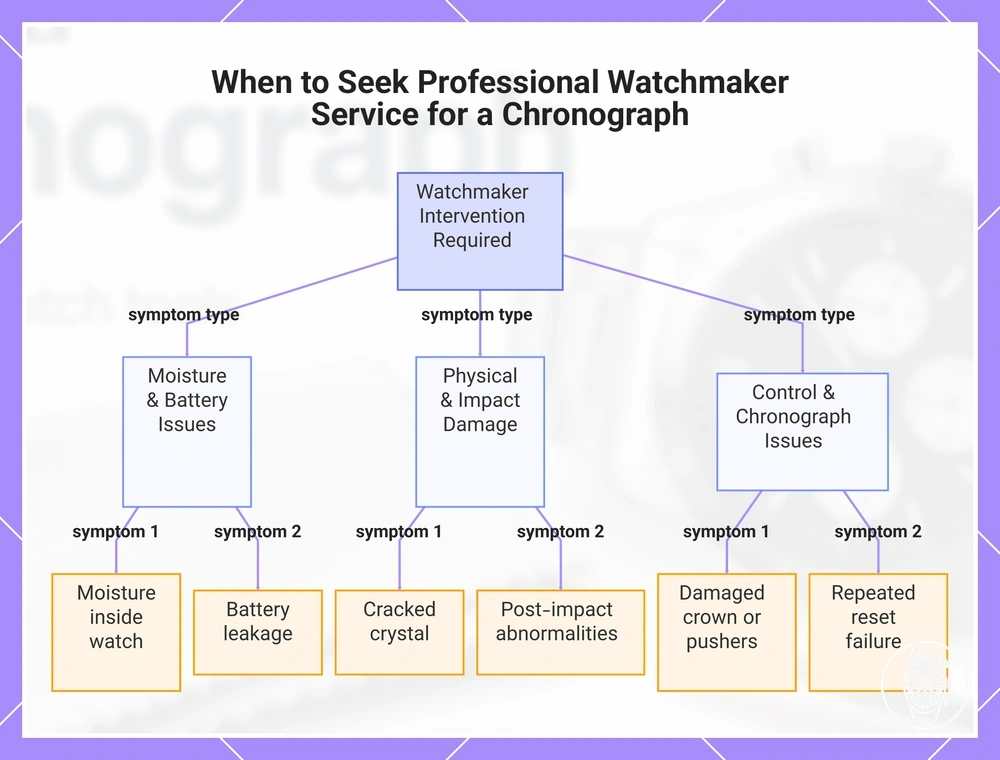
A men's chronograph watch needs a watchmaker or professional service when maintenance reaches an internal symptom, moisture problem, damaged control, structural defect, or persistent chronograph failure that external owner care cannot verify or correct. Moisture inside the watch, battery leakage, a cracked crystal, or abnormalities after a severe impact should stop routine maintenance immediately; a damaged crown, damaged pushers, repeated reset failure, chronograph hands that do not return correctly, stripped threads, gasket uncertainty, or movement irregularity also require professional inspection when the model's documented external operating checks do not resolve the condition.
Safe owner care remains limited to external cleaning, drying, normal winding or battery-condition observation, and only the operating or reference-position checks documented for the specific movement.
Safe owner care remains limited to external cleaning, drying, normal winding or battery-condition observation, and only the operating or reference-position checks documented for the specific movement. Citizen states that persistent internal fogging or water entry requires inspection or repair, while Seiko states that persistent condensation or water droplets indicate deteriorated water resistance and require consultation; seal assessment, internal adjustment, chronograph calibration beyond documented controls, and water-resistance pressure testing therefore belong with qualified service rather than owner maintenance.
- Moisture inside the watch → stop water exposure: Persistent fogging, condensation, or visible droplets beneath the crystal require professional inspection. Citizen advises inspection or repair when water enters a watch or internal fogging persists, while Seiko identifies persistent condensation or droplets as a sign that water resistance requires professional attention.
- Damaged crown or pushers → seal and control uncertainty: A bent, loose, broken, non-securing, or abnormally operating crown or pusher needs inspection because exterior care cannot establish the condition of the control mechanism or surrounding seals. Citizen states that operation of the crown or buttons while wet can allow water into the watch, so damaged controls should remain out of further moisture exposure until assessed.
- Battery leakage → internal quartz-movement risk: Suspected electrolyte leakage, corrosion, or residue around a battery-powered movement requires professional service. Citizen warns that leaving an expired battery installed can result in leakage and severe watch damage, so leakage is an internal-damage condition rather than a routine battery-maintenance issue.
- Repeated reset failure → chronograph inspection: If the chronograph repeatedly fails to reset after the exact operating procedure documented for its movement, stop repeated attempts and arrange inspection. Citizen's H50 guidance specifies that a normal reset returns the chronograph minute and second hands to 0 minutes and 0 seconds; continued failure after that model-specific check exceeds routine operation.
- Chronograph hands not returning correctly → calibration boundary: A displaced hand does not by itself prove internal damage because certain Citizen movements provide documented reference-position correction, and Citizen notes that strong shock can move chronograph hands away from their reference position on applicable models. If the hand remains misaligned after the authorised correction for that movement, a watchmaker should assess the chronograph mechanism or calibration.
- Cracked crystal → stop normal wear and moisture exposure: A cracked, chipped, or structurally damaged crystal requires professional inspection because the reviewed manufacturer evidence provides no crack size or depth at which original seal integrity can be assumed. Treat any visible crack as unresolved structural damage until the case and crystal condition are assessed.
- Severe impact → inspect new abnormalities: A severe impact followed by hand displacement, inaccurate timing, movement irregularity, damaged controls, or case or crystal damage requires professional inspection. Citizen documents that strong shock can displace chronograph hands on applicable movements, so a new post-impact fault should not be addressed by repeated forcing or undocumented adjustment.
- Stripped threads or gasket uncertainty → seal-service boundary: Crown or case threads that no longer engage normally, or gasket uncertainty after damage, age, or prior case disturbance, require a watchmaker before further water exposure. The reviewed manufacturer guidance provides no universal visual check or owner-applied pressure value that confirms gasket integrity across all chronographs, so model-appropriate professional pressure testing is the relevant verification method.
- Movement irregularity → professional diagnosis: Persistent stopping, abnormal hand movement, unusual mechanical behaviour, or chronograph operation that remains incorrect after the movement's documented battery, winding, or operating check requires professional service. At that point, inspection protects seals, movement parts, and chronograph calibration without extending owner care into internal repair.
This chart shows the main symptoms and conditions that indicate a chronograph watch needs professional service rather than owner maintenance.