Men's Chronograph Watch Size and Wrist Fit
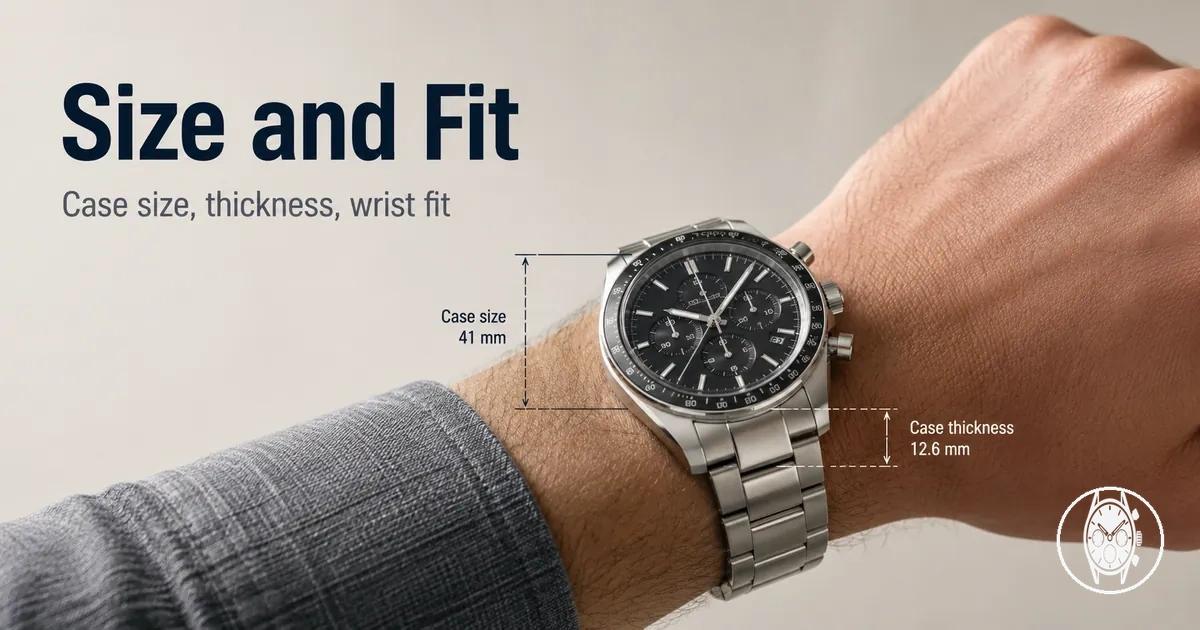
A men's chronograph watch achieves wrist fit through the combined proportion of wrist size, case diameter, case thickness, lug-to-lug length, dial layout, strap fit and personal preference rather than through one universal case-size value. Happy Jewelers' watch-sizing guide separates case diameter, case thickness, lug-to-lug distance, pushers and strap construction as distinct fit variables, and its wrist-size chart places a 7-inch wrist in a 38–40 mm case range while treating the chart as a starting point rather than a universal rule. Case diameter therefore provides a measurable reference, but it remains only one input in the overall fit decision.
Case diameter therefore provides a measurable reference, but it remains only one input in the overall fit decision.
On the same wrist size, greater case thickness raises the watch farther above the wrist, while a longer lug-to-lug length increases wrist coverage and can increase overhang risk; strap behavior and wrist shape then affect how closely the watch follows the wrist. Happy Jewelers reports that most everyday watches in its sizing guide fall between 8 mm and 14 mm in case thickness and notes that chronograph pushers can make a case feel larger than its nominal diameter; its example states that a 40 mm watch with substantial pushers can feel closer to a 42 mm watch on the wrist. Dial layout and subdials can further increase perceived size and visual density, so comfort and visual balance should be judged from the complete case geometry rather than the diameter alone.
For the broader decision context around chronograph features and selection criteria, use the men's chronograph watch guide .
Read the sizing guidance that follows as qualified fit decision support: compare any case-size range with lug-to-lug length, case thickness, wrist shape, strap fit and the level of wrist presence that remains comfortable for the intended wearing context. For the broader decision context around chronograph features and selection criteria, use the men's chronograph watch guide.
Table of Contents
Chronograph Size Factors That Change Wrist Fit
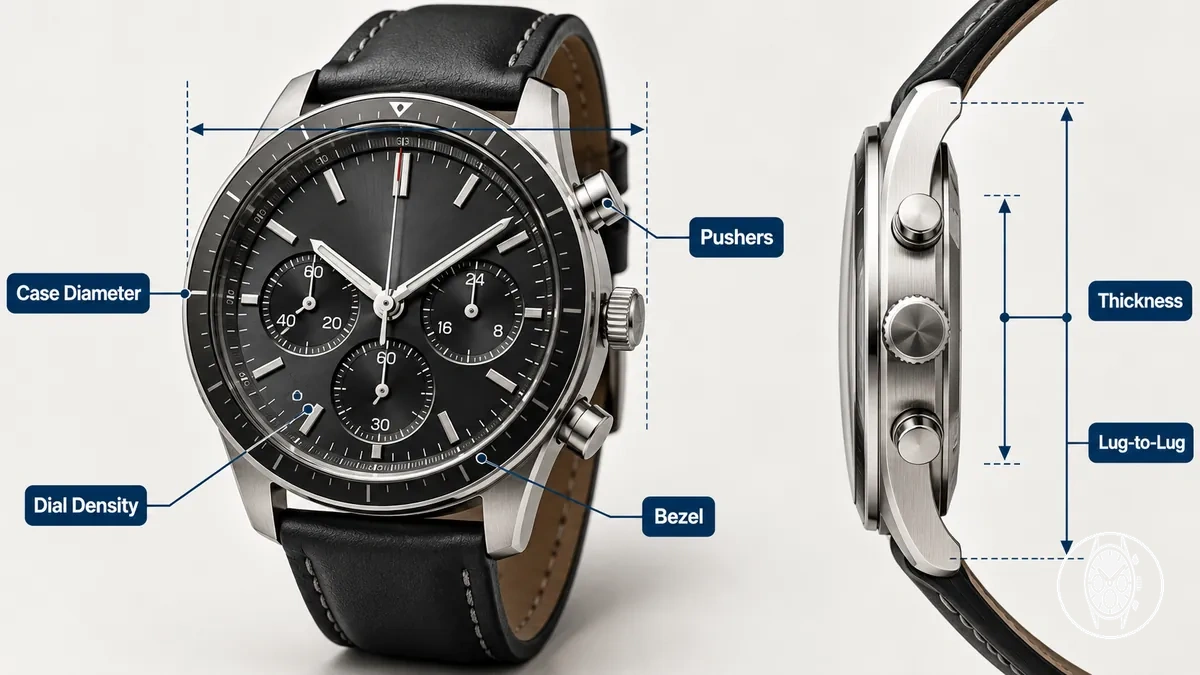
Chronograph size factors shape wrist fit through two groups of attributes: measured dimensions and perceived-size signals. The measured dimensions are case diameter, thickness and lug-to-lug length, while pushers, bezel shape and dial density modify wrist presence and visual balance without replacing those measurements. OMEGA describes case diameter as case width excluding the crown and pushers, lug-to-lug as the length from the upper to lower lugs, and thickness as the distance from the case base to the top of the crystal. The component set that should therefore inform wrist comfort and the fit decision is case diameter, thickness, lug-to-lug length, pusher profile, bezel shape and dial density.
Chronograph size factors shape wrist fit through two groups of attributes: measured dimensions and perceived-size signals.
Relying only on case diameter can misrepresent how much space a chronograph occupies because watches with nearly equal diameters can differ measurably in height and wrist coverage. Seiko specifies the SSB429 at 41.5 mm in diameter, 12.1 mm thick and 46.5 mm lug-to-lug, while the Prospex SRQ053 measures 42.0 mm in diameter, 14.6 mm thick and 49.5 mm lug-to-lug; calculated from those manufacturer-stated specifications, a 0.5 mm diameter difference accompanies a 2.5 mm thickness difference and a 3.0 mm lug-to-lug difference. Under that comparison, the SRQ053 occupies more vertical and longitudinal space despite the similar case diameter, illustrating why thickness and lug-to-lug should remain separate fit criteria rather than being inferred from diameter. The table separates these measured dimensions from the pusher, bezel and dial-density signals that can change perceived size.
| Size factor | What it changes | Fit effect | Decision caution |
|---|---|---|---|
| Case diameter | Case width; OMEGA's measurement excludes the crown and pushers. | Changes the horizontal footprint and wrist presence, affecting visual balance. | Interpret diameter with thickness and lug-to-lug rather than treating width as universally decisive. |
| Thickness | Case height from the base to the top of the crystal under OMEGA's measurement description. | More thickness places more case height above the wrist, which can affect wrist comfort and sleeve clearance. | Check the model-specific measurement: Seiko specifies 12.1 mm for the SSB429 and 14.6 mm for the SRQ053. |
| Lug-to-lug length | Longitudinal case span from the upper to lower lugs. | A longer span increases wrist coverage; whether it produces overhang depends on the watch's span relative to the wearer's usable wrist width. | Do not infer it from diameter: Seiko specifies 46.5 mm for the SSB429 and 49.5 mm for the SRQ053. |
| Pusher profile | Adds projections beside the case body; OMEGA's case-diameter measurement excludes pushers. | Changes the chronograph's side profile and can add perceived width beyond the stated case diameter. | The reviewed manufacturer evidence provides no universal numerical conversion between pusher projection and wrist comfort; assess the specific case profile separately. |
| Bezel shape | Changes the visible proportion between the dial opening and surrounding case surface. | A broader visible bezel increases the case surface surrounding the dial, while a narrower visible bezel gives the dial a greater share of the face. | The reviewed manufacturer evidence provides no standard numerical conversion from bezel proportion to perceived size; treat the bezel as a visual signal, not a substitute for physical dimensions. |
| Dial density | Changes the concentration of visible subdials, scales, markers and other dial elements. | Changes visual complexity and therefore the perceived size or visual weight of the chronograph without changing its measured case dimensions. | The reviewed manufacturer evidence specifies no standard numerical dial-density threshold for wrist comfort; use dial density as a perceived-size signal after evaluating the measured dimensions. |
Case Diameter and Wrist Presence
Case diameter changes the visible footprint and wrist presence of a chronograph case: a smaller diameter creates a more compact appearance, a mid-size diameter creates an intermediate footprint, and a larger diameter creates a bolder wrist appearance. As broad examples rather than fit rules, Longines groups case diameters into 32–36 mm, 36–42 mm, and 42–46 mm bands as case size increases. These ranges describe diameter impressions, not guaranteed visual balance on an individual wrist. Overall wear size can still change with the chronograph's thickness and lugs, even when case diameter is similar.
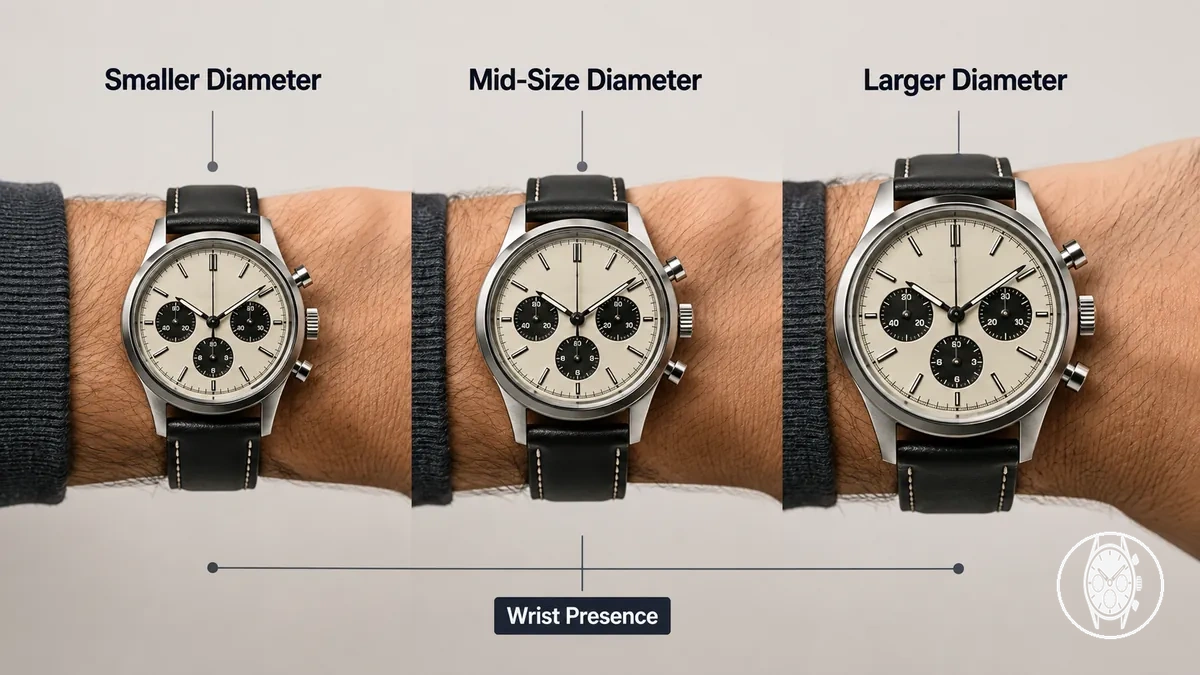
- Smaller diameter: The broad 32–36 mm Longines reference band represents a smaller diameter and a more compact visible footprint, with lower overhang risk only when the case's lugs and thickness also remain proportionate to the wrist.
- Mid-size diameter: The broad 36–42 mm Longines reference band represents a mid-size diameter and an intermediate level of wrist presence; whether it looks visually balanced remains conditional on the complete chronograph case geometry.
- Larger diameter: The broad 42–46 mm Longines reference band represents a larger diameter and a bolder visible footprint, while possible bulk depends on thickness, lugs, and wrist shape rather than diameter alone.
Case Thickness and Wearing Comfort
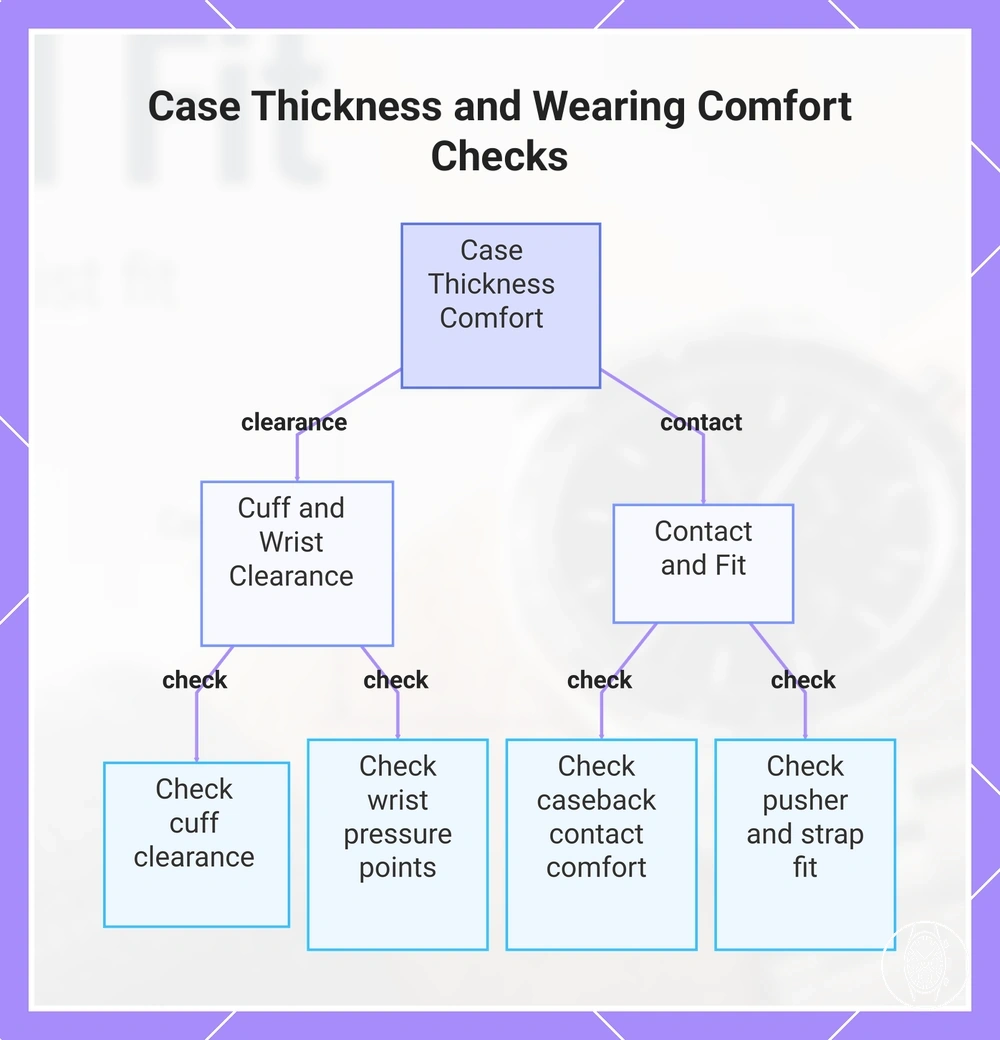
Case thickness changes a chronograph's wrist height and sleeve clearance: greater case depth places more of the watch above the wrist, which can increase the feeling of bulk, while a slim chronograph has a lower vertical profile. There is no universal case-thickness threshold that establishes wearing comfort, because caseback shape, wrist shape, strap angle and pusher position change how that height and pressure are experienced. Seiko specifies the Prospex Speedtimer SSC961 at 13.3 mm thick and the Prospex Speedtimer SRQ053 at 14.6 mm thick; calculated from these manufacturer-stated specifications, the SRQ053 has 1.3 mm more case thickness, illustrating a measurable difference in wrist height without establishing that either model is inherently more comfortable. Use the following checks to assess how a slim chronograph or thick chronograph actually sits during intended wear.
- Sleeve clearance: With the intended cuff, check whether the chronograph passes underneath without catching; greater case thickness reduces the available vertical clearance when the sleeve opening remains unchanged.
- Wrist pressure: During normal wrist movement, check for concentrated pressure rather than relying on a universal millimetre limit; no general thickness-to-pressure threshold is established by the cited manufacturer specifications.
- Caseback feel: Check whether the caseback shape distributes contact comfortably or creates a concentrated contact point, because the same overall case thickness can place the underside of the watch differently against the wrist.
- Pusher contact: Flex the wrist through its normal range and check whether the pushers contact the hand or wrist; this outcome is conditional on pusher position, case position and wrist movement rather than thickness alone.
- Strap angle: Check whether the strap follows the wrist without forcing the case edge or caseback into a pressure point; strap geometry changes how the chronograph's vertical bulk is supported.
Sleeve clearance and caseback shape therefore qualify the relationship between case thickness and wearing comfort: a low-profile case provides more vertical cuff clearance under the same sleeve opening, while a higher case places more watch height in that space. Neither a slim chronograph nor a thick chronograph has a universal comfort advantage; the practical wearability outcome is whether its wrist height, caseback contact, pressure points, pusher position and strap angle remain comfortable under the wearer's actual cuff and wrist conditions.
This chart shows the key checks to assess how case thickness affects chronograph wearing comfort, based on sleeve clearance, wrist pressure, caseback feel, pusher contact, and strap angle.
This chart shows the key checks to assess how case thickness affects chronograph wearing comfort, based on sleeve clearance, wrist pressure, caseback feel, pusher contact, and strap angle.
Lug-to-Lug Length and Wrist Coverage
Lug-to-lug length controls how far a watch case spans the wrist, so it directly affects wrist coverage and overhang risk. Time+Tide defines lug-to-lug length as the distance between the outermost ends of the lugs and reports a Jaeger-LeCoultre Reverso Tribute Chronograph measuring 29.9 mm across the case but 49.4 mm lug-to-lug, demonstrating that case width alone does not describe wrist span. No universal millimetre threshold guarantees a secure fit because the outcome also depends on usable wrist width, case shape and strap angle. When the lug span remains within the supporting wrist surface, the strap has more opportunity to drop downward from the lugs; as the span approaches or passes the wrist edges, strap drop becomes less favourable and overhang risk increases.
- Flush fit: When the lug-to-lug length remains inside the usable wrist width, the lugs stay supported by the wrist and the strap angle can turn downward from the watch case, supporting secure wrist coverage.
- Borderline fit: When lug-to-lug length approaches the usable wrist width, case coverage reaches close to the wrist edges; whether the watch remains comfortable then depends more strongly on case shape, lug curvature and strap drop.
- Overhang risk: When the lug span extends beyond the usable wrist width, one or both lug ends can project beyond the supporting wrist surface, increasing overhang risk and reducing the strap's ability to drop naturally around the wrist.
Measuring Wrist Size for a Chronograph Watch
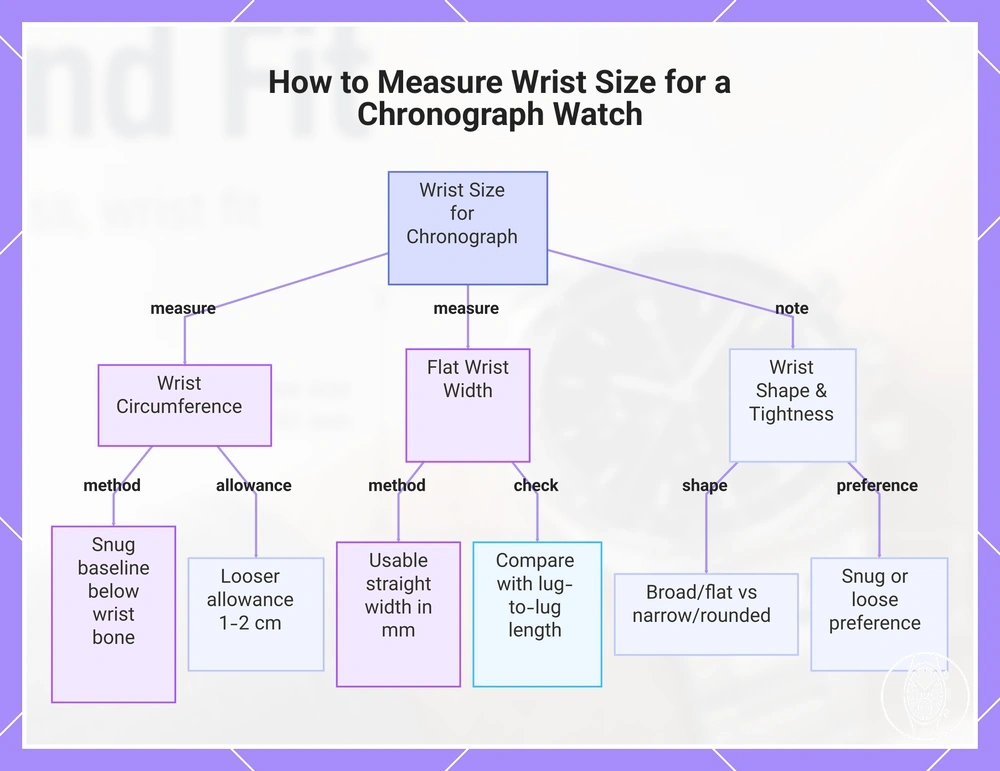
Measure wrist size for chronograph case-size selection by recording wrist circumference, flat wrist width, wrist shape and preferred tightness; these measurements provide a fit starting point rather than a fixed case-size result. Daniel Wellington instructs users to measure wrist circumference by wrapping a measuring tape around the wrist just below the wrist bone and states that adding 1–2 cm provides a looser fit allowance. Keep the snug wrist circumference as the baseline measurement and record preferred tightness separately, because circumference alone does not establish how the watch case will cover the wrist. Use the following steps to compare the wrist measurement with the chronograph's case geometry and comfort risk.
- Measure wrist circumference. Wrap a flexible measuring tape snugly around the wrist just below the wrist bone and record the circumference in millimetres or centimetres.
- Check flat wrist width. Measure the usable straight width across the top of the wrist in millimetres; comparing this width with lug-to-lug length helps identify how much of the supporting wrist surface the watch case would occupy.
- Note wrist shape. Record whether the top of the wrist is relatively broad and flat or narrower and rounded, because wrist shape changes the usable supporting width available to the case and strap fit.
- Choose preferred tightness. Record a snug or loose preference separately from wrist circumference; Daniel Wellington uses an additional 1–2 cm as its stated loose-fit allowance, but this is a strap-fit reference rather than a universal chronograph case-size rule.
- Compare against case dimensions. Use wrist circumference as the measurement starting point, then compare flat wrist width with lug-to-lug length and consider case thickness and strap angle when assessing likely case range, overhang and wearing comfort.
For example, suppose two wrists each have an illustrative 180 mm circumference, but their flat wrist widths are 60 mm and 50 mm; with a hypothetical 52 mm lug-to-lug chronograph, the case span equals approximately 87% and 104% of those respective widths. These percentages are calculated illustrations, not sourced fit thresholds, and show why the same wrist circumference can produce different wrist coverage and overhang risk when wrist shape changes flat wrist width. Use circumference and flat wrist width together as fit measurements, then check the actual case geometry and preferred tightness before judging likely comfort.
This chart shows the key wrist measurements needed to assess chronograph case fit, including circumference, flat width, shape, and tightness preference.
This chart shows the key wrist measurements needed to assess chronograph case fit, including circumference, flat width, shape, and tightness preference.
Matching Chronograph Case Size to Wrist Size
Match chronograph case size to wrist size by using case diameter as a starting range, then validating lug-to-lug tolerance, case thickness and dial presence against wrist width and personal preference. Longines currently groups wrists below 16 cm with a 32–36 mm case-diameter range, wrists of about 16–17.8 cm with 36–42 mm, and wrists above 17.8 cm with 42–46 mm; its corresponding case-thickness guidance is 7–9 mm, 9–12 mm and 12–15 mm. Longines presents these measurements as general sizing guidance rather than universal compatibility limits. The table therefore organizes likely fit ranges and caution conditions rather than fixed rules.
The table therefore organizes likely fit ranges and caution conditions rather than fixed rules.
A borderline fit needs extra checks because case diameter does not describe the complete footprint of a chronograph. Lug-to-lug tolerance should be compared with usable wrist width because excessive case span increases overhang risk, while case thickness changes vertical presence and dial presence changes how large the watch appears without changing its measured diameter. The reviewed guidance does not establish a universal numerical lug-to-lug threshold that guarantees comfort, so case shape, strap angle and wearer preference remain part of the fit decision. Treat a case near or outside a suggested diameter range as a caution condition that requires geometry checks rather than automatic acceptance or rejection.
| Wrist condition | Case-size tendency | Extra check | Fit decision |
|---|---|---|---|
| Small wrist: below 16 cm circumference | Longines' general sizing guidance places this wrist size in a 32–36 mm case-diameter range. | Longines pairs this group with 7–9 mm case thickness; also compare lug-to-lug length with usable wrist width and assess dial presence. | Suitable choice: Treat 32–36 mm as a starting range when the lug span remains proportionate to the supporting wrist surface and the resulting visual presence matches wearer preference. |
| Medium wrist: about 16–17.8 cm circumference | Longines' general sizing guidance places this wrist size in a 36–42 mm case-diameter range. | Longines pairs this group with 9–12 mm case thickness; check lug-to-lug tolerance because two cases with similar diameter can have different longitudinal spans. | Suitable choice: Treat 36–42 mm as a starting range, with caution near either end when case geometry produces substantially more or less wrist coverage than expected. |
| Large wrist: above 17.8 cm circumference | Longines' general sizing guidance places this wrist size in a 42–46 mm case-diameter range. | Longines pairs this group with 12–15 mm case thickness; also check whether lug span and dial presence create the intended wrist coverage. | Suitable choice: Treat 42–46 mm as a starting range rather than a minimum requirement because case geometry and personal preference can support a different case size. |
| Flat wrist | The reviewed Longines guidance does not specify a separate case-diameter range for flat wrist shape. | Compare lug-to-lug length with usable flat wrist width because a broader supporting surface can accommodate the same lug span differently from a rounder wrist of equal circumference. | Caution: Validate wrist coverage directly instead of changing case diameter solely because the wrist is flat. |
| Round wrist | The reviewed Longines guidance does not specify a separate case-diameter range for round wrist shape. | Check lug-to-lug tolerance and strap angle because usable top width can be narrower even when wrist circumference matches another wrist. | Caution: Prefer the case geometry that keeps the lugs supported and the strap following the wrist without unwanted overhang or concentrated pressure. |
| Borderline case size | A case near or outside the applicable 32–36 mm, 36–42 mm or 42–46 mm Longines reference range requires individual validation rather than automatic rejection. | Check lug-to-lug tolerance, case thickness, dial presence, strap angle and wearer preference together; the reviewed guidance provides no universal numerical overhang threshold. | Borderline fit: Treat visible lug overhang, unwanted case height or excessive visual presence as fit-risk signals that require caution before judging the case proportionate. |
Small Wrists and Compact Chronograph Fit
On a small wrist, a compact chronograph is more likely to achieve a compact fit when case diameter, lug-to-lug length and thickness remain controlled together and dial density does not create excessive visual weight. Seiko specifies the Prospex Speedtimer SSC961 at 39.0 mm in case diameter, 45.5 mm lug-to-lug and 13.3 mm thick, providing a manufacturer-stated example of three independent case dimensions rather than a universal small-wrist prescription. The reviewed evidence provides no universal numerical threshold for dial density or any single dimension that guarantees small-wrist suitability, so wrist width, strap angle and visual balance remain fit conditions. Overhang risk increases when lug-to-lug length extends beyond the wrist's usable supporting width, which can turn an otherwise compact-looking case into an oversized appearance.
- Case diameter: A smaller diameter reduces the horizontal footprint of the chronograph case, but compact fit still requires the lug span and thickness to remain proportionate to the small wrist.
- Lug-to-lug length: A lug span that remains within the usable wrist width keeps the case supported by the wrist; a span that extends beyond that width creates an overhang condition.
- Thickness: Less case height reduces vertical bulk, while greater thickness increases wrist height and can strengthen an oversized appearance even when case diameter is restrained.
- Dial density: Dense subdials, scales and markers can increase perceived visual weight without changing physical case dimensions; the reviewed evidence specifies no universal numerical dial-density threshold for compact fit.
Medium and Large Wrists and Case Proportion
Medium and large wrists can often carry greater chronograph case proportion, but 40mm, 42mm and 44mm cases still need lug-to-lug, thickness and large-face presence checks before they can be described as balanced. Longines currently places medium wrists of about 16–17.8 cm in a general 36–42 mm case-diameter range and large wrists above about 17.8 cm in a 42–46 mm range, which places 40mm within its medium-wrist guidance, 42mm at the boundary between those ranges and 44mm within its large-wrist guidance. Longines also pairs medium wrists with 9–12 mm case thickness and large wrists with 12–15 mm, while presenting these figures as general sizing guidance rather than fixed fit rules. A balanced fit therefore keeps case diameter, lug-to-lug span, thickness and visual weight proportionate to the supporting wrist instead of assuming that a larger wrist should use the largest available chronograph.
- Balanced fit: A 40mm chronograph sits within Longines' 36–42 mm reference range for a medium wrist; it is more likely to maintain balanced case proportion when lug-to-lug length and thickness also remain proportionate to the wrist.
- Bold appearance: A 42mm or 44mm chronograph creates greater case presence, with 42mm at the boundary of Longines' medium- and large-wrist ranges and 44mm inside its 42–46 mm large-wrist range; greater dial complexity and large-face presence can add visual weight without changing the measured diameter.
- Oversized outcome: Even on a large wrist, an oversized outcome remains possible when lug-to-lug span, thickness and dial presence collectively dominate the supporting wrist surface; the reviewed guidance provides no universal numerical threshold at which that visual or comfort limit begins.
40mm, 42mm, and 44mm Chronograph Size Differences
A 40mm chronograph, 42mm chronograph and 44mm chronograph differ by 2mm between each adjacent case diameter and by 4mm from 40mm to 44mm, but wrist suitability also depends on thickness, lugs and dial layout. When the other dimensions are comparable, 40mm produces the most compact perceived presence of the three, 42mm provides an intermediate presence, and 44mm produces the strongest large-face presence and style signal. Manufacturer specifications show why diameter alone does not determine the comfort trade-off: Seiko specifies the 42.0mm Prospex Speedtimer SRQ053 at 14.6mm thick and 49.5mm lug-to-lug, while Citizen specifies the Caliber 2100 AV0050-54A at 44mm case width but does not publish a directly comparable lug-to-lug value on the reviewed product page. :contentReference[oaicite:0]{index=0} The comparison therefore treats 40mm, 42mm and 44mm as size options whose final fit depends on complete case geometry.
Check the model-specific dimensions and, where possible, how each case sits on the intended wrist before deciding between adjacent sizes.
For adjacent size uncertainty, such as 40mm versus 42mm, the nominal diameter difference is 2mm, but the change in wrist appearance and comfort does not have to be proportional to that number. For example, Seiko specifies the Prospex Speedtimer SSC963 at 39.0mm diameter, 13.3mm thickness and 45.5mm lug-to-lug, while the SRQ053 measures 42.0mm, 14.6mm and 49.5mm respectively; the manufacturer-stated dimensions therefore differ by 3.0mm in diameter, 1.3mm in thickness and 4.0mm in lug-to-lug length. :contentReference[oaicite:1]{index=1} These models are not controlled variants of one case design, but they illustrate why an adjacent size decision should include thickness and lug span rather than diameter alone. Check the model-specific dimensions and, where possible, how each case sits on the intended wrist before deciding between adjacent sizes.
| Size | Likely wrist impression | Comfort caution | Best-fit condition |
|---|---|---|---|
| 40mm | A 40mm chronograph has 2mm less case diameter than a 42mm chronograph and 4mm less than a 44mm chronograph, so it provides the most compact nominal case presence of these three sizes when thickness, lugs and dial layout are comparable. | A 40mm diameter does not guarantee compact wear because a long lug-to-lug span or substantial thickness can increase wrist coverage and case height. | More suitable when compact perceived presence is intended and the specific lug-to-lug span, thickness and strap angle remain proportionate to the wrist; no universal wrist-size threshold applies to every 40mm chronograph. |
| 42mm | A 42mm chronograph is 2mm wider than 40mm and 2mm narrower than 44mm, giving it an intermediate nominal case presence between the adjacent sizes. | Thickness and lug span can shift the comfort trade-off materially; Seiko specifies the 42.0mm SRQ053 at 14.6mm thick and 49.5mm lug-to-lug. :contentReference[oaicite:2]{index=2} | More suitable when intermediate perceived presence is intended and the model-specific case height and lug span remain proportionate to the wrist; the reviewed evidence establishes no universal wrist-size threshold for every 42mm chronograph. |
| 44mm | A 44mm chronograph is 2mm wider than 42mm and 4mm wider than 40mm, producing the strongest nominal case and large-face presence of the three when other proportions are comparable. | Greater case diameter increases horizontal wrist presence, while comfort still depends on model-specific thickness and lug geometry; Citizen specifies the AV0050-54A at 44mm case width but does not publish lug-to-lug length on the reviewed product page. :contentReference[oaicite:3]{index=3} | More suitable when a bold appearance is intended and the complete case span remains supported by the wrist; the reviewed evidence does not establish a universal larger-wrist threshold for all 44mm chronographs. |
| Borderline adjacent size | A 40mm-to-42mm or 42mm-to-44mm decision changes nominal case diameter by 2mm, but perceived presence can change by a different amount because thickness, lugs and dial layout remain independent attributes. | Do not infer comfort from the 2mm case-diameter difference alone; Seiko's 39.0mm SSC963 and 42.0mm SRQ053 show that a 3.0mm diameter difference can coincide with a 1.3mm thickness difference and a 4.0mm lug-to-lug difference. :contentReference[oaicite:4]{index=4} | Prefer the adjacent size whose model-specific diameter, thickness, lug-to-lug geometry and dial presence produce the intended wrist coverage and visual balance after those attributes are checked together. |
Why Chronographs Can Wear Larger Than Their Case Size
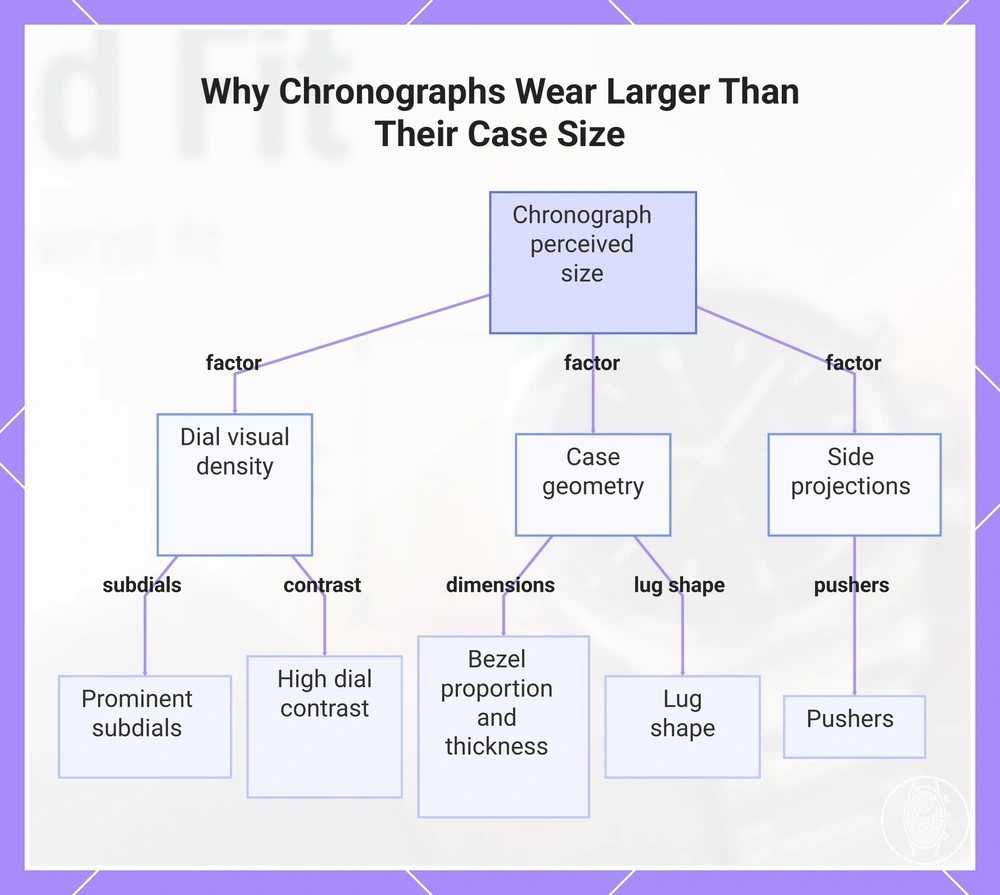
A chronograph can wear larger than its listed case size because case diameter describes only measured width, while subdials, pushers, bezel proportions, dial contrast, case thickness and lug shape can increase perceived size and wrist presence. NOVE's watch-sizing guidance identifies chronograph pushers, prominent subdials and visible dial area as factors that can make a watch appear larger than its nominal diameter, while WatchCrunch likewise identifies dial size, colour, thickness and lug-to-lug length as contributors to wearing impression. These attributes do not make every chronograph wear large; their effect is conditional on the specific case and dial design. The main perceived-size factors are therefore dial visual density, side projections, bezel-to-dial proportion, contrast, vertical case height and longitudinal lug span.
Use diameter, thickness, lug span and the visual factors below together for the fit decision.
Check measured size against the complete case geometry before deciding how large a chronograph will feel on the wrist. Seiko specifies the SSB429 chronograph at 41.5mm in diameter, 12.1mm thick and 46.5mm lug-to-lug, while the Prospex Speedtimer SRQ053 measures 42.0mm in diameter, 14.6mm thick and 49.5mm lug-to-lug; although their diameters differ by only 0.5mm, the manufacturer-stated specifications differ by 2.5mm in thickness and 3.0mm in lug-to-lug length. This model-specific comparison does not establish a universal wear-size formula, but it shows why similar listed case size can produce materially different case height and wrist coverage. Use diameter, thickness, lug span and the visual factors below together for the fit decision.
- Subdials: Prominent or tightly grouped subdials increase dial density, which NOVE identifies as a condition that can increase perceived size even when measured case diameter is unchanged.
- Pushers: Pushers project beyond the main case body, adding side presence beyond the listed diameter; NOVE identifies these external controls as one reason a chronograph can appear broader on the wrist.
- Bezel: A narrower bezel exposes a greater proportion of the dial, while a broader bezel reduces the visible dial opening; NOVE uses this bezel-to-dial relationship to explain why equal case diameters can create different visual-size impressions.
- Dial contrast: High contrast between the dial, subdials and markers increases visual separation and apparent dial activity, while lower contrast reduces that effect; the reviewed evidence provides no universal numerical contrast threshold for when perceived size changes.
- Case thickness: Greater case thickness increases vertical wrist presence; Seiko's 42.0mm SRQ053 is 14.6mm thick compared with 12.1mm for the 41.5mm SSB429, a manufacturer-stated 2.5mm difference in case height.
- Lug shape: Longer or straighter lugs increase longitudinal wrist coverage, while shorter or more downward-curved lugs reduce effective span; Seiko specifies 49.5mm lug-to-lug for the SRQ053 and 46.5mm for the SSB429, illustrating a 3.0mm difference in wrist coverage despite only a 0.5mm difference in diameter.
This chart shows the main factors that increase the perceived size of a chronograph beyond its measured case diameter.
Choosing Between Slim and Large-Face Chronographs
A slim chronograph and a large-face chronograph solve different fit priorities rather than competing for one universal better-fit decision: the slim chronograph reduces vertical case presence and usually improves sleeve clearance, while the large-face chronograph increases dial area, dial readability and visual weight. Wrist size, sleeve use, face size, case thickness and wearing context therefore determine which subtype is more proportionate. For an illustrative comparison, a 10mm-thick case leaves 3mm more cuff clearance than a 13mm-thick case when every other dimension and the sleeve opening are unchanged; this is a geometric example, not a universal comfort threshold. Use the criteria below to compare comfort, readability and case presence before choosing either format.
| Option | Fit advantage | Trade-off | Better use case |
|---|---|---|---|
| Slim chronograph | Lower case height reduces vertical wrist presence and provides more sleeve clearance under the same cuff opening. | A compact face can provide less visual separation between hands, markers and subdials when the dial layout is dense. | A better fit when comfort under sleeves, restrained visual weight and lower case height are the main criteria. |
| Large-face chronograph | A larger visible dial provides more physical area for hands, markers and subdials, which can support dial readability when the layout uses that space clearly. | Greater face size increases wrist presence, while comfort still requires proportionate case thickness, lug span and wrist coverage. | A better fit when stronger visual weight and easier at-a-glance dial reading are priorities and the case geometry remains proportionate to the wrist. |
| Borderline wrist | Neither subtype has an automatic fit advantage when the case approaches the usable supporting width of the wrist. | Lug-to-lug span, strap angle and case thickness can change comfort even when face size appears acceptable. | Choose the option whose lugs remain supported by the wrist and whose case height does not create unwanted pressure or overhang. |
| Sleeve-heavy wear | A low-profile chronograph preserves more space between the watch and cuff under otherwise identical clothing conditions. | A large-face chronograph may still clear the sleeve if its thickness is restrained, so face diameter alone does not determine cuff compatibility. | Favour the slimmer case when repeated cuff contact is the practical fit problem. |
| Readability-first preference | A larger dial can increase spacing between visual elements and reduce crowding when the chronograph layout is well organised. | Large face size does not guarantee readability because subdial density, contrast and marker design still control visual separation. | Favour the option with the clearest dial organisation at the intended viewing distance, regardless of whether it is categorised as slim or large-face. |
For everyday wear, a slim chronograph is the stronger candidate when frequent sleeve use makes case height the main comfort constraint, while a large-face chronograph becomes more suitable when dial readability and stronger wrist presence carry more weight. NOVE's chronograph selection guidance treats dial layout and readability as distinct design criteria, supporting the need to inspect visual organisation rather than assuming that a larger face automatically reads more clearly. A practical criteria check is to compare chronograph watches by wearing style against the clothing, cuff and daily-wear conditions in which the watch will actually be used. The better-fit decision is the option that keeps case height, dial clarity and visual weight acceptable across those conditions.
The better-fit decision is the option that keeps case height, dial clarity and visual weight acceptable across those conditions.
Dress-leaning wear usually benefits from restrained case presence and reliable sleeve clearance, while a sport context can justify greater face size and visual weight when wrist size, lug geometry and comfort support that proportion. Treehut's chronograph guidance treats case size, dial design and intended use as separate selection factors, which supports matching the subtype to wearing context rather than assigning either format to every occasion. Comparing dress and sport chronograph watches can therefore clarify whether a low-profile case or a more prominent face better serves the intended use without making either option universally superior. The final selection should preserve comfort, readable dial organisation and proportionate case presence for the wearer's actual wrist and clothing context. :contentReference[oaicite:0]{index=0}
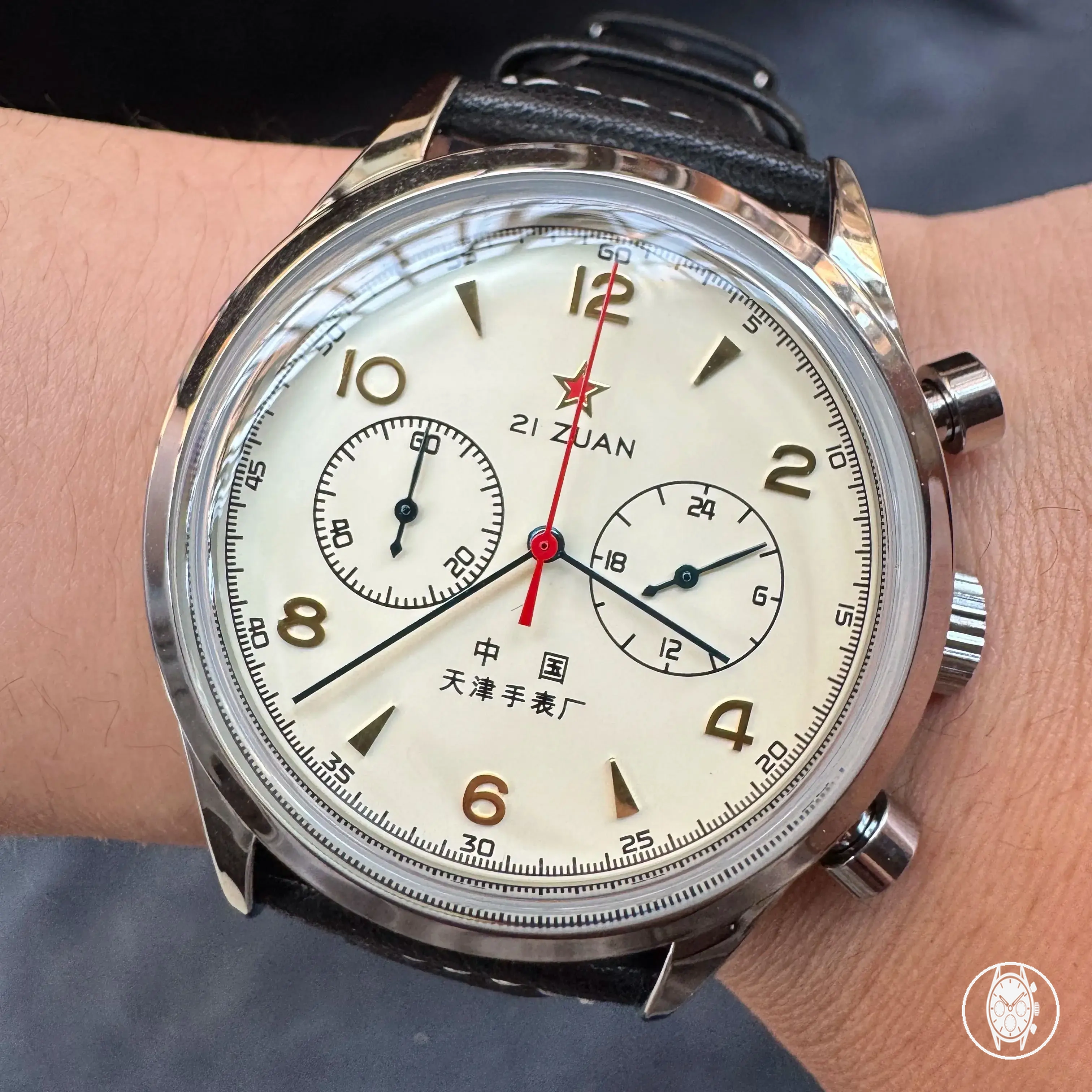
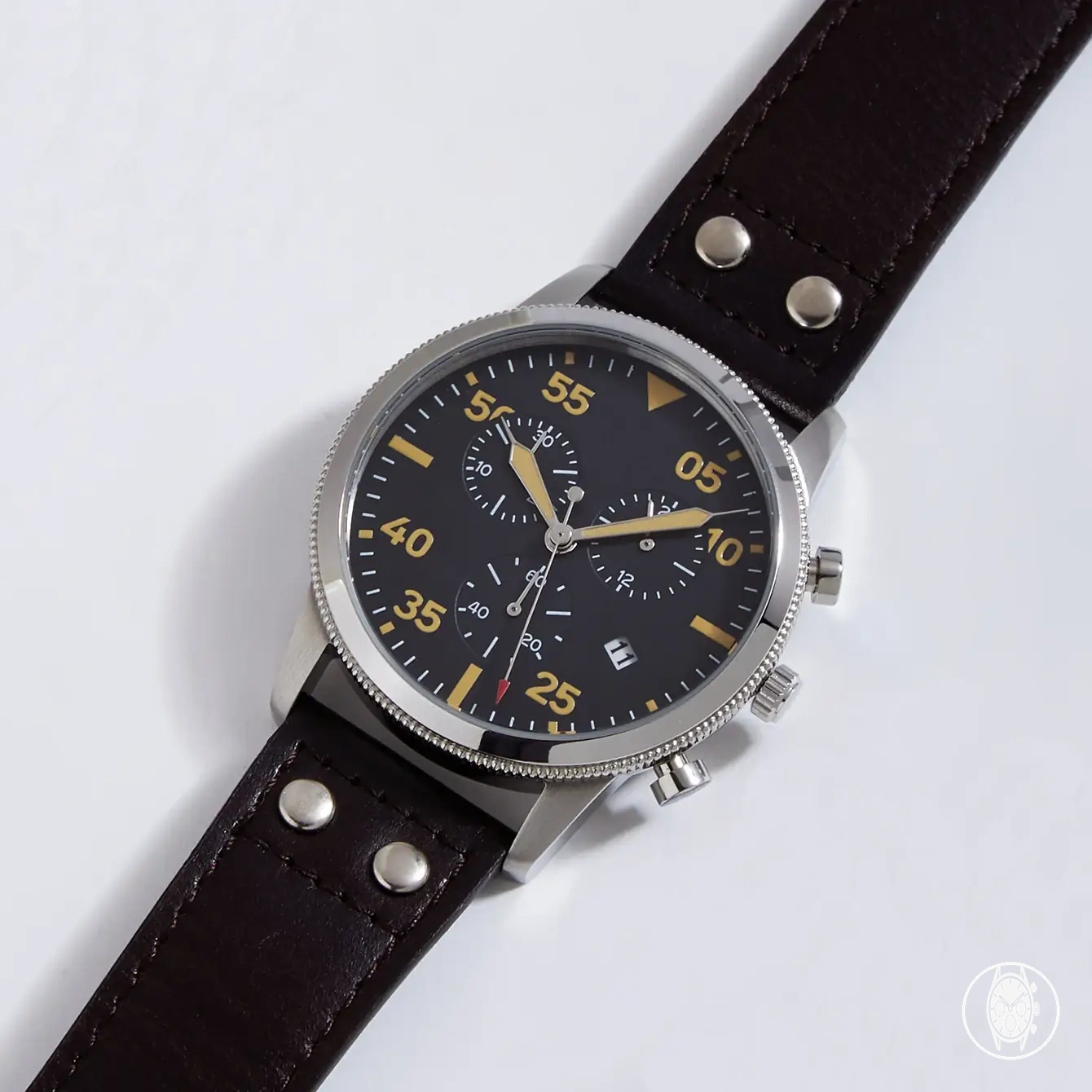
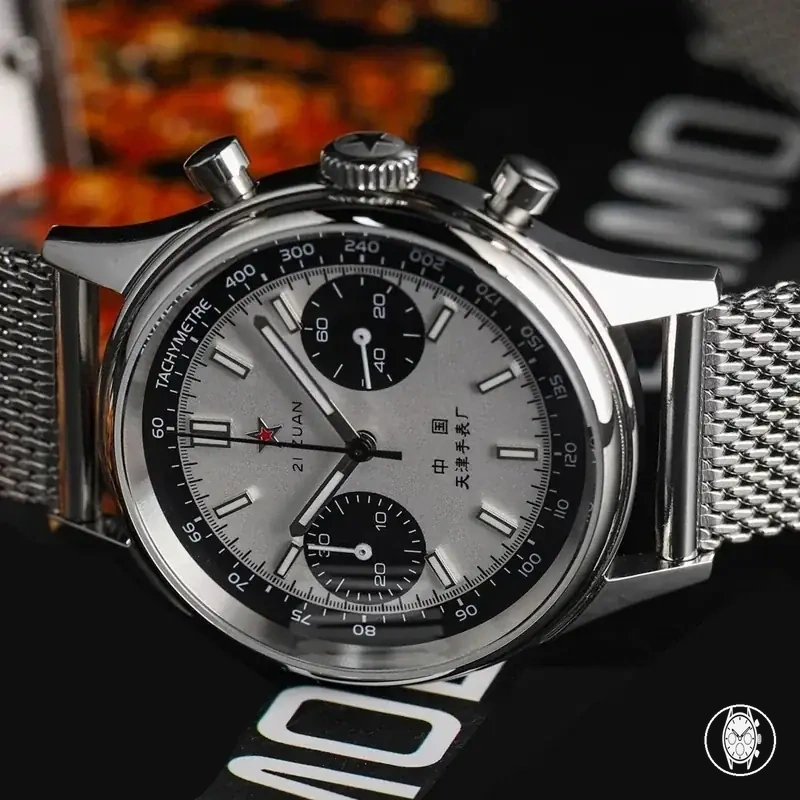
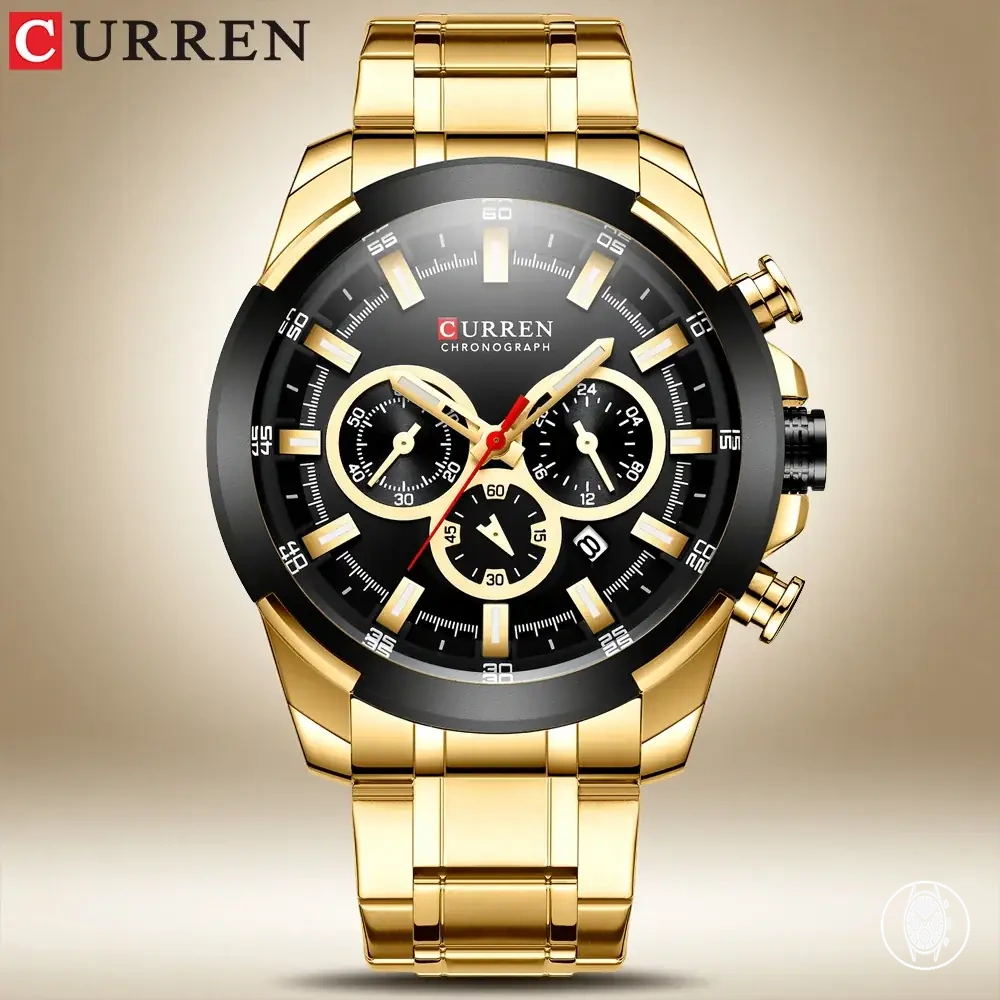
The products below are useful examples for comparing available options.
The products below are useful examples for comparing available options. Before buying, check that the compatibility criteria, key features, and product details match your needs.
Fit Checks Before Choosing a Men's Chronograph Watch
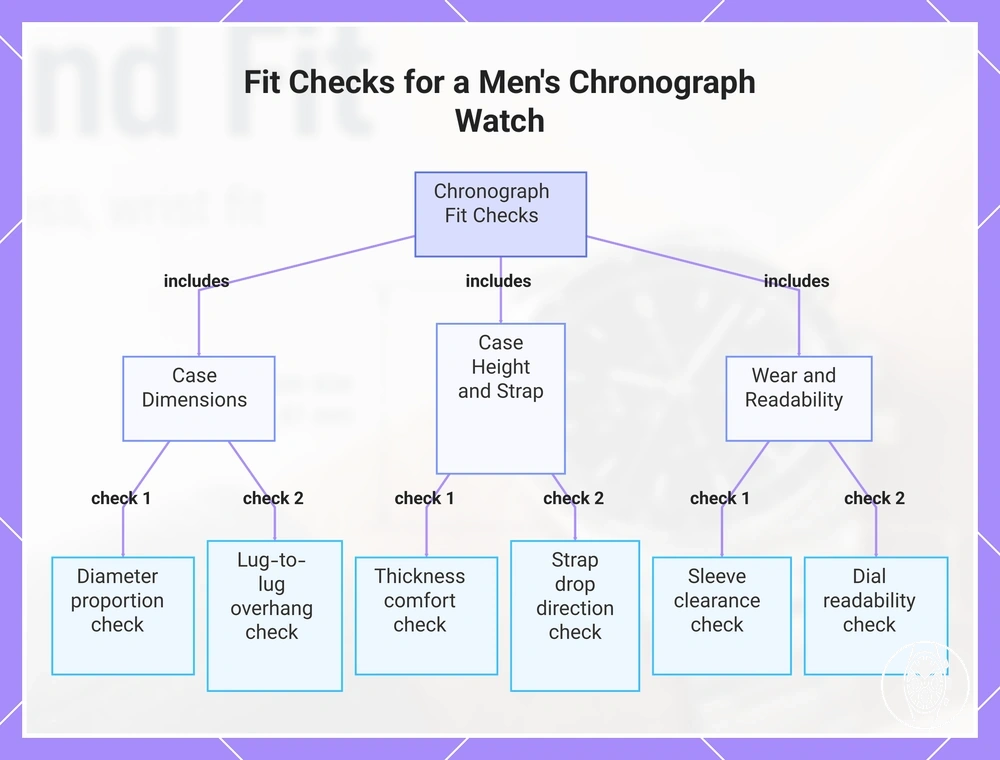
Final fit checks for a men's chronograph watch should confirm wrist comfort, case proportion and practical wear before selection. Timex's 2025 watch-size guidance states that case size and thickness affect comfort and appearance and recommends measuring the wrist and assessing the watch on-wrist rather than relying on one dimension alone. Use case diameter, lug-to-lug length, thickness, strap drop, sleeve clearance, dial readability and personal tolerance as pass, caution or avoid criteria. The checklist below turns those attributes into final decision signals.
- Case diameter: Pass when the listed width produces the intended wrist presence while the complete case remains proportionate; caution when the diameter looks acceptable but other dimensions create substantially greater wrist coverage.
- Lug-to-lug length: Pass when both lug ends remain supported by the usable wrist surface; avoid when the lugs extend beyond the wrist edges and create visible overhang. Seiko specifies its SSB429 at 41.5mm diameter and 46.5mm lug-to-lug, confirming that longitudinal span is a separate manufacturer-stated dimension from diameter.
- Thickness: Pass when case height remains comfortable through normal wrist movement; caution when the case repeatedly presses into the wrist or interferes with clothing. Seiko specifies the same SSB429 at 12.1mm thick, illustrating that case height must be checked independently of its 41.5mm diameter.
- Strap drop: Pass when the strap turns downward from the lugs and follows the wrist; caution when the lug shape keeps the strap projecting outward and concentrates pressure near the case edges.
- Sleeve clearance: Pass when the watch moves beneath the intended cuff without repeated contact; caution when the crystal, bezel or pushers consistently catch the sleeve.
- Dial readability: Pass when the hands, markers and subdials remain distinguishable at the wearer's normal viewing distance; caution when dial density or contrast makes the timing display difficult to separate during daily wear.
- Personal tolerance: Pass when case presence, wrist pressure and movement remain acceptable during normal use; avoid when discomfort, overhang or pressure persists after reasonable strap adjustment.
During daily wear, test sleeve clearance and dial readability in the clothing and viewing conditions that matter most rather than only with an uncovered wrist. A chronograph that passes the physical case checks can become a caution result if the pushers repeatedly catch a close cuff or if the dial cannot be read comfortably at the normal viewing distance. Timex specifically links watch dimensions with both comfort and visual balance, so practical wear should confirm the dimensional assessment rather than replace it. Reconsider the case shape when poor strap drop, persistent cuff interference or difficult readability remains after adjustment.
Reconsider the case shape when poor strap drop, persistent cuff interference or difficult readability remains after adjustment.
Size down when excessive wrist coverage, case height or overhang causes the caution or avoid result; size up only when greater dial readability or wrist presence is wanted and the larger option still passes the lug, thickness and comfort checks. If two sizes remain viable, use the broader criteria for choosing a chronograph watch to compare their complete geometry and wearing context rather than diameter alone. After those fit checks are complete, best men's chronograph watches can be compared against the verified wrist, comfort and use-context requirements instead of treated as universally suitable options. A persistent avoid result is a reason to compare options or reconsider the case shape rather than forcing the nominal size to fit. :contentReference[oaicite:0]{index=0}
A persistent avoid result is a reason to compare options or reconsider the case shape rather than forcing the nominal size to fit.
This chart groups the key fit checks for a men's chronograph watch into three categories: case dimensions, case height and strap, and wear and readability.
Before buying, check that the compatibility criteria, key features, and product details match your needs.
The products below are useful examples for comparing available options. Before buying, check that the compatibility criteria, key features, and product details match your needs.
Common Chronograph Size Questions
Is a chronograph suitable for small wrists?
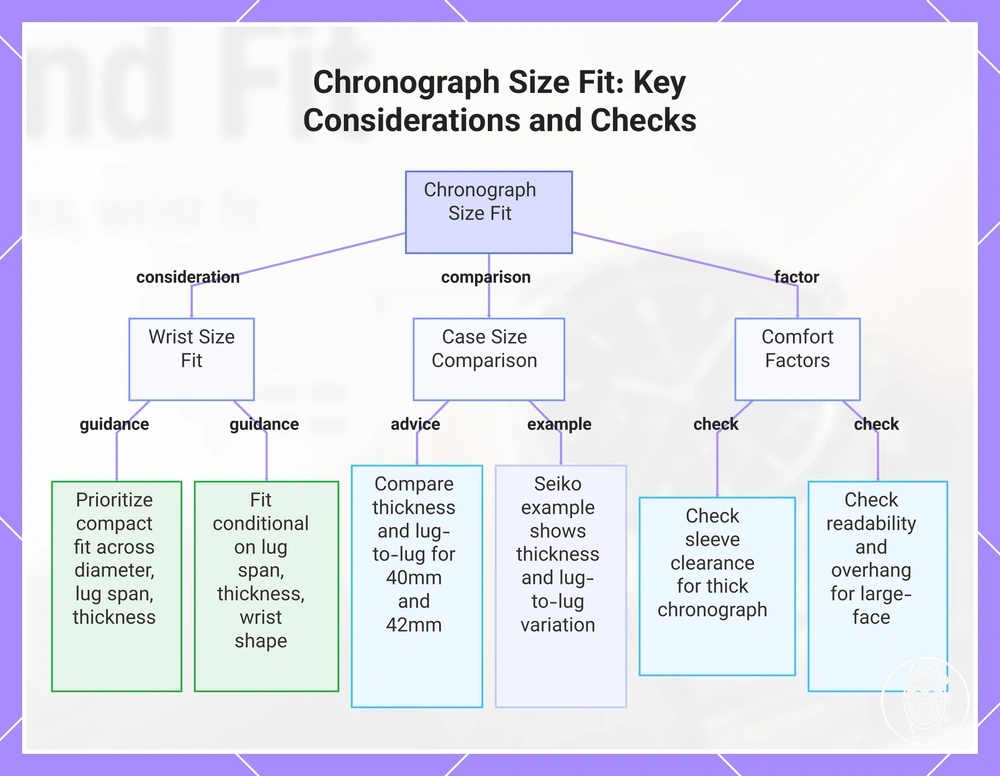
Yes, if the chronograph keeps its lugs supported by the wrist and remains comfortable without persistent overhang or pressure. Longines' general sizing guidance places wrists below approximately 16cm in a 32–36mm case-diameter range, but Longines presents that range as guidance rather than a chronograph-specific fit rule. Small wrists should therefore prioritise compact wrist fit across diameter, lug span and thickness rather than treat one case-size number as decisive.
Should I choose a 40mm or 42mm chronograph?
Choose conditionally: a 42mm chronograph is 2mm wider in nominal case diameter than a 40mm chronograph, calculated directly from the listed sizes, but that difference does not predict the same change in comfort or perceived size. Seiko demonstrates why adjacent-size uncertainty needs more than diameter: its SSB429 measures 41.5mm in diameter, 12.1mm thick and 46.5mm lug-to-lug, while the SRQ053 measures 42.0mm, 14.6mm and 49.5mm respectively. Compare thickness and lug-to-lug length as well as the 40mm or 42mm label before deciding.
Can a thick chronograph still be comfortable?
Yes, if the thick chronograph distributes its case height without creating persistent wrist pressure or unacceptable sleeve interference. Seiko specifies the 42.0mm SRQ053 at 14.6mm thick, showing that substantial case height can accompany a conventional chronograph diameter without establishing a universal comfort limit. Sleeve clearance, caseback contact and strap position should determine whether that thickness remains acceptable for daily wear.
Should a 44mm chronograph only be worn on a large wrist?
No, not exclusively; a 44mm chronograph is a larger case option whose wrist fit remains conditional on lug span, thickness, wrist shape and comfort. Longines' general guidance associates wrists above approximately 17.8cm with a 42–46mm case-diameter range, which places 44mm inside that reference band, but the guidance is not an official size rule for every chronograph. A 44mm case should still be reconsidered when its lugs overhang the supporting wrist or its case height produces unwanted pressure.
Can a large-face chronograph be comfortable for daily wear?
Yes, if the large-face chronograph provides useful dial readability without excessive overhang, case height or restricted wrist movement. Greater dial area increases visual weight and perceived size, while wearing comfort remains a separate condition determined by the complete case and strap geometry. Use daily sleeve clearance, readable hands and subdials, and stable wrist support as the practical fit cues rather than large-face appearance alone. :contentReference[oaicite:0]{index=0}
Yes, if the large-face chronograph provides useful dial readability without excessive overhang, case height or restricted wrist movement.
This chart summarizes the main fit factors and checks for common chronograph sizing questions, including wrist size, case comparison, and comfort.