Men's Chronograph Watch Water Resistance Guide
A men's chronograph watch is water resistant only within the rating, test conditions and construction applicable to that watch, so the rating should be treated as a safety boundary rather than an unconditional wet-use promise. ISO 22810:2010 establishes requirements and test methods for verifying the water resistance of watches and specifies the marking manufacturers may apply. For a chronograph, the case, seals, crown and pushers are therefore relevant parts of the water-entry barrier, while age, seal condition, pressure, temperature and use case can affect the risk during real-world exposure. Water resistant describes conditional protection rather than absolute protection from water.
Water resistant describes conditional protection rather than absolute protection from water.
Consider two men's chronograph watches before wet exposure: the printed rating alone does not establish that their controls, sealing systems and present condition are equivalent. A concrete model example shows why those details matter: Rolex specifies the Cosmograph Daytona with a 100-metre (330-foot) water-resistance rating, a Triplock crown with a triple sealing system, and a crown and chronograph pushers that screw down against the case. That specification applies to the Daytona's own construction and must not be generalised to another rated chronograph. For a purchase decision, compare the stated rating and model-specific construction; for wet-use behavior, follow the conditions and limitations specified for the actual watch.
The next distinctions are what the ratings mean and how the crown, pushers and seals affect the water-entry boundary.
A men's chronograph watch should therefore be evaluated by its stated water-resistance rating and applicable manufacturer conditions before wet exposure, with risk assessed for the intended use case rather than from the words “water resistant” alone. The next distinctions are what the ratings mean and how the crown, pushers and seals affect the water-entry boundary.
Table of Contents
What Water Resistance Means for a Men's Chronograph Watch
Water resistance for a men's chronograph watch is a tested protection level for the case against water entry under stated conditions, represented by the watch's stated rating. ISO 22810:2010 specifies requirements and test methods for determining the water resistance of watches and applies the designation to watches that satisfy those tests. For men's chronograph watches, the stated rating therefore describes tested water-entry protection under applicable conditions rather than protection under every possible use condition.
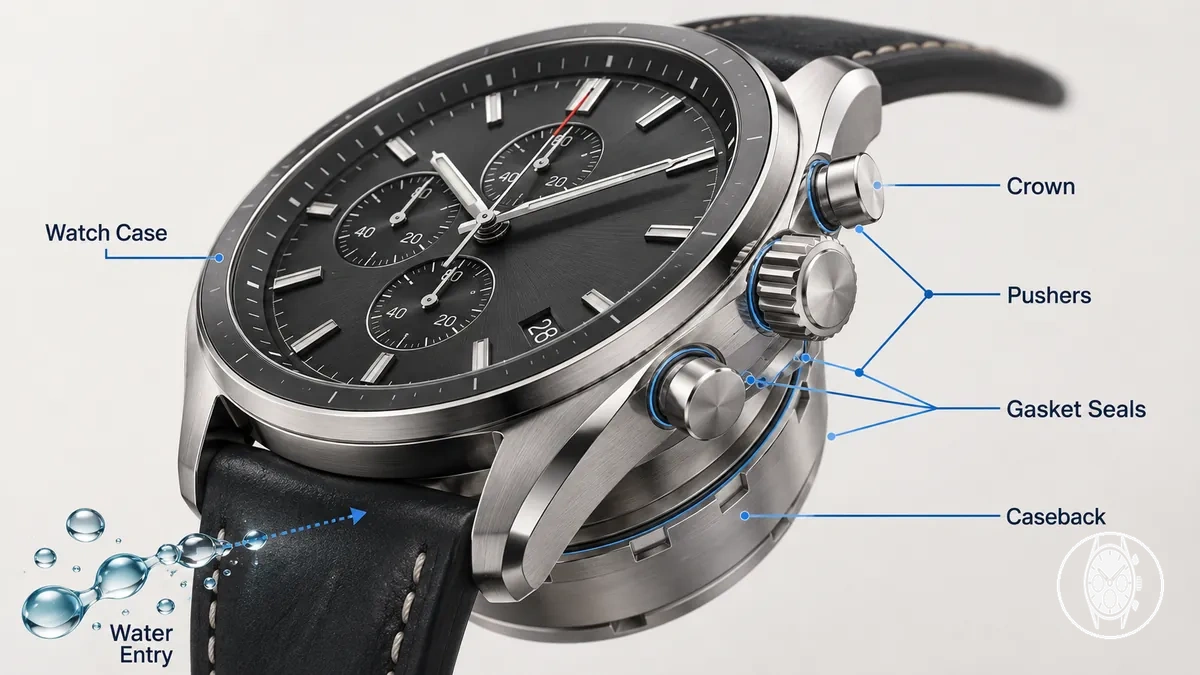
Bucherer explains that chronographs have openings at the crown, pushers, crystal and caseback and that gaskets seal these openings against water entry.
What water resistance means for a men's chronograph watch also includes the integrity of the case and its water-entry points: the gasket seals, crown, pushers and caseback must maintain the rated case's sealing function. Bucherer explains that chronographs have openings at the crown, pushers, crystal and caseback and that gaskets seal these openings against water entry. The stated rating consequently applies to the watch as a sealed construction under its relevant test and use conditions, while the presence and condition of seals and controls affect whether that boundary is maintained in use.
Water resistance supports safer decisions about wet exposure, but it does not establish that every men's chronograph watch is suitable for every wet activity. The appropriate boundary is the specific model's stated rating and applicable use conditions.
Water Resistant Versus Waterproof Chronograph Wording
Water resistant and waterproof chronograph wording should not be treated as identical claims: a water resistant label connects the protection expectation to the chronograph's stated rating and applicable conditions, while waterproof-style wording alone does not establish a higher or unlimited rating. The practical distinction is to use the stated rating and manufacturer limitation to judge wet use rather than infer greater protection from the word waterproof.
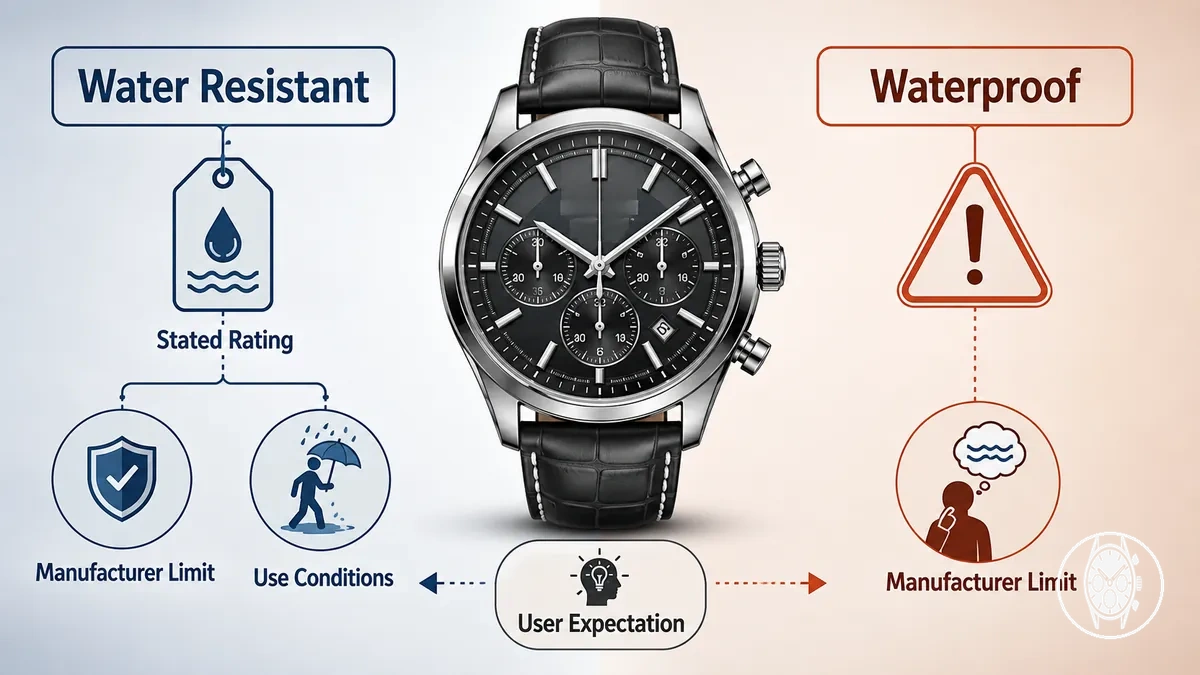
The myth is that a waterproof claim automatically means greater protection than a water resistant claim; the useful value is the rating specified for the particular chronograph under the manufacturer's conditions. For example, Rolex specifies the Cosmograph Daytona reference 126505 as waterproof to 100 metres (330 feet), giving that model a manufacturer-stated 100-metre rating rather than establishing a universal value for waterproof wording. User expectation should therefore remain bounded by the rating value and manufacturer conditions attached to the specific watch.
Water Resistance Ratings and Real-World Exposure Limits
A chronograph watch's water resistance rating is a pressure-related value that needs its test condition and real-world exposure interpreted together rather than treating the rating depth as an everyday use limit. ISO 22810:2010 establishes requirements and test methods for verifying watch water resistance, and ISO's technical explanation equates 1 bar of overpressure to approximately 10 metres of water depth, making 5 bar approximately 50 metres, 10 bar approximately 100 metres and 20 bar approximately 200 metres. Pressure during use, temperature and seal age can change the practical limit, so the rating needs real-use interpretation.
Pressure during use, temperature and seal age can change the practical limit, so the rating needs real-use interpretation.
Water resistance ratings and real-world exposure limits become clearer when the numerical rating is separated from the activity decision. Citizen specifies WR 50 as 5 bar, WR 100 as 10 bar and WR 200 as 20 bar; its usage guidance permits swimming at 5 bar and permits skin diving and marine sports at 10 or 20 bar, while excluding scuba diving for all three categories.
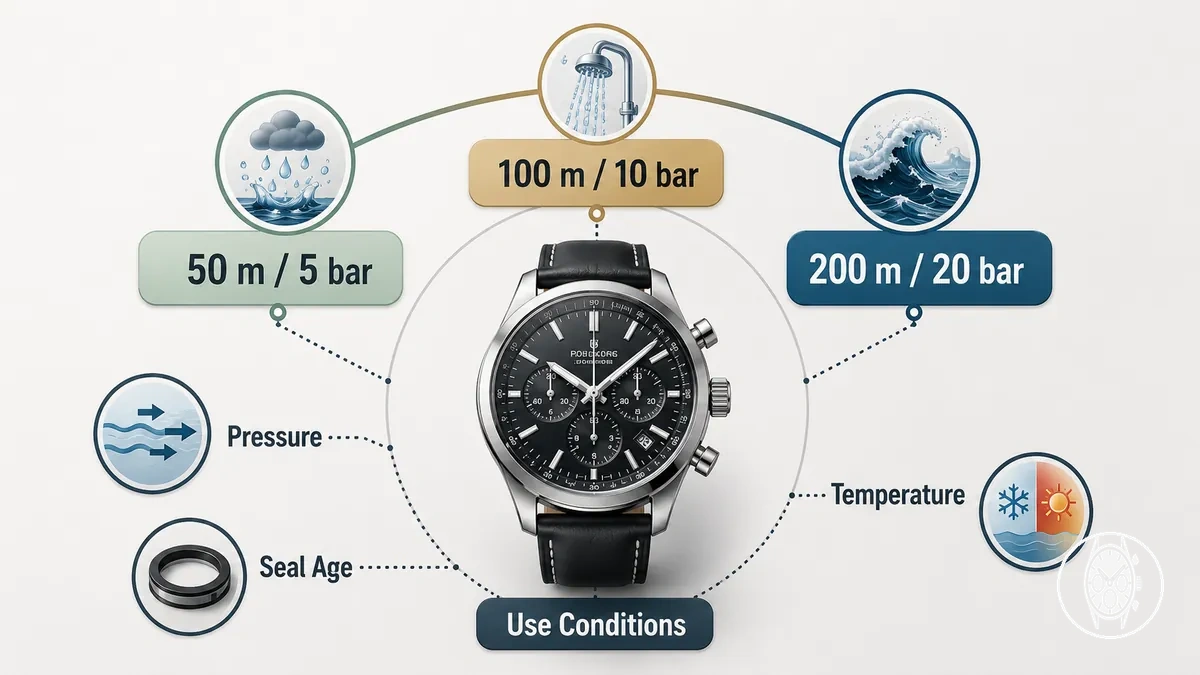
| Rating/label | Test meaning | Real-use condition | Safer decision |
|---|---|---|---|
| 50 m / 5 bar | Citizen specifies WR 50 as water resistance to 5 atmospheres. | Citizen permits swimming and general washing work at 5 bar but excludes skin diving, marine sports and scuba diving. | Limit wet use to activities permitted by the specific watch manufacturer and avoid treating 50 m as an everyday operating depth. |
| 100 m / 10 bar | Citizen specifies WR 100 as water resistance to 10 atmospheres. | Citizen permits swimming, skin diving and marine sports at 10 bar but excludes scuba diving. | Use the 100 m rating within the specific model's activity guidance rather than converting the meter value directly into a practical depth. |
| 200 m / 20 bar | Citizen specifies WR 200 as water resistance to 20 atmospheres. | Citizen permits swimming, skin diving and marine sports at 20 bar but excludes scuba diving for this everyday-use rating; Citizen separately identifies DIVER'S 200m as a scuba-diving category. | Distinguish a 200 m / 20 bar everyday-use rating from a manufacturer-designated diver's watch before choosing the exposure. |
For example, Citizen's guidance allows swimming at both 5 bar / 50 m and 10 bar / 100 m, but only its 10 bar and 20 bar everyday-use categories extend to skin diving and marine sports; this shows why a higher rating changes the permitted exposure category rather than establishing an everyday depth target. Seiko also states that gasket ageing or deformation from accidental shock can impair water resistance, warns against bath or sauna use because steam and heat-related conditions can accelerate deterioration, and advises against operating a crown or button while the watch is wet. A chronograph's safer practical limit therefore combines its rating with the manufacturer's activity guidance, current seal condition, pressure exposure and temperature conditions.
30m, 50m, 100m, and 200m Rating Meanings
The 30m, 50m, 100m, and 200m rating meaning is a conditional wet-use guide rather than a universal activity rule: Citizen classifies 3-atmosphere water resistance for minor exposure such as splash and rain, WR 50 as 5 bar with swimming permitted, WR 100 as 10 bar with swimming, skin diving and marine sports permitted, and WR 200 as 20 bar with those same non-scuba activities permitted. These rating values set different exposure categories, but manufacturer guidance and the chronograph's current condition remain necessary limits for actual use.
| Rating | Usually signals | Common caution | Safer interpretation |
|---|---|---|---|
| 30m | Citizen's 3-atmosphere category permits minor exposure such as accidental splash and rain. | Citizen excludes swimming and exposure involving substantial changes in water pressure at 3 atmospheres. | Interpret 30m as a splash-and-rain category unless the specific watch manufacturer provides different activity guidance. |
| 50m | Citizen specifies WR 50 as 5 bar and permits swimming and general washing work. | Citizen excludes skin diving, marine sports, scuba diving and saturation diving at 5 bar. | Interpret 50m as permitting swimming only when the specific manufacturer's instructions and the watch's condition support that use. |
| 100m | Citizen specifies WR 100 as 10 bar and permits swimming, skin diving and marine sports. | Citizen excludes scuba diving and saturation diving from its 10-bar everyday-use category. | Interpret 100m within the manufacturer's specified swimming and water-activity conditions rather than as a universal activity boundary. |
| 200m | Citizen specifies WR 200 as 20 bar and permits swimming, skin diving and marine sports in its everyday-use category. | Citizen excludes scuba diving and saturation diving at ordinary 20-bar WR 200; it separately identifies DIVER'S 200m as a scuba-diving category. | Check whether 200m denotes ordinary 20-bar water resistance or a manufacturer-designated diver's watch before higher-pressure exposure. |
For example, Citizen's activity table permits swimming at both 5 bar / 50m and 10 bar / 100m, while skin diving and marine sports move from excluded at 5 bar to permitted at 10 bar, showing that the rating changes the manufacturer's activity category rather than defining a universal use outcome. Seiko states that gasket deterioration with age or deformation caused by accidental shock can impair water resistance, so seal condition and manufacturer instructions should be checked alongside the printed rating before wet use.
Static Pressure, Movement, and Temperature Changes
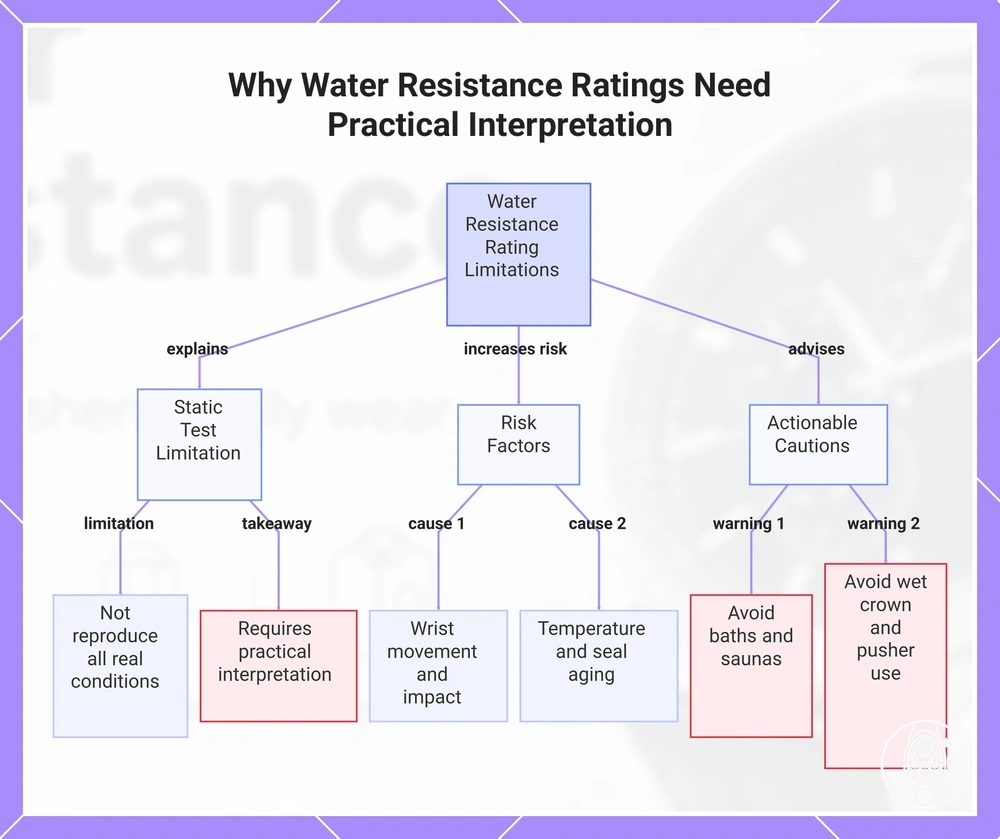
Static pressure in a controlled water-resistance test does not reproduce every exposure condition a chronograph can face in real use. Seiko explains that a pressure rating is based on a test condition and that swimming movement can increase pressure at a given depth, while direct running water can also create pressure at the watch case. Wrist movement, impact and changing water pressure can therefore raise water-entry risk compared with a controlled static test, so the rating still needs practical interpretation.
Static pressure in a controlled water-resistance test does not reproduce every exposure condition a chronograph can face in real use.
A chronograph exposed to hot water, a rapid temperature change, an impact or aged seals can place additional stress on the case and gasket system. Seiko states that gasket ageing and deformation from accidental shock can reduce water resistance and advises against baths and saunas, while Citizen states that the crown and buttons should not be operated when the watch is wet because water may enter the case. These conditions increase seal stress and water-entry risk, so hot water, cold-to-hot changes, impact, seal age and wet crown or pusher operation should be treated as caution conditions rather than assumed equivalent to a controlled rating test.
A chronograph exposed to hot water, a rapid temperature change, an impact or aged seals can place additional stress on the case and gasket system.
This chart shows how static water resistance tests differ from real-world conditions and what factors increase water-entry risk, along with key precautions.
Wet-Use Decisions for Daily Wear, Swimming, and Showering
Wet-use decisions for a water-resistant chronograph should separate light daily wear exposure from swimming, showering and repeated or pressurised water contact. Citizen's water-resistance guidance permits accidental splash and rain at 3 atmospheres and ordinary swimming at 5 bar, while more demanding wet use requires the rating, watch condition and manufacturer instructions to support that activity. Splash, rain, hand washing, swimming, showering, hot water, soap and pressure change therefore carry different use-case risks.
Splash, rain, hand washing, swimming, showering, hot water, soap and pressure change therefore carry different use-case risks.
For light exposure, the minimum check is that the chronograph has an appropriate water-resistance rating and its crown and pushers are secured as specified. Swimming and showering add sustained contact, movement, running-water pressure, temperature change or soap exposure, so the decision should follow the manufacturer's stated activity limits rather than the presence of a water-resistant label alone.
| Wet-use situation | Main risk | Minimum check | Safer action |
|---|---|---|---|
| Daily splash | Brief moisture around the case, crown and pushers. | Confirm a daily-use water-resistance rating and secured controls. | Citizen permits accidental splash at 3 atmospheres; keep the exposure within the specific model's instructions. |
| Rain | Repeated surface moisture can reach vulnerable seals or unsecured controls. | Confirm the watch is rated for daily water exposure and the crown and pushers are secured. | Citizen includes rain within its 3-atmosphere daily-use category; follow any stricter model-specific limitation. |
| Hand washing | Direct tap flow creates a pressure change beyond passive splash exposure. | Check the manufacturer's instructions and keep the watch away from a concentrated running-water stream where that exposure is not permitted. | Seiko advises against directing faucet water onto a water-resistant watch because tap-water pressure can impair water-resistance performance. |
| Swimming | Continuous immersion and arm movement increase the exposure burden. | Confirm that the specific rating, watch condition and manufacturer guidance permit swimming. | Citizen permits ordinary swimming at 5 bar but not at its 3-atmosphere daily-use level, so use the stated activity category rather than assuming all water-resistant watches are suitable. |
| Showering | Running-water pressure, temperature change and soap exposure add conditions not present in light daily splash. | Verify that the specific manufacturer explicitly permits showering for that chronograph and rating. | Avoid treating swimming permission as automatic showering permission; keep the watch out of the shower when the model guidance does not cover that exposure. |
| Hot water | Heat and steam can increase seal stress and accelerate deterioration of water-resistance components. | Check whether the manufacturer's instructions permit elevated-temperature water exposure. | Seiko advises against wearing a watch in a bath or sauna because steam and heat-related conditions can accelerate deterioration of water-resistance performance. |
| Soap exposure | Soap combined with prolonged wet exposure can contribute to deterioration of water-resistance performance. | Check the manufacturer's guidance for washing, bathing or showering conditions. | Seiko identifies soap as a factor that can accelerate deterioration during bath or sauna exposure, so avoid repeated soapy-water exposure unless the model instructions permit it. |
| Repeated or high-pressure exposure | Repeated pressure change and prolonged wet use increase the burden on seals and controls. | Confirm the stated rating, permitted activity, watch condition and required crown or pusher position. | Keep exposure within the manufacturer's stated use category and do not operate wet controls where the manufacturer prohibits it. |
Daily splash or rain permission does not establish suitability for swimming or showering, and swimming permission does not automatically cover hot water, soap or concentrated running water. For repeated or higher-burden wet use, the safer decision is the one supported by the chronograph's rating, current condition and specific manufacturer guidance.
Splash, Rain, and Hand-Washing Exposure
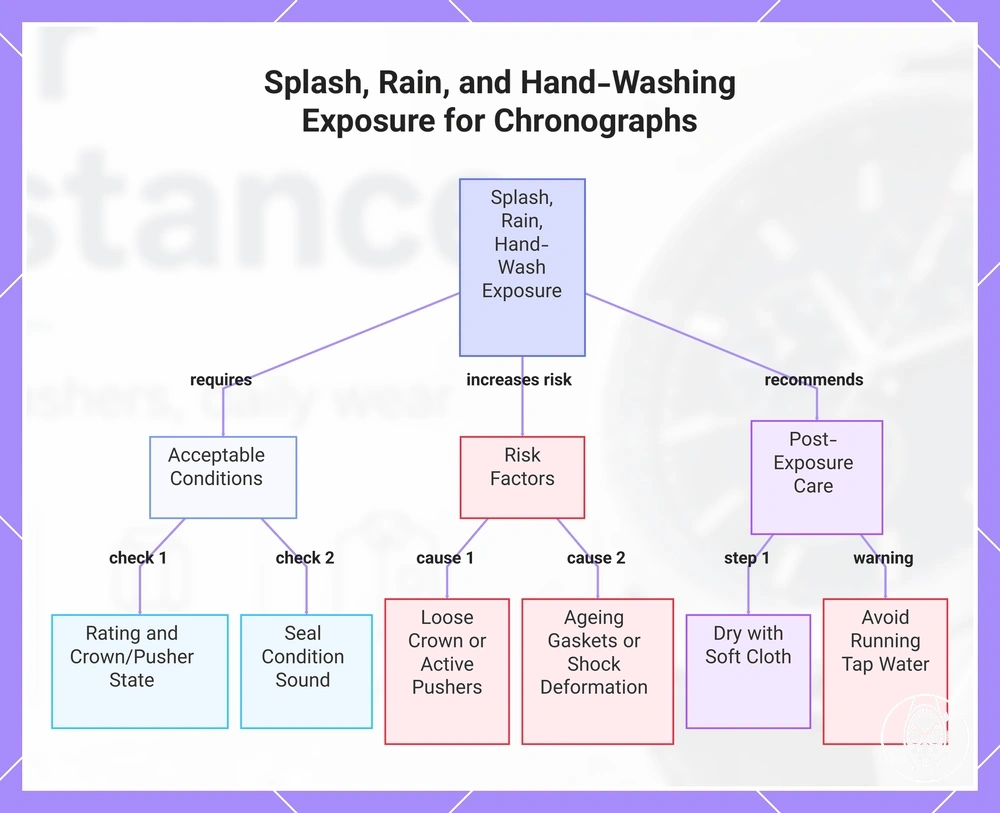
Light daily exposure such as splash, rain and brief hand washing is generally acceptable only when the chronograph is rated for that exposure, its crown position is fully secured as specified, its pushers remain inactive while wet, and its seal condition is sound. Citizen classifies 3-atmosphere water resistance as suitable for minor exposure such as face washing and rain, while both Citizen and Seiko instruct users not to operate the crown or buttons when the watch is wet. A loose crown or active pushers therefore changes the advice from acceptable incidental wetting to avoidable water-entry risk.
A loose crown or active pushers therefore changes the advice from acceptable incidental wetting to avoidable water-entry risk.
After splash, rain or hand washing, drying the chronograph with a soft dry cloth limits prolonged surface moisture; Seiko specifically recommends wiping off moisture after wear and states that ageing gaskets or deformation from accidental shock can reduce water resistance. Repeated wetting should therefore be treated more cautiously when seal condition is uncertain, and direct running tap water should be avoided because Seiko states that faucet pressure can allow moisture penetration even in a water-resistant watch.
This chart shows the conditions under which splash, rain, and hand-washing exposure is acceptable for a chronograph, the risk factors that change the advice, and recommended post-exposure care.
This chart shows the conditions under which splash, rain, and hand-washing exposure is acceptable for a chronograph, the risk factors that change the advice, and recommended post-exposure care.
Swimming and Higher-Pressure Water Exposure
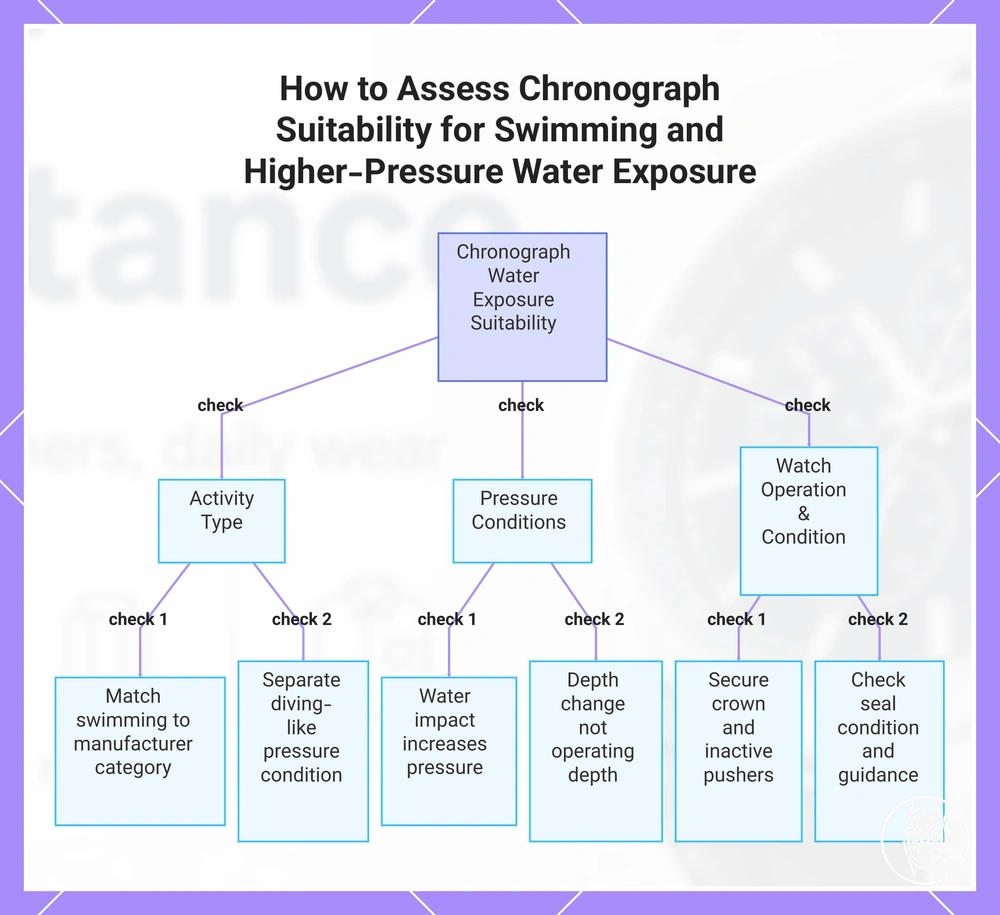
Swimming and higher-pressure exposure become higher-risk decisions for a chronograph when movement, water impact or depth change increases the water-pressure burden beyond ordinary wet contact. Citizen permits swimming for its 5 bar, 10 bar and 20 bar everyday-use categories but separates scuba use into a distinct diver-watch category, while Seiko states that swimming movement can increase pressure at a given depth. Suitability therefore remains conditional on the specific model, rating, crown and seal design, watch condition and manufacturer guidance.
- Swimming: Match pool use to the manufacturer's stated activity category rather than assuming the rating alone permits it; Citizen permits swimming at 5 bar, 10 bar and 20 bar within the everyday-use categories it specifies.
- Diving-like pressure: Treat stronger underwater exposure as a separate use condition; Citizen excludes scuba diving from its ordinary 10 bar and 20 bar categories and identifies DIVER'S 200m as a separate scuba-use category.
- Water impact: Jumping, forceful entry or fast movement can create a different pressure condition from steady immersion; Seiko states that swimming movement can increase pressure at a given depth and advises caution when diving into water.
- Depth change: Do not treat the rating as an operating-depth promise; Seiko states that bar pressure is a test pressure and does not directly correspond to actual diving depth.
- Crown: Secure the crown in the position specified for water use; Seiko instructs users of its 5, 10, 15 and 20 bar watches to push the crown in completely before water exposure.
- Pushers: Keep chronograph pushers inactive while wet unless the specific model explicitly permits operation; Citizen's 5 bar, 10 bar and 20 bar guidance prohibits operating the crown or buttons while the watch is wet.
For example, a chronograph marked 200 m should not be assumed suitable for diving-like pressure solely from that number: Citizen distinguishes ordinary WR 200 / 20 bar watches, for which scuba diving is excluded, from DIVER'S 200m watches intended for scuba use. That model-category distinction shows why swimming, water impact, depth change, crown position, pusher use and current seal condition must be checked against the specific manufacturer's guidance rather than inferred from the rating alone.
This chart shows the key factors to check when determining whether a chronograph is suitable for swimming or higher-pressure water exposure, based on manufacturer guidance and pressure conditions.
This chart shows the key factors to check when determining whether a chronograph is suitable for swimming or higher-pressure water exposure, based on manufacturer guidance and pressure conditions.
Chronograph Pushers, Crowns, and Seal Integrity
Chronograph pushers and the crown are central water-entry risk points because these controls pass through the case and rely on seal integrity around their openings. Rolex specifies the Cosmograph Daytona with a Triplock screw-down crown, screw-down chronograph pushers and a screw-down caseback as parts of its model-specific 100-metre water-resistance construction, showing that the stated rating applies to the complete sealing system rather than to the case body alone. The pusher tube, crown stem, gasket interfaces and caseback therefore remain local risk points when their specified closure or seal condition is not maintained.
The crown, pushers, caseback and gaskets protect different openings and should be assessed as separate part-to-risk relationships.
The crown, pushers, caseback and gaskets protect different openings and should be assessed as separate part-to-risk relationships. Screw-down mechanisms add a model-specific closure condition, while gasket age, damage or incorrect control position can change whether the intended seal is maintained.
| Part | Seal attribute | Risk condition | What it changes |
|---|---|---|---|
| Crown | The crown stem passes through the case and relies on the watch's specified gasket and closure design; some models add a screw-down mechanism. | The crown is not fully secured as specified, or the crown-stem seal is worn or damaged. | The crown opening becomes a potential path for water entry and may no longer maintain the intended case seal. |
| Chronograph pushers | Each pusher operates through a pusher tube and relies on the model's gasket and control design; some chronographs use screw-down pushers. | A pusher is operated while wet where the manufacturer does not permit it, or its sealing components are compromised. | Water pressure can act at the pusher opening, increasing water-entry risk even when other sealed parts remain intact. |
| Caseback | The caseback forms a separate case closure and relies on its specified gasket or manufacturer-defined sealing arrangement. | The caseback seal is aged, damaged, disturbed or not seated as specified. | The rear case opening can lose part of the sealing performance required for the watch's rated construction. |
| Gaskets | Gaskets provide sealing interfaces around components such as the crown, pusher tube and caseback. | Seiko states that gasket deterioration with age or deformation caused by accidental shock can reduce water resistance. | Reduced gasket integrity increases the likelihood that water reaches an opening that previously maintained a seal. |
Control operation near water should follow the specific chronograph design, current condition and manufacturer guidance. Citizen instructs users not to operate the crown or buttons while a watch is wet, while Rolex's Daytona demonstrates that screw-down pushers, crown and caseback are model-specific elements of one sealing system rather than universal requirements for every chronograph.
Using Chronograph Pushers Near or Under Water
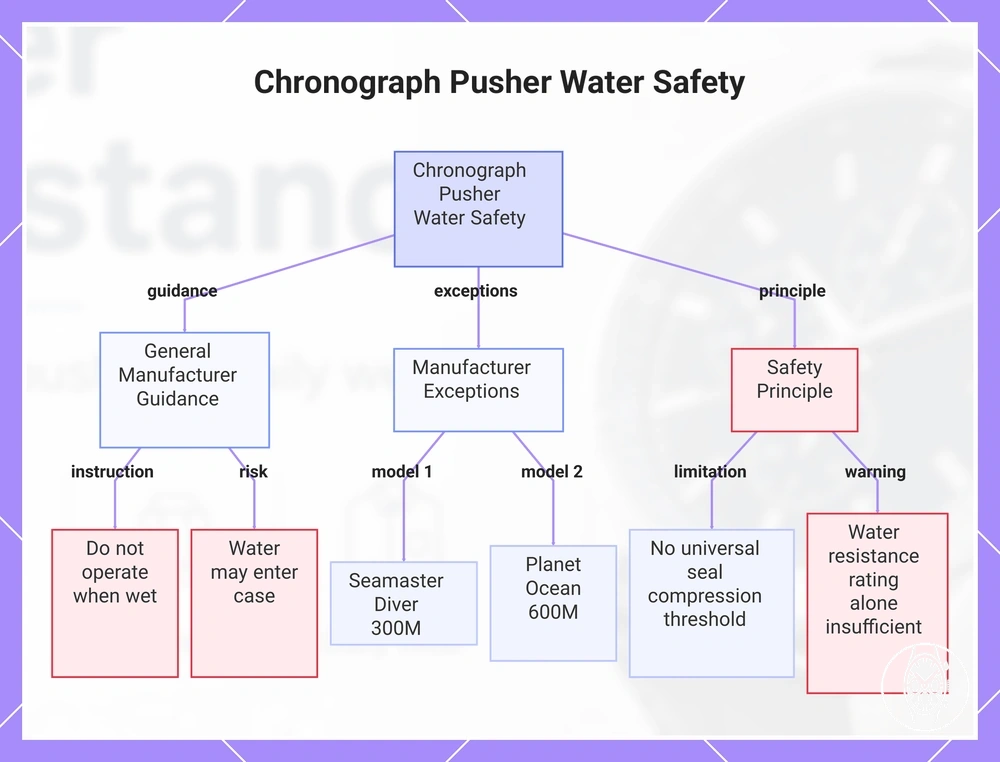
Chronograph pushers should generally remain inactive near water or under water unless the manufacturer explicitly states that the specific watch is designed for underwater pusher action. Citizen instructs users not to operate the crown or buttons while a watch is wet because water may enter the case, while OMEGA instructs users not to handle chronograph pushers in water except on its Seamaster Diver 300M and Planet Ocean 600M chronograph models, whose pushers are designed to function in water. No universal seal compression or water-pressure threshold for safe pusher operation is specified by these manufacturers, so a water-resistance rating alone should not be treated as permission for underwater operation unless explicitly designed for it.
Chronograph pushers should generally remain inactive near water or under water unless the manufacturer explicitly states that the specific watch is designed for underwater pusher action.
With wet fingers or while the watch is under water, pressing a pusher changes the control from its resting condition while water pressure is acting around the case opening, making manufacturer-specific pusher design the relevant safety boundary. OMEGA's stated exceptions show that underwater pusher use is a model-specific capability, whereas Citizen's general guidance requires buttons to remain inactive when wet; where equivalent design permission is absent, leave the chronograph pushers untouched until the watch is out of the water and dry to reduce water-entry risk.
This chart summarizes manufacturer guidance, exceptions, and safety principles for using chronograph pushers near or under water.
This chart summarizes manufacturer guidance, exceptions, and safety principles for using chronograph pushers near or under water.
Screw-Down Crowns and Screw-Down Pushers
A screw-down crown and screw-down pushers add a defined locking state that can improve sealing confidence, but they do not make incorrect use safe or remove water-entry risk. Seiko states that a screw-down crown locks when not being operated to prevent operational errors and improve water-resistant performance, while Rolex specifies that the Cosmograph Daytona uses a screw-down Triplock crown and screw-down chronograph pushers as part of its 100-metre water-resistance construction. The sealing benefit remains conditional on correct closure, gasket contact, model design and component condition, so the intended seal requires the control to be in its specified locking state.
| Control type | Sealing benefit | User risk |
|---|---|---|
| Standard crown or pusher | No threaded locking state is added; sealing relies on the model's normal gasket and control arrangement. | Incorrect position or operation can alter the intended sealed condition, so use must follow the specific watch design. |
| Screw-down crown | Seiko states that locking the threaded crown prevents operational errors and increases water-resistant performance. | An unlocked crown removes the intended locked state, while Seiko warns that forcing the crown during closure can damage its screw interface. |
| Screw-down pusher | Rolex specifies screw-down chronograph pushers on the Daytona as part of the case's model-specific sealing construction. | A partially secured or unlocked pusher does not provide its intended locking state, so water-entry risk remains dependent on correct closure, gasket condition and manufacturer guidance. |
For example, Rolex specifies the Cosmograph Daytona with a 100-metre water-resistance rating, a screw-down Triplock crown and screw-down chronograph pushers; that value applies to the complete Daytona construction, not to screw-down hardware as a universal category. An unlocked crown, partial pusher closure or compromised gasket changes the intended sealing condition, making user error a direct water-entry risk even when screw-down controls are fitted.
Choosing a Water Resistant Chronograph for Your Use Case
Choose a water resistant chronograph by matching its rating value, crown design, pusher design, case material, strap material and maintenance expectation to the exposure expected in daily wear or sport use. Citizen classifies 3-atmosphere water resistance for occasional accidental splashing, 5 bar for swimming, and 10 or 20 bar for swimming plus skin diving and marine sports, while scuba diving remains excluded from those everyday-use categories. The selection decision should therefore match the manufacturer's stated activity category and your acceptable water-entry risk rather than rely on the largest rating value alone.
These criteria separate occasional wet exposure in daily wear from frequent swimming or sport use that places greater demands on controls, strap material and maintenance.
Crown design and pusher design should support the intended wet-use need because Citizen instructs users not to operate the crown or buttons while a watch is wet, making the specified sealed position a selection criterion. Case material affects weight, corrosion exposure and comfort; for example, Citizen specifies its Super Titanium as approximately 40% lighter than stainless steel and corrosion resistant, while Seiko states that leather straps are more susceptible than metal bracelets to deterioration from moisture and sweat. Maintenance also affects long-term suitability: Citizen recommends regular servicing and replacement of water-resistant gaskets at least every 2 to 3 years because ageing seals can lose elasticity and water resistance. These criteria separate occasional wet exposure in daily wear from frequent swimming or sport use that places greater demands on controls, strap material and maintenance.
Use the following criteria to compare a water resistant chronograph before selecting it.
Use the following criteria to compare a water resistant chronograph before selecting it. The safer choice signal is the condition that keeps the watch within its documented activity, control, material and maintenance limits.
| Selection factor | What to check | Why it matters | Safer choice signal |
|---|---|---|---|
| Rating value | Compare the marked rating with the manufacturer's permitted activities. | Citizen separates occasional splashing at 3 atmospheres, swimming at 5 bar, and skin diving or marine sports at 10 or 20 bar. | Choose a rating category that explicitly includes the intended water exposure. |
| Crown design | Check whether the crown is standard or screw-lock and which secured position is required near water. | An unsecured crown changes the intended sealing condition at the crown opening. | Choose a crown design whose required locking state is clear and practical for the planned use. |
| Pusher design | Check whether the chronograph pushers must remain inactive when wet and whether any underwater operation is explicitly permitted. | Citizen states that the crown and buttons should not be operated while the watch is wet because water may enter the case. | Choose a pusher design whose permitted operating condition matches the intended wet-use need. |
| Case material | Compare stainless steel, titanium or another stated case material for weight, corrosion resistance and care requirements. | Citizen specifies Super Titanium as approximately 40% lighter than stainless steel and corrosion resistant, illustrating how material can change comfort and maintenance without defining the water-resistance rating. | Choose a case material whose documented properties suit the expected environment and wearing duration. |
| Strap material | Check whether the strap is leather, metal, urethane or another material and whether its care guidance permits repeated water exposure. | Seiko states that leather is more susceptible than metal bands to deterioration from moisture and sweat and advises against swimming with a leather band even when the watch itself is water resistant. | For frequent swimming or sport use, choose a strap material whose manufacturer permits repeated wet exposure. |
| Maintenance | Check the manufacturer's inspection, gasket and pressure-testing expectations for the specific watch. | Citizen recommends regular servicing and replacement of water-resistant gaskets at least every 2 to 3 years because ageing gaskets can lose elasticity and reduce water resistance. | Choose a chronograph only when its maintenance requirement is realistic for the intended frequency of water exposure. |
For mainly dry daily wear with occasional splash exposure, prioritise the documented lower-exposure category, comfortable materials and manageable maintenance; for frequent swimming or sport use, require explicit activity permission, suitable crown and pusher conditions, a water-compatible strap material and a realistic servicing plan. Use the chronograph buying checklist to carry these criteria into the wider selection decision.
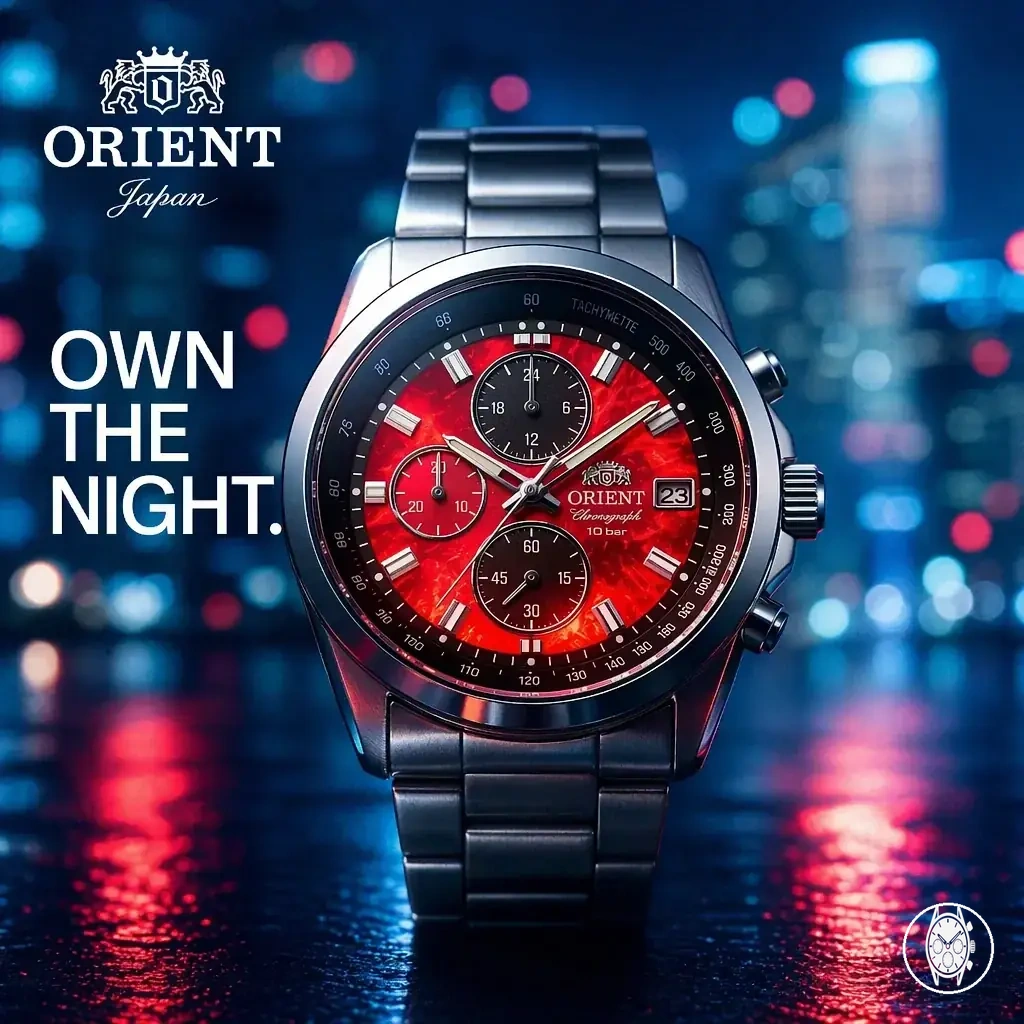
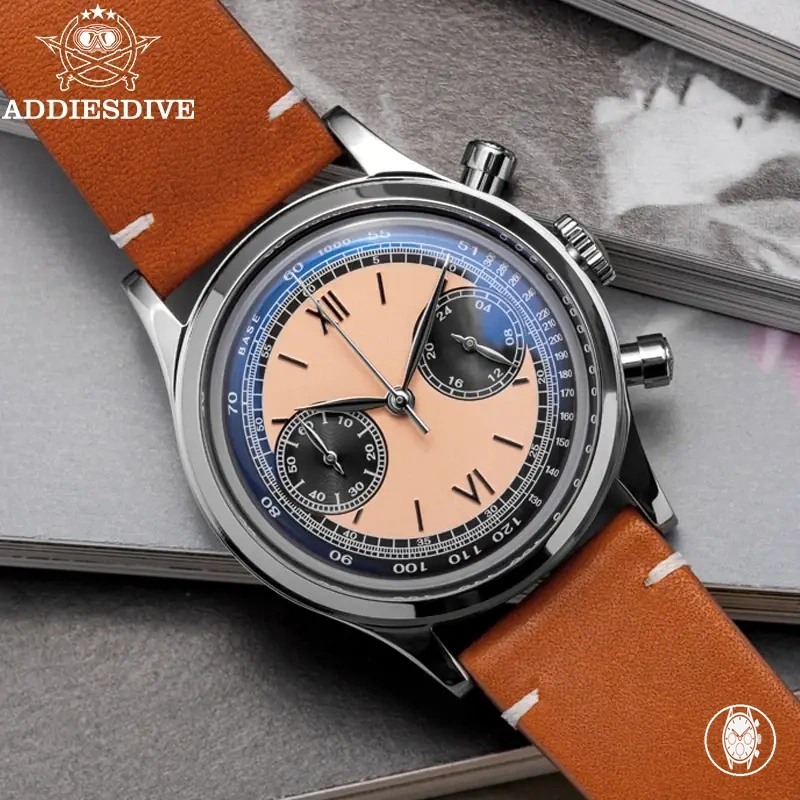
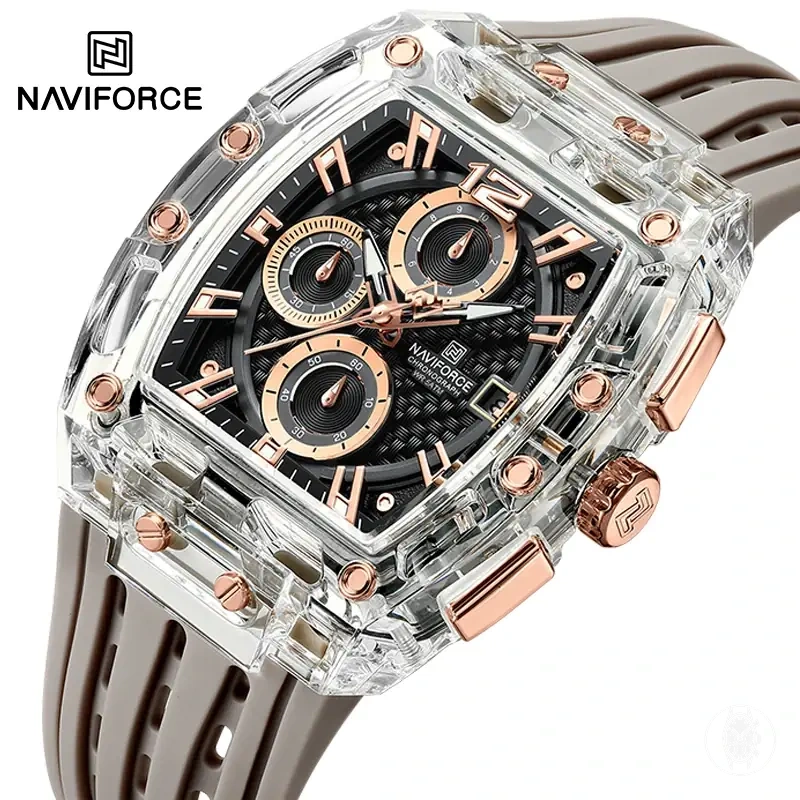
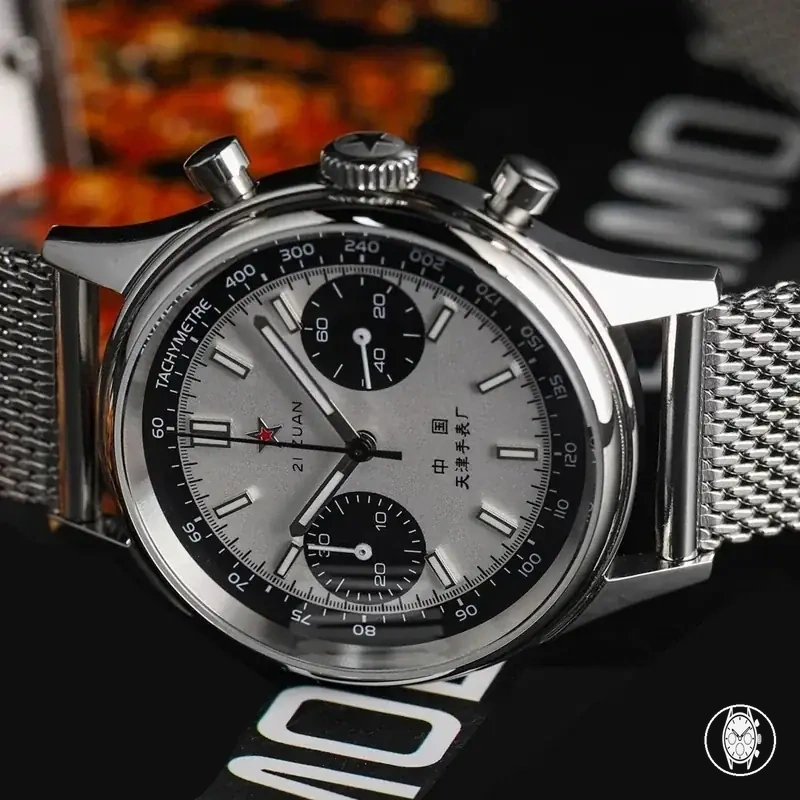
The products below are useful examples for comparing available options.
The products below are useful examples for comparing available options. Before buying, check that the compatibility criteria, key features, and product details match your needs.

Sport Use, Daily Wear, and Dress-Watch Trade-Offs
For a water resistant chronograph, intended wear context changes the sensible water-resistance expectation: Citizen specifies 3 atmospheres for occasional accidental splashing, 5 bar for ordinary swimming, and 10 or 20 bar for skin diving and marine sports, while scuba diving is excluded from those everyday-use categories. Sport use with frequent water exposure therefore calls for a rating category documented for that activity, while daily wear limited to incidental water can remain within the 3-atmosphere category; a dress watch remains subject to the same exposure-based limits regardless of visual style. Wear context, defined by activity intensity and exposure frequency, is the key filter.
| Wear context | Exposure pattern | Trade-off | Sensible rating signal |
|---|---|---|---|
| Sport use | Frequent water exposure, swimming, or marine activity. | Case robustness and strap suitability carry more decision weight than a slim formal profile because the watch and strap face repeated exposure. | Citizen specifies 5 bar for ordinary swimming and 10 or 20 bar for skin diving and marine sports; scuba diving requires a separately designated diving-watch category. |
| Daily wear | Rain, face-washing splashes, and other incidental water; swimming only when the rating category permits it. | Comfort and visual versatility can carry more weight when the expected exposure is incidental rather than sustained. | Citizen specifies 3 atmospheres for occasional accidental splashing and 5 bar when ordinary swimming forms part of the use profile. |
| Dress watch | Primarily dry or incidental-water use, particularly with a leather strap. | Visual style and comfort can favour leather or a dress-oriented profile, but strap suitability creates a separate wet-use boundary. | The case rating should still match the actual exposure; Seiko advises against bathing, swimming, or water-related work while wearing a leather band, even when the watch itself is water resistant. |
The trade-off is therefore between activity intensity, exposure frequency, case robustness, strap suitability, comfort, and visual style rather than between fixed watch labels. For example, under Citizen's published categories, the same 5-bar chronograph can cover daily wear that includes ordinary swimming, whereas a 3-atmosphere chronograph is limited to occasional accidental splashing; for a dress watch on leather, Seiko's band-care guidance adds a separate caution against swimming even when the watch case is water resistant.
Case Material, Strap Material, and Water Exposure
Case material and strap material affect comfort, corrosion risk, durability, and drying after water exposure, but neither replaces the chronograph's water-resistance rating or seal condition. Seiko advises rinsing a suitably water-resistant watch with fresh water after seawater exposure and drying it thoroughly, while Citizen states that stainless steel can still develop rust when sweat or dirt compromises its protective surface film. Material choice therefore supports water-use suitability, but it does not replace the required case rating and intact seals.
The practical difference between materials is the amount and type of post-exposure care they require.
The practical difference between materials is the amount and type of post-exposure care they require.
| Material | Water exposure behavior | Care concern | Decision signal |
|---|---|---|---|
| Stainless steel case | Stainless steel resists corrosion, but Citizen states that sweat and dirt can damage its protective surface film and allow rust to develop. | Remove moisture, salt, sweat, and dirt after exposure and dry the case thoroughly. | Suitable where repeated wet exposure is permitted by the watch rating and regular cleaning and drying are practical. |
| Coated case | The reviewed manufacturer guidance does not specify a universal water-exposure limit for all coated cases; coating type and manufacturer care instructions remain model-specific. | Seiko warns that chemicals and solvents can deteriorate or discolour case and band surfaces. | Check the specific coating-care guidance and do not treat the coating as additional water-entry protection. |
| Leather strap | Seiko states that leather is more susceptible than metal to deterioration and discoloration from moisture and sweat. | Seiko advises against bathing, swimming, or water-related work with a leather strap, while Citizen advises blotting wet leather promptly with a soft dry cloth. | Use a leather strap where water exposure is incidental and prompt drying is practical rather than for repeated swimming. |
| Rubber strap | Citizen's guidance for urethane bands permits washing with water, making this type of synthetic strap compatible with repeated cleaning when the watch itself is rated for the exposure. | Citizen advises drying the band after washing and replacing it when cracking or loss of elasticity appears. | A rubber strap can reduce the care burden around permitted wet use compared with leather when its condition is monitored. |
| Silicone strap | No universal immersion or swimming limit for all silicone straps is specified in the reviewed manufacturer guidance. | Drying, hardware condition, and attachment design should be checked against the specific strap manufacturer's instructions. | Use a silicone strap for wet exposure only when its own care guidance and the watch's rating both permit the intended activity. |
| Metal bracelet | Water, sweat, and salt can remain between bracelet links after exposure. | Seiko advises wiping away moisture and drying between bracelet segments to reduce corrosion risk. | A metal bracelet suits repeated wet exposure when its weight and comfort are acceptable and regular cleaning and drying fit the user's routine. |
For repeated water exposure, strap suitability is therefore a care-and-comfort decision as well as a durability decision: leather carries a manufacturer-stated swimming restriction, while rubber, silicone, and metal options require different drying and inspection routines. Broader comparisons of materials and straps belong outside this water-resistance section; here, the useful boundary is whether the chosen case material and strap material tolerate the intended exposure and care routine without being mistaken for substitutes for the watch's rating or seal condition.
Water Damage Signs and Immediate Risk Response
Possible water damage in a chronograph includes persistent fogging, visible droplets under the crystal, dial discoloration, new hand or subdial irregularity, pusher stiffness, crown looseness, or timing disruption after water exposure. Seiko states that persistent condensation or droplets inside a watch indicate deteriorated water-resistant performance, while Citizen advises stopping use when water has entered or is suspected inside because internal moisture can damage watch components. When these warning signs appear, stop further wet use and avoid operating the crown or pushers until the watch has been inspected.
The symptom identifies the immediate response but does not prove which internal component has failed.
The symptom identifies the immediate response but does not prove which internal component has failed. Use the table below to separate direct moisture signs from control or timing changes that require inspection before they are attributed specifically to water damage.
| Sign | Likely risk | What to do now | When to inspect |
|---|---|---|---|
| Persistent fogging | Moisture may be trapped inside the case; Seiko identifies long-lasting condensation inside the glass as a sign that water-resistant performance has deteriorated. | Stop wet use, leave the case closed, and dry only the exterior with a soft dry cloth. | Arrange inspection when the fogging persists rather than clearing normally. |
| Visible droplets under the crystal | Visible internal droplets are a direct water-entry symptom rather than ordinary exterior moisture. | Stop using the chronograph around water, do not operate the crown or pushers, and keep the exterior dry. | Seek inspection promptly; Citizen advises stopping use when water has entered the watch. |
| Dial discoloration | New discoloration after suspected water entry can indicate moisture exposure to the dial, although the exact internal damage cannot be identified visually. | Stop further water exposure and keep the watch externally dry. | Arrange inspection when discoloration is new, spreading, or accompanied by fogging or droplets. |
| Hand or subdial irregularity | Irregular hand or subdial movement can indicate an internal fault, but it is not specific to water damage. | If the change follows water exposure or appears with internal moisture, stop wet use and avoid manipulating wet controls. | Seek inspection when the irregularity persists or occurs together with fogging, droplets, or dial changes. |
| Pusher stiffness | New pusher stiffness after water exposure can indicate contamination, corrosion, or a control-seal problem, but the exact cause requires inspection. | Do not force or repeatedly operate the pusher, especially while the watch is wet. | Arrange inspection when stiffness is new, persistent, or accompanied by other water-entry symptoms. |
| Crown looseness | A crown that no longer seats or locks in its specified position can compromise the intended seal even though looseness alone does not prove water entry. | Stop deliberate water exposure and do not force the crown. | Seek inspection before further wet use when the crown cannot return to its normal secured position. |
| Timing disruption | Sudden stopping, erratic indication, or an unexpected timing change after water exposure can signal an internal fault, but timing disruption has multiple possible causes. | Keep the watch dry and stop further wet use when the timing change follows suspected water entry. | Arrange inspection when timing disruption persists or occurs together with fogging, droplets, dial discoloration, or abnormal controls. |
The immediate response is to stop water exposure, keep the case closed, wipe external moisture away with a soft dry cloth, and avoid operating wet crowns or pushers. Citizen states that operating the crown or buttons while a watch is wet can allow water to enter, so external drying and non-operation are safer immediate actions than attempting internal intervention.
The immediate response is to stop water exposure, keep the case closed, wipe external moisture away with a soft dry cloth, and avoid operating wet crowns or pushers.
Persistent fogging, visible droplets, confirmed water entry, or a crown that cannot return to its specified sealed position are sufficient inspection thresholds before continued wet use. Pusher stiffness, dial discoloration, hand or subdial irregularity, and timing disruption also justify inspection when they begin after water exposure, although those symptoms do not identify the exact internal fault without examination; broader chronograph watch problems should be diagnosed separately.
Moisture, Fogging, and Water Inside the Case
Visible moisture or persistent fogging inside a chronograph should be treated as a warning sign of possible water inside the case. Seiko states that condensation or droplets remaining inside the crystal for a long time indicate deteriorated water-resistant performance, while Citizen advises inspection when fogging persists or water enters the watch; neither reviewed manufacturer specifies a universal number of minutes or hours that defines persistence. The warning threshold is therefore persistent or recurring crystal fog, visible internal droplets, or dial marks following recent water exposure. :contentReference[oaicite:0]{index=0}
- Crystal fog: Brief fogging associated only with a rapid temperature change is ambiguous, but crystal fog that persists after temperatures stabilise or repeatedly returns should be treated as an internal-moisture warning.
- Droplets: Visible droplets beneath the crystal indicate moisture inside the case; Seiko identifies long-lasting internal droplets as a sign that water-resistant performance has deteriorated.
- Dial marks: New staining or discoloration after recent water exposure increases concern because the visible change is consistent with moisture having reached surfaces inside the case, although inspection is required to establish the exact cause.
- Duration: Seiko and Citizen use persistence as the decision signal, but the reviewed guidance does not provide a universal numerical duration for abnormal fogging.
- Recent exposure: Fogging, droplets, or dial marks appearing after swimming, rain, washing, or another wet event provide a stronger water-entry signal than an isolated episode associated only with temperature change.
- Recurrence: Fogging that clears and then returns under ordinary conditions remains a warning signal because recurrence is consistent with moisture remaining inside the case.
Temperature change is the main cautionary edge case because a short-lived episode of condensation does not identify the cause by itself. Persistent fogging, recurrence, visible droplets, or dial marks after recent water exposure move the condition beyond that ambiguity and should be treated as possible internal moisture pending inspection.
When a Chronograph Needs Professional Inspection
A chronograph needs professional inspection when water inside the case, repeated fogging, a hard knock, an opened caseback, an ageing gasket, a loose crown, or malfunctioning pushers make its movement or water-resistant sealing condition uncertain. Citizen states that water inside a watch or fogging that does not clear for an extended period requires inspection, while Seiko states that gasket ageing and deformation caused by accidental shock can impair water resistance. Stop deliberate wet use when internal moisture is visible, fogging recurs, the crown cannot secure normally, or the chronograph controls malfunction. :contentReference[oaicite:0]{index=0}
- Water inside the case: Visible internal droplets or confirmed water entry are immediate professional inspection triggers; Citizen instructs users to stop using a watch and seek service when water enters it because moisture can damage the movement, electronic components, and dial.
- Repeated fogging: Fogging that remains for an extended period or repeatedly returns warrants inspection; Citizen identifies prolonged internal fogging as a condition requiring an authorised service check.
- Hard knock: Have water resistance checked before relying on the previous rating after a significant impact; Seiko states that deformation of watch parts caused by accidental shock can reduce water-resistant performance.
- Opened caseback: Treat case opening as a reason to verify water resistance before future wet use. Seiko states that opening and reclosing the caseback can reduce the original water-resistant quality and specifies a water-resistance test after each battery replacement for its watches rated at 10 bar or higher.
- Ageing gasket: Use the manufacturer's service interval rather than assuming the original seal remains unchanged; Citizen recommends inspection of gaskets and seals every 2 to 3 years, with more frequent checks for watches exposed to conditions such as chlorinated pools or inadequately rinsed salt water.
- Loose crown: If the crown no longer pushes in, seats, or screw-locks as specified, stop relying on the previous water-resistance condition and arrange a professional inspection before further wet use; Citizen requires the crown to be fully pushed in and screw-lock crowns to be securely locked for the intended water-resistant condition.
- Malfunctioning pushers: New sticking, abnormal resistance, unreliable start-stop operation, or failure to reset is an inspection trigger when future water exposure matters because the external symptom cannot establish whether the fault involves the control, seal, or movement.
Professional inspection provides the decision point for whether the movement, controls, gasket system, case closure, and water-resistant condition remain suitable for continued use without assuming which component has failed. Where future water exposure is intended, an appropriate pressure test after case opening, impact, seal concern, loose controls, or malfunction provides evidence of the watch's current sealing condition rather than relying only on its original rating.
Care Habits That Preserve Chronograph Water Resistance
Care habits help preserve water resistance in a chronograph by reducing seal wear, limiting avoidable water entry, and identifying deterioration before further wet use. Seiko states that water resistance is not permanently guaranteed because ageing gaskets and deformation from accidental shock can reduce it, and its care guidance also warns that steam, soap, and hot-water conditions can accelerate deterioration. Maintenance reduces these risks, but water resistance can still decline with age, impact, heat, and seal condition.
Maintenance reduces these risks, but water resistance can still decline with age, impact, heat, and seal condition.
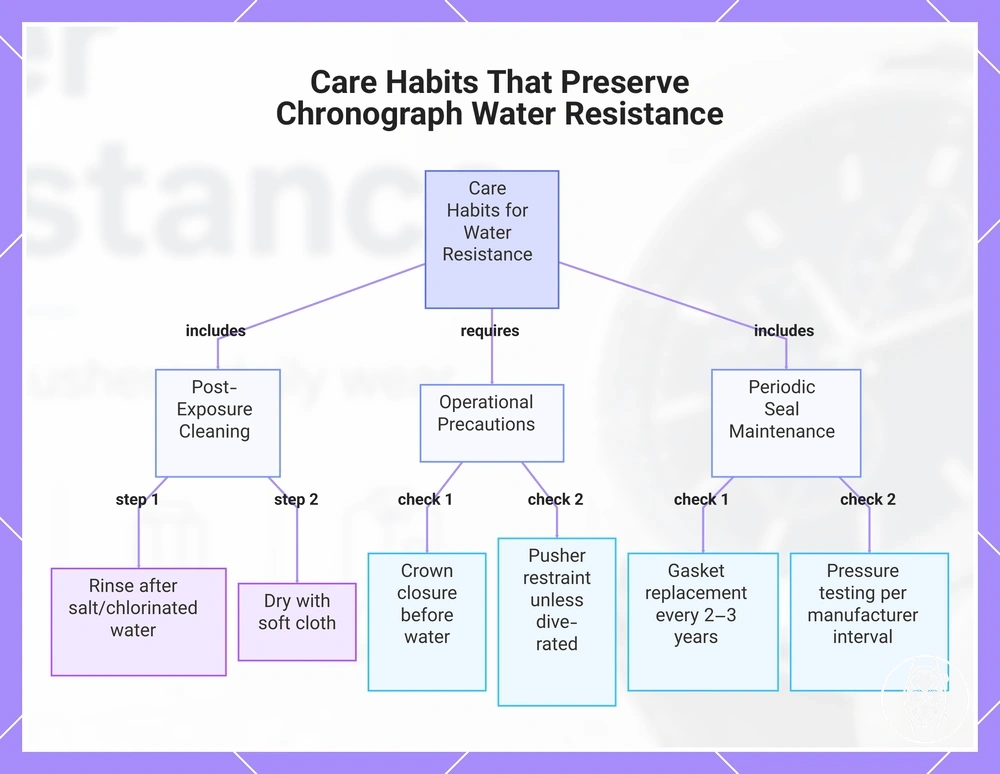
The practical maintenance pattern is habit → exposure condition → risk reduction, with the specific chronograph manual taking priority where requirements differ. Use these checks for rinsing, drying, crown closure, pusher restraint, gasket checks, pressure testing, strap care, and storage.
- Rinse after salt or chlorinated water: When the chronograph is rated for the exposure, remove residues after use. Seiko instructs users to rinse a water-resistant watch with fresh water after seawater exposure and dry it with a soft cloth, while Patek Philippe recommends a clean-water rinse after each contact with salt water or chlorinated pool water; removing residue reduces prolonged exposure of the case, bracelet, and sealing areas.
- Drying: Remove moisture, sweat, and dirt with a soft dry cloth after permitted water exposure. Seiko states that this drying habit supports the durability of the caseback, gaskets, and band and reduces conditions associated with corrosion and declining water resistance.
- Crown closure: Return the crown to the manufacturer-specified secured position before water exposure. Seiko states that a screw-in crown should be screwed down carefully to reduce the risk of moisture penetrating the movement; correct crown closure therefore preserves the intended sealing condition.
- Pusher restraint: Leave chronograph pushers inactive in water unless the model is explicitly designed for underwater operation. OMEGA's current user manual instructs users not to operate chronograph pushers in water, with its Seamaster Diver 300M and Planet Ocean 600M chronographs identified as model-specific exceptions.
- Gasket checks: Treat gaskets as ageing components rather than permanent seals. Citizen states that water-resistant gaskets can lose elasticity through long-term exposure to sweat and moisture and recommends gasket replacement at least every 2 to 3 years as part of regular maintenance.
- Pressure testing: Use the manufacturer's interval rather than one universal schedule. OMEGA recommends water-resistance testing once a year, Seiko recommends regular water-resistance checks alongside servicing that it generally schedules about every 3 years, and Citizen recommends gasket-related maintenance at least every 2 to 3 years; the applicable interval therefore remains manufacturer- and condition-specific.
- Strap care: Match wet-use care to the strap material. Patek Philippe states that contact with water can prematurely age leather straps, while its metal-bracelet guidance recommends rinsing with clean water after salt or chlorinated water exposure; strap care therefore affects durability and comfort even when the chronograph case is appropriately rated.
- Storage: Store the chronograph dry and away from conditions that add unnecessary heat, moisture, or shock. Seiko warns that extreme temperature, steam, and accidental shock can affect watch function or water resistance, so dry storage after use reduces avoidable environmental stress between wear periods.
Use gasket checks and pressure testing as decision points after significant impact, case opening, repeated water exposure, or uncertainty about seal condition instead of assuming routine care keeps the original rating unchanged. Broader chronograph watch care covers the wider maintenance routine; for water resistance specifically, safer long-term use depends on correct crown closure, pusher restraint, drying, sound gaskets, suitable strap care, appropriate storage, and manufacturer-specified inspection intervals.
This chart outlines the essential care habits to preserve water resistance in a chronograph, including post-exposure cleaning, operational precautions, and periodic seal maintenance.
This chart outlines the essential care habits to preserve water resistance in a chronograph, including post-exposure cleaning, operational precautions, and periodic seal maintenance.