Men's Chronograph Watch Functions, Subdials, and Controls
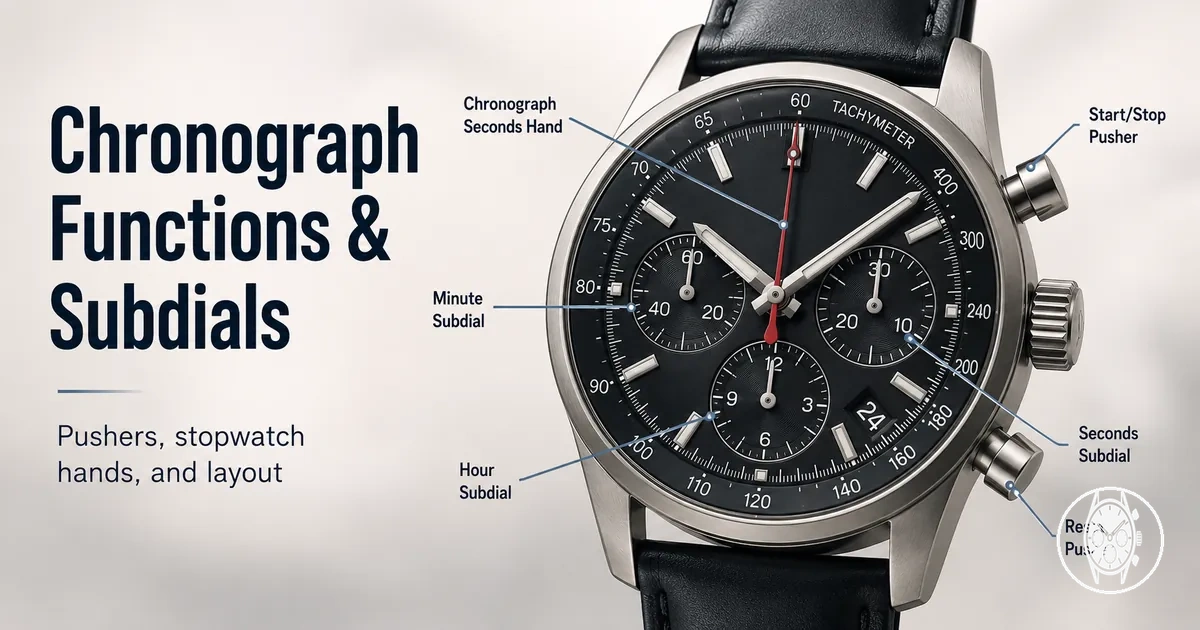
Men's chronograph watch functions combine normal time display with a separate timing function for measuring elapsed time, with the dial commonly using subdials, a stopwatch hand, pushers, a crown and, on applicable models, a tachymeter scale. Seiko's chronograph documentation describes the chronograph as a function for measuring elapsed time while the watch continues to indicate the current time; the number, labels and roles of these visible parts are model-specific rather than universal.
Dial labels and hand movement identify what a register measures, while the documented controls identify how the timing function is assigned.
Dial labels and hand movement identify what a register measures, while the documented controls identify how the timing function is assigned. For example, Seiko specifies a 30-minute stopwatch capacity for its calibre 8R46 and a 12-hour capacity for the 8R48, which adds a stopwatch hour hand; for these calibres, Button A controls start and stop, while Button B controls reset. This model-level difference means a subdial's position alone does not establish whether it shows elapsed minutes, elapsed hours or another indication.
This model-level difference means a subdial's position alone does not establish whether it shows elapsed minutes, elapsed hours or another indication.
A tachymeter scale, when fitted, converts the time required to cover a known distance into an average rate, so its reading depends on the elapsed-time measurement and the scale supplied on that watch. Seiko's tachymeter instructions give the numerical example of covering 1 kilometre in 45 seconds: the tachymeter indication is 80, corresponding to an average speed of 80 kilometres per hour. A multi-dial design without documented stopwatch timing should therefore not be interpreted as a functional chronograph solely because it resembles a two-subdial or three-subdial chronograph dial layout.
This is an explanatory reading of chronograph functions and their visible controls, not a procedure for operating, resetting or repairing a specific men's chronograph watch.
For clear interpretation, connect each visible part to its documented label and function: identify which hand or register records elapsed time, which pushers control the chronograph, what the crown controls, and whether a timing scale is present. This is an explanatory reading of chronograph functions and their visible controls, not a procedure for operating, resetting or repairing a specific men's chronograph watch.
Table of Contents
What Chronograph Functions Mean on a Men's Watch
Chronograph functions on a men's watch are timing features added to the normal time display to measure elapsed time independently of the watch's regular hour, minute and seconds indications. Seiko describes a chronograph as a watch function that measures elapsed time while the watch continues to indicate the current time. The time display therefore tells the current time, while the chronograph provides the separate stopwatch timing function.
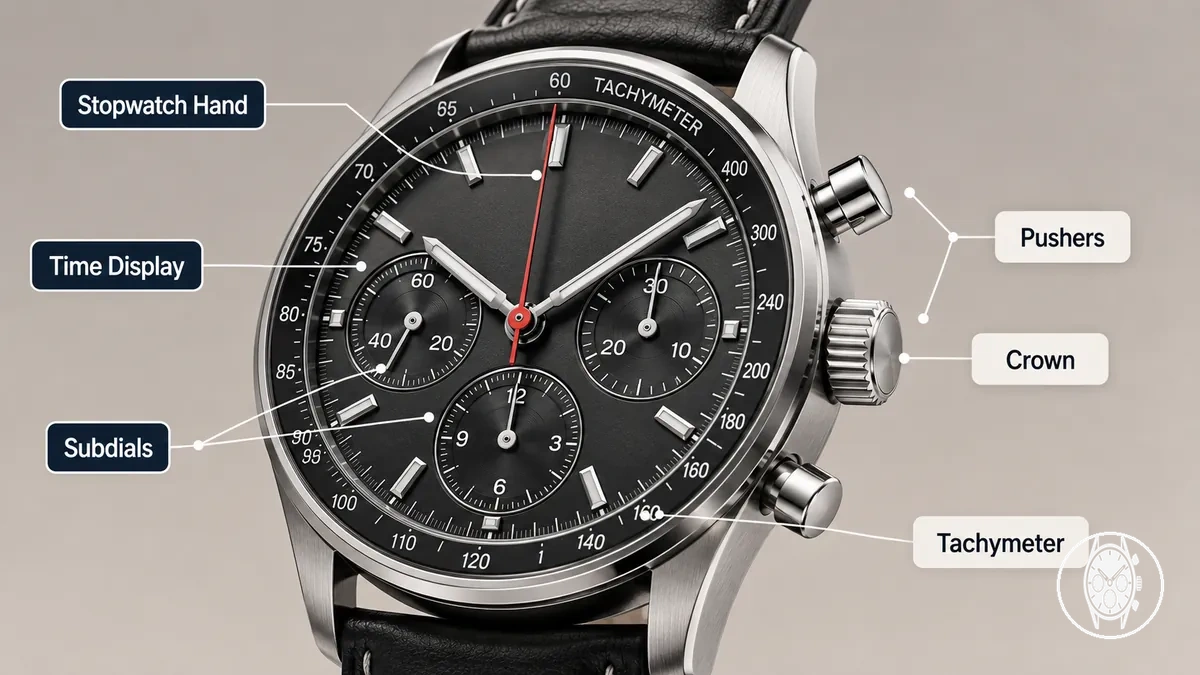
The chronograph watch meaning is reflected on the dial through dedicated timing indications and controls: a stopwatch hand measures elapsed seconds, subdials or registers can display additional elapsed-time units, pushers control stopwatch timing, and a tachymeter provides a rate scale when that feature is fitted. For a model-specific numerical example, Seiko specifies a maximum stopwatch measurement of 30 minutes for calibre 8R46, while calibre 8R48 adds a stopwatch hour hand and extends the maximum measurement to 12 hours; Seiko also specifies Button A for start and stop and Button B for reset on these calibres. These documented differences mean that elapsed-time capacity, subdial roles, pusher functions and tachymeter availability must be interpreted from the specific model rather than assumed from a multi-dial layout alone.
Chronograph Dial Parts and Control Points
Chronograph dial parts and control points are the visible components that provide a timing reading or operate a chronograph function: subdials or registers display assigned timing values, the central chronograph hand can display elapsed seconds or fractions of a second, pushers provide timing controls, the crown provides position-dependent settings, and a tachymeter scale provides a rate reading when fitted. The reading outcome of each part should therefore be interpreted by its assigned role rather than by its position on the dial alone.
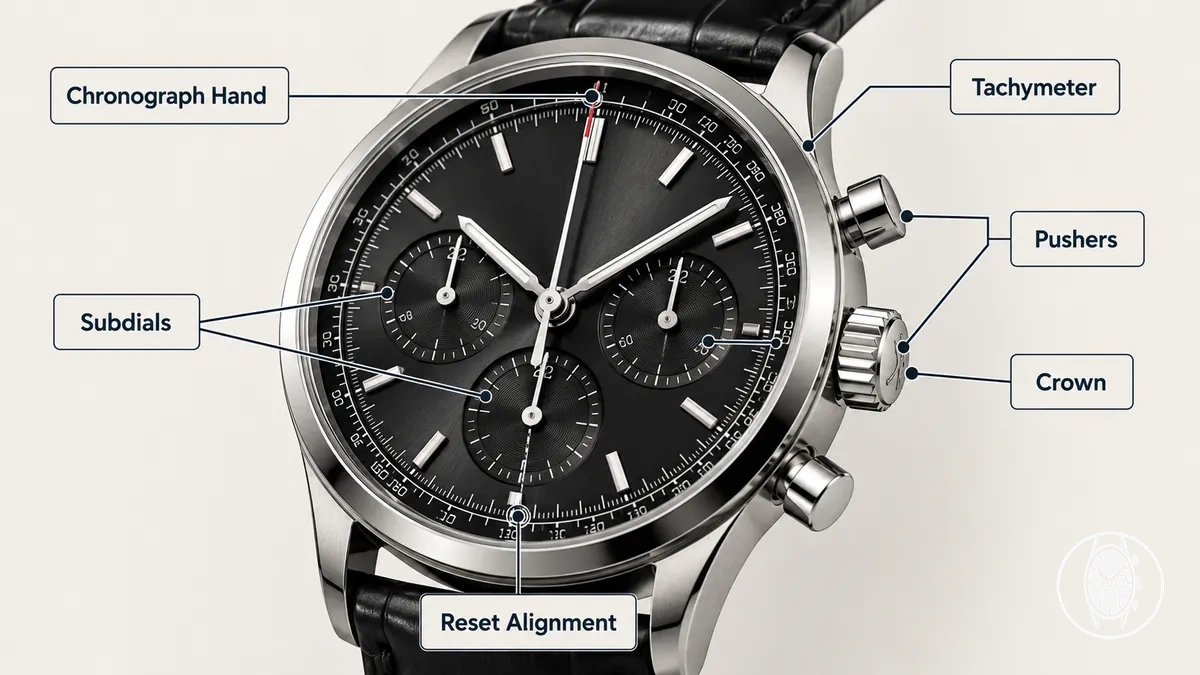
Seiko's instructions for the V172 and V174 provide a documented example of how these visible parts work together: the stopwatch hand advances in 1/5-second increments, the stopwatch minute hand advances in 1-minute increments, Button A provides Start/Stop, and Button B provides Split/Reset, with a maximum stopwatch measurement of 60 minutes. The same documentation assigns the crown's normal position to stopwatch use, its first-click position to date and alarm settings, and its second-click position to time setting, stopwatch-hand preliminary-position setting and system reset; Seiko also states that the tachymeter position differs with model design and that some models omit the tachymeter. Reset alignment has a defined visible value on V172 and V174: Seiko specifies 0 seconds and 0 minutes as the reference position after reset, while a hand stopping elsewhere indicates that its preliminary position requires model-specific adjustment.
The table uses Seiko V172/V174 only as a documented example of part-to-role relationships, because chronograph layouts and control assignments differ by model.
Grouping dial parts and control points by role separates what the wearer can see and read from the internal mechanisms covered by how chronograph watches work. The table uses Seiko V172/V174 only as a documented example of part-to-role relationships, because chronograph layouts and control assignments differ by model.
| Part | Attribute | Condition | Reading or control outcome |
|---|---|---|---|
| Subdials | Elapsed-time registers | Function follows the model's assigned register | On Seiko V172/V174, the stopwatch minute register advances in 1-minute increments |
| Central chronograph hand | Elapsed-time indication | During stopwatch measurement | On Seiko V172/V174, it displays elapsed time in 1/5-second increments |
| Pushers | Timing controls | With the stopwatch available for operation | Seiko V172/V174 assigns Button A to Start/Stop and Button B to Split/Reset |
| Crown | Position-dependent control | Normal, first-click or second-click position on Seiko V172/V174 | Normal position supports stopwatch use; first click provides date and alarm settings; second click provides time setting, preliminary hand-position setting and system reset |
| Tachymeter scale | Rate scale linked to elapsed seconds | When the model includes a tachymeter | Seiko's example converts 45 seconds over 1 km to a tachymeter reading of 80 km/h; the scale may be positioned differently or omitted on other models |
| Reset alignment | Reference hand position | After stopwatch reset on Seiko V172/V174 | The correct reference is 0 seconds and 0 minutes; another hand position indicates that preliminary-position adjustment is required |
Subdials, Registers, and Stopwatch Hands
Subdials are the small dials within a chronograph dial, while registers are counters assigned to a measured unit, and stopwatch hands indicate elapsed time through their motion during chronograph use. Seiko's V172/V174 documentation provides a model-specific example: it identifies a normal seconds hand for timekeeping, a stopwatch 1/5-second hand for elapsed fractions of a second, and a stopwatch minute hand that advances in 1-minute increments. These roles are model-specific, so labels, measured unit, and motion are more reliable for interpretation than a subdial's position.
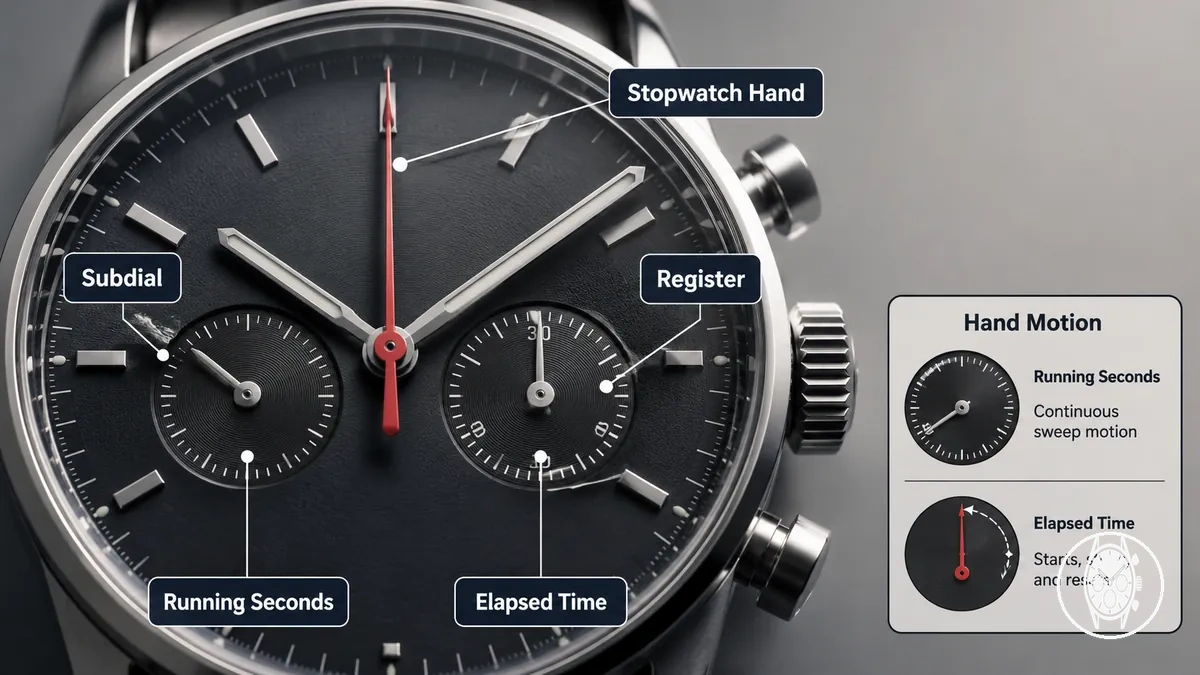
For a running-seconds versus elapsed-time scenario, observe the hands before and after chronograph timing starts: on Seiko V172/V174, the normal seconds hand belongs to the three-hand main-time display, while the separate stopwatch hand measures elapsed time in 1/5-second increments and the stopwatch minute register advances in 1-minute increments. Seiko specifies that this stopwatch measures for up to 60 minutes and then stops at the 0-minute, 0-second position; therefore, a continuously advancing normal seconds hand should not be read as the elapsed stopwatch measurement merely because another timing hand is stationary.
Pushers, Crown, and Reset Controls
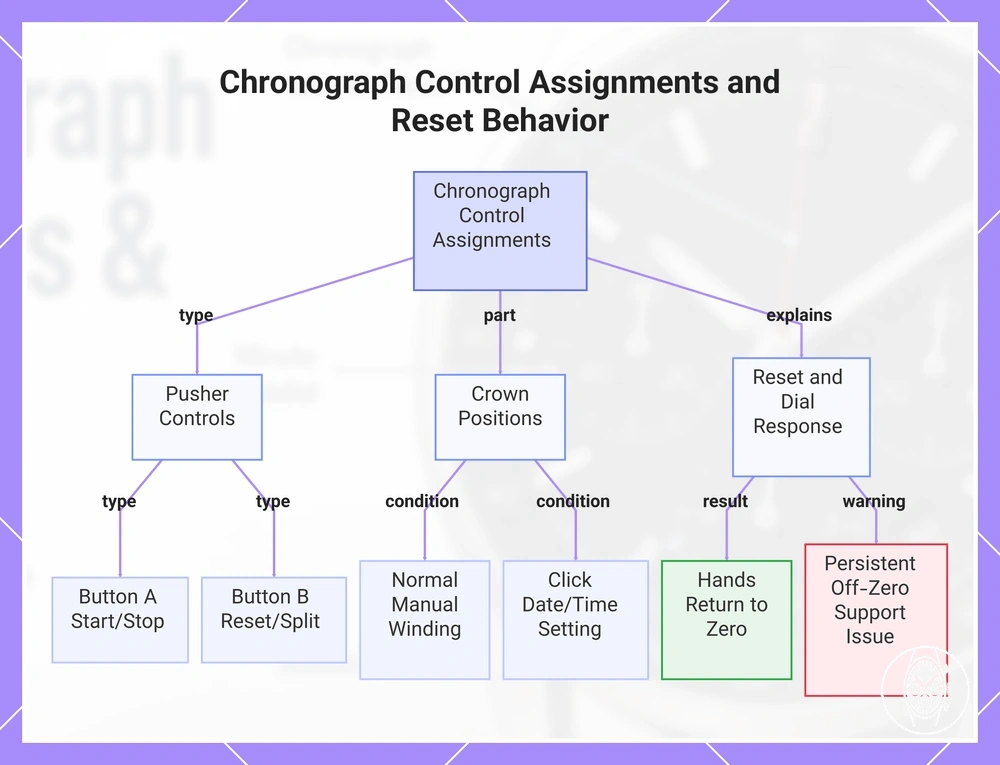
On a men's chronograph, pushers provide local stopwatch controls such as start, stop, and reset, while the crown uses defined positions to adjust watch settings. Seiko specifies for its mechanical 8R46/8R48 that Button A provides start and stop, Button B provides reset, and the crown has three documented states: normal for manual winding, first click for date setting, and second click for time setting; these assignments are model-specific rather than universal.
The expected dial response helps confirm the role of the reset controls and hand alignment.
The expected dial response helps confirm the role of the reset controls and hand alignment. Seiko specifies that resetting the 8R46/8R48 returns the stopwatch hands to the 0 position; for V172/V174, Seiko specifies Button A for Start/Stop, Button B for Split/Reset, and a reset reference of 0 seconds and 0 minutes, so a persistent off-zero position is outside normal reset behavior and belongs to a support-focused context.
- Pusher location: Distinguish the chronograph pushers or side buttons from the crown, then match each one to the model's documented control assignment.
- Crown position: Identify the documented crown position before interpreting its adjust or setting role; on Seiko 8R46/8R48, the normal, first-click, and second-click positions correspond to manual winding, date setting, and time setting.
- Start-stop role: Seiko assigns Button A to start and stop on both the 8R46/8R48 and V172/V174 examples.
- Reset behavior: Seiko assigns Button B to reset on 8R46/8R48 and to Split/Reset on V172/V174, with the latter using 0 seconds and 0 minutes as its reset reference.
- Visible dial response: After a documented zero reset, the stopwatch hands should return to their specified zero position; a persistent offset is a hand alignment issue rather than an elapsed-time reading.
For the operating sequence beyond identifying these local roles, follow the model documentation and the separate guidance on using chronograph controls; the control assignment should not be inferred from pusher location alone.
Caution: If the reset controls repeatedly leave the stopwatch hands away from their documented zero position, treat the persistent hand alignment issue as a support matter rather than continuing normal control identification; model-specific guidance for resetting chronograph hands covers that separate context.
This chart identifies the functions of chronograph pushers and crown positions, and explains reset behavior and dial response verification.
This chart identifies the functions of chronograph pushers and crown positions, and explains reset behavior and dial response verification.
What Common Chronograph Subdials Measure
Common chronograph subdials measure running seconds for normal timekeeping or stopwatch values such as elapsed seconds, elapsed minutes, elapsed hours, and fractions of a second, depending on the movement and dial design. Citizen documents these roles across different calibres: B620 uses chronograph seconds and minutes, 0510 includes chronograph hour, minute, and second hands, and E810 uses a function hand for chronograph minutes or 1/20-second timing. A subdial's measured unit is therefore model-specific rather than fixed by its position.
Labels, the printed unit scale, and hand behavior determine the reading outcome.
Labels, the printed unit scale, and hand behavior determine the reading outcome. Citizen specifies that calibre E650 measures up to 59 minutes 59 seconds in 1-second units, while E810 measures up to 59 minutes 59.95 seconds in 1/20-second units; Citizen's 0510 documentation separately identifies chronograph hour, minute, and second indications. A running-seconds subdial belongs to normal timekeeping, whereas an elapsed-time counter advances according to the chronograph's active timing scale.
| Subdial or timing display | Label or unit attribute | Value range or condition | Reading outcome |
|---|---|---|---|
| Running-seconds subdial | Normal seconds | Runs as part of the regular time display rather than the stopwatch measurement | Read it as running seconds; it is not an elapsed-time counter merely because it is located in a small dial |
| Elapsed-seconds display | Chronograph seconds | Active during stopwatch timing; Citizen E650 records in 1-second units up to 59 minutes 59 seconds | Read the hand as elapsed seconds within that movement's measurement range |
| Elapsed-minutes register | Chronograph minutes | Advances as stopwatch time accumulates; Citizen E650's function hand advances in 1-minute steps | Read the register as accumulated elapsed minutes rather than clock minutes |
| Elapsed-hours register | Chronograph hours | Present on movements that include an hour counter; Citizen 0510 specifies a dedicated chronograph hour hand and measures elapsed time up to 11 hours 59 minutes 59 seconds | Read the counter as accumulated elapsed hours within that model's chronograph range |
| Fractional-seconds display | Fractions of a second | Resolution follows the movement's unit scale; Citizen E810 measures in 1/20-second units up to 59 minutes 59.95 seconds | Read the display as finer elapsed-time fractions, not as normal running seconds |
Running Seconds Versus Elapsed Time Counters
Running seconds indicate seconds during normal timekeeping, while elapsed time counters show the interval measured when the chronograph stopwatch is running. On Seiko calibre V192, the manufacturer distinguishes the small seconds hand from the stopwatch 1/5-second and minute hands, so hand movement alone does not determine whether a displayed value belongs to normal timekeeping or stopwatch measurement. The practical distinction is the indicator's label and timing role: small seconds belong to normal timekeeping, while elapsed counters respond to chronograph timing.
Read the label, hand movement, and response to chronograph start and stop together when distinguishing the two indicators.
For example, Seiko's V192 instructions state that the stopwatch cannot operate when the small seconds hand is moving at 2-second intervals, demonstrating that a visibly moving small seconds hand does not itself mean the stopwatch is running. In the same instructions, Seiko gives a stopwatch example of 20 minutes 41 seconds after start and stop measurement, so the elapsed value belongs to the stopwatch hands rather than the continuously visible small-seconds indication. Read the label, hand movement, and response to chronograph start and stop together when distinguishing the two indicators. :contentReference[oaicite:0]{index=0}
| Running seconds | Elapsed time counters |
|---|---|
| Shows seconds for normal timekeeping; on Seiko V192, the small seconds hand can move in 2-second intervals when the watch indicates an energy condition. | Shows accumulated stopwatch time after chronograph timing starts; Seiko V192 uses separate stopwatch 1/5-second and minute hands. |
| Hand movement can continue independently of stopwatch measurement, so movement by itself does not confirm chronograph use. | Hand movement and the value shown are tied to the chronograph's start, stop, and reset states. |
| Interpret the indicator from its small-seconds label or normal-timekeeping role. | Interpret the indicator from its elapsed-time label, unit scale, and behavior while the stopwatch is running. |
Seconds, Minutes, Hours, and Fractions of a Second
Chronograph timing units can include seconds, minutes, hours, and fractions of a second, with the dial marking or counter type defining the value range and reading effect for a specific movement. Seiko specifies that calibres V172, V174, and V175 measure elapsed time in 1/5-second increments for up to 60 minutes, while V176 uses 1/20-second increments for up to 60 minutes; Citizen specifies that calibre 0510 measures up to 11 hours 59 minutes 59 seconds. These model-specific values show why both the unit scale and measurement range must be identified before interpreting a chronograph display.
These model-specific values show why both the unit scale and measurement range must be identified before interpreting a chronograph display.
Timing-unit layouts are not identical across chronographs: Seiko V172/V174 provide fractional-second and minute stopwatch indications without an elapsed-hour counter, while Citizen 0510 includes an hour counter for longer elapsed-time measurement. Fractional displays also differ by calibre, so a 1/5-second or 1/20-second scale describes the documented movement rather than a universal chronograph capability. :contentReference[oaicite:0]{index=0}
| Timing unit | Dial marking or counter type | Value range | Reading effect |
|---|---|---|---|
| Seconds | Stopwatch seconds hand | Citizen 0510 records seconds from 0 to 59 seconds within each elapsed minute. | The seconds indication supplies the seconds component of the elapsed-time reading. |
| Minutes | Minute counter or stopwatch minute hand | Seiko V172/V174/V175/V176 measure elapsed time for up to 60 minutes, with the stopwatch minute indication advancing in 1-minute units. | The minute counter shows accumulated elapsed minutes until the documented measurement limit is reached. |
| Hours | Hour counter | Citizen 0510 measures elapsed time up to 11 hours 59 minutes 59 seconds. | The hour counter extends the readable elapsed interval beyond minutes; Seiko V172/V174 omit an elapsed-hour counter. |
| Fractions of a second | Fractional stopwatch hand or scale | Seiko specifies 1/5-second increments for V172/V174/V175 and 1/20-second increments for V176. | The fractional scale subdivides each elapsed second according to the documented calibre, so the displayed fraction should be interpreted from that model's scale. |
How Two-Subdial and Three-Subdial Layouts Differ
A two-subdial layout contains 2 registers, while a three-subdial layout contains 3, so the three-register arrangement has 1 additional display position that can be assigned a measurement role or another watch indication. The reviewed evidence describes chronograph registers as displays that can be assigned to seconds, minutes, or hours and notes that 3, 6, and 9 o'clock is one common three-register arrangement; register count therefore affects reading and information density, not quality by itself.
The main limitation is that register count alone does not identify the functions shown: the position, labels, scales, and hand behaviour determine the measurement roles.
The main limitation is that register count alone does not identify the functions shown: the position, labels, scales, and hand behaviour determine the measurement roles. A two-subdial layout has 2 positions and can therefore present 2 register roles, while a three-subdial layout has 3 positions and can present 3 roles; the additional position increases the possibility of another elapsed-time counter, but it does not establish that the third register measures elapsed hours or any other specific unit. The reviewed section evidence also states that subdial number, size, position, and function differ by watch design, so the table treats readability, dial balance, and function density as decision signals rather than fixed outcomes. :contentReference[oaicite:0]{index=0}
| Layout | Number and position of registers | Likely measurement roles | Interpretation or limitation |
|---|---|---|---|
| Two-subdial layout | 2 registers; their positions are configuration-specific rather than fixed by register count. | 2 register roles can be displayed; these can include running seconds or elapsed-time counters when the movement assigns those functions. | The 2-register arrangement has 1 fewer dial element than a three-subdial layout, which can support a less visually dense dial balance. The limitation is 1 fewer register position, so verify whether a required elapsed-time counter is omitted. |
| Three-subdial layout | 3 registers; 3, 6, and 9 o'clock is one documented common arrangement in the reviewed evidence, not a universal position standard. | 3 register roles can be displayed, providing 1 additional position that may be assigned to another elapsed-time counter or another model-defined indication. | The additional register increases function density but also adds 1 more dial element to interpret. Readability therefore depends on the specific labels, scales, spacing, and assigned functions rather than register count alone. |
For readability and dial balance, compare how clearly the 2 or 3 registers can be distinguished and read; for function density, check what each register actually measures. The practical decision signal is whether the additional counter in a three-subdial layout supplies an elapsed-time value needed for the intended use case, because an extra register without a required measurement role adds visual density without adding relevant timing information.
How to Read Chronograph Subdials by Position and Label
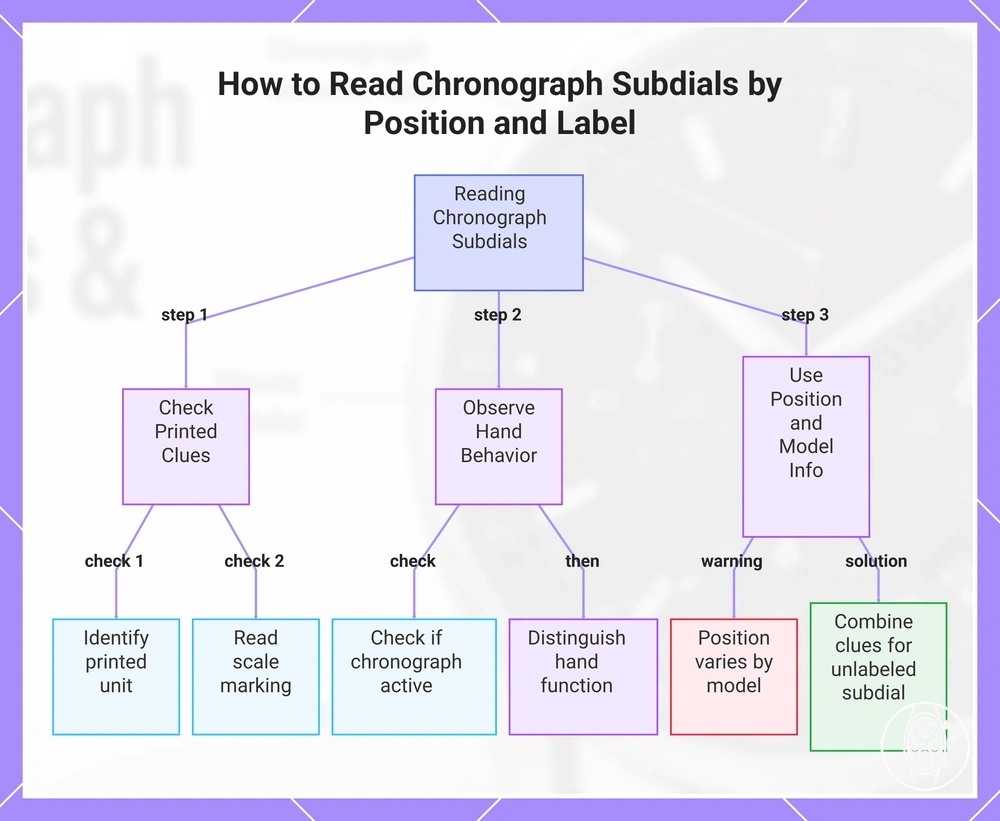
To read chronograph subdials, check the label and printed units first, then use position and hand behavior to decide what the observed value represents and whether the stopwatch is active. Seiko's V192 instructions identify separate small-seconds, stopwatch-minute, and central 1/5-second indications and explicitly state that display position and design can vary by model, so dial position should qualify a reading rather than determine it by itself. :contentReference[oaicite:0]{index=0}
This sequence keeps the reading tied to the specific dial and preserves model variation when a subdial is minimally labelled.
Read chronograph subdials by moving from the strongest visible clue to the weakest: printed units and scale marking, hand behavior, then position. This sequence keeps the reading tied to the specific dial and preserves model variation when a subdial is minimally labelled. :contentReference[oaicite:1]{index=1}
- Check the label and printed units: Identify whether the subdial is marked for seconds, minutes, hours, fractions of a second, or another indication. The visible unit establishes what kind of observed value the scale is intended to show; if no unit is printed, keep the reading provisional until the other clues agree.
- Read the scale marking: Match the hand to the numbers or divisions printed around that subdial rather than assigning a value from its position on the main dial. For example, Seiko specifies that V192 stopwatch timing uses 1/5-second increments and a stopwatch-minute indication with a maximum measurement of 60 minutes, so those scales must be interpreted within that model's documented timing range. :contentReference[oaicite:2]{index=2}
- Observe hand behavior: Check whether the hand belongs to normal timekeeping or changes as part of chronograph timing. On Seiko V192, the manufacturer distinguishes the small seconds hand from the stopwatch minute hand and the central stopwatch 1/5-second hand, showing that hand behavior and assigned function are stronger clues than dial position alone. :contentReference[oaicite:3]{index=3}
- Use position as a secondary clue: Note whether the subdial is near 3, 6, 9, or another clock position only after identifying its scale and behavior. Seiko states that the position and design of the V192 display may vary by model, so the same clock position should not be treated as a universal indicator of one timing unit. :contentReference[oaicite:4]{index=4}
- Qualify an unlabeled subdial: If a subdial has little or no label text, combine its scale marking, hand behavior, observed value, and model documentation before making the reading decision. For instance, a hand pointing to 15 on an unlabeled counter should not automatically be read as 15 minutes; it becomes a 15-minute reading only when the scale and documented counter type establish that the register measures elapsed minutes.
This chart shows the step-by-step process to correctly interpret chronograph subdials using printed clues, hand behavior, and model-specific position information.
How Tachymeter Scales Connect to Chronograph Timing
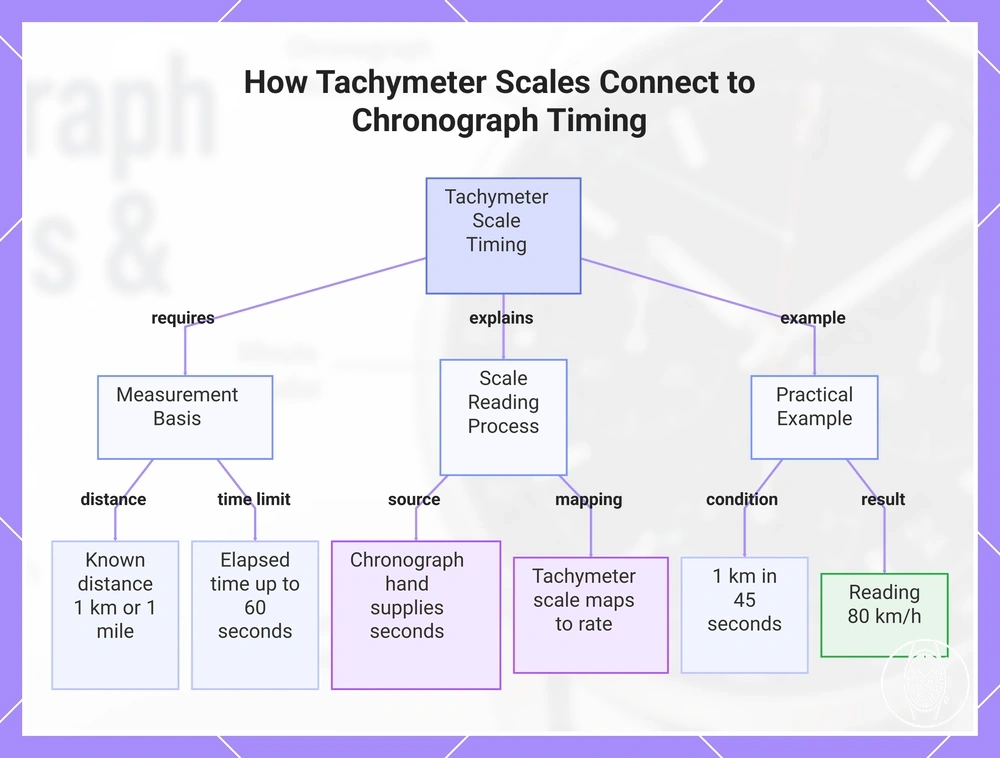
A tachymeter scale uses chronograph timing to convert elapsed time over a known distance or fixed measurement base into an approximate rate. Citizen Watch specifies that its tachymeter can estimate average speed from the elapsed seconds required to travel 1 kilometre or 1 mile, with a supported measuring range of up to 60 seconds. The reading therefore depends on both the chronograph seconds hand and a known distance rather than on elapsed time alone.
The reading therefore depends on both the chronograph seconds hand and a known distance rather than on elapsed time alone.
The chronograph hand supplies the elapsed-seconds value, while the tachymeter scale maps that value to the corresponding rate. Citizen Watch also notes that the tachymeter markings may appear on the outer bezel or on the dial ring depending on scale design, so placement and use-case are model-specific. Tachymeter readings are contextual estimates: the scale is useful only when the measurement base matches the intended distance or unit interval and the elapsed time falls within the scale's supported range. :contentReference[oaicite:0]{index=0}
This chart shows the measurement basis, the reading process, and a practical example of how a tachymeter scale uses chronograph timing to estimate speed.
Chronograph Dial Meanings That Vary by Model
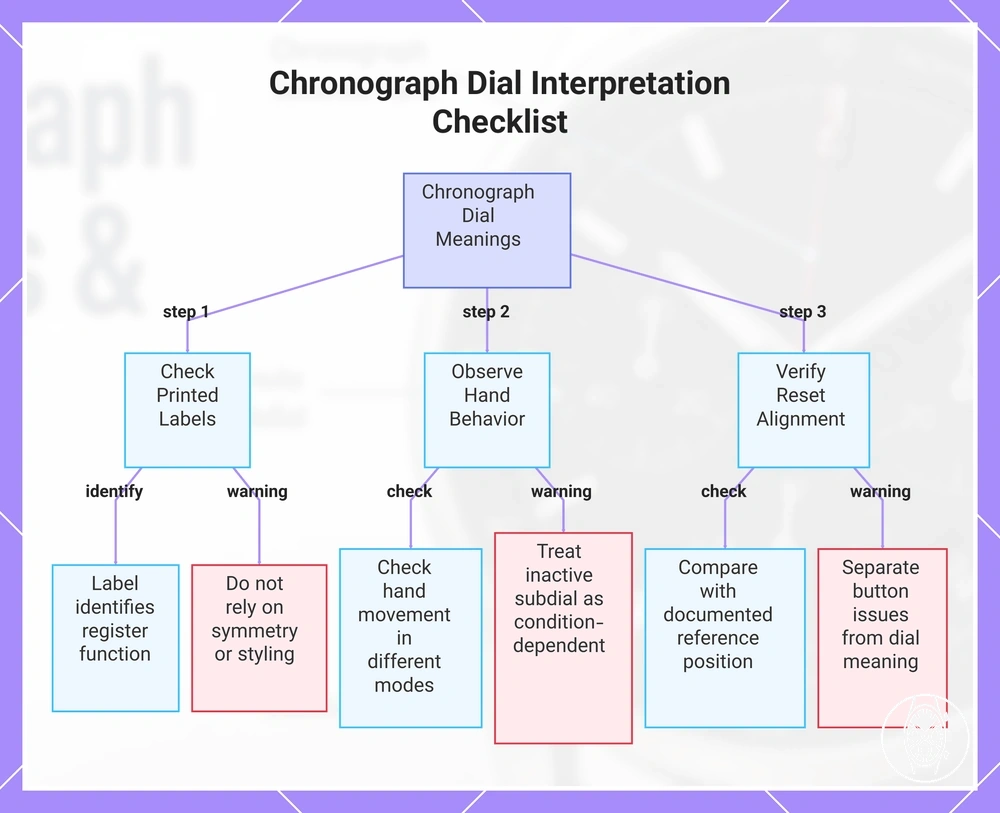
Chronograph dial meanings can vary by model because the movement, layout, brand design, printed labels, and hand behavior determine what each visible hand, register, or scale represents. Seiko's official chronograph instructions state that display position and design may vary by model, so a subdial's clock position should not be treated as sufficient evidence of its function. Read the printed labels and scale first, then use hand behavior to confirm the interpretation. :contentReference[oaicite:0]{index=0}
Read the printed labels and scale first, then use hand behavior to confirm the interpretation.
Model variation affects both the functions displayed and their visible states: a chronograph layout can assign separate indications to normal seconds, elapsed seconds, minutes, hours, or fractional timing, while another movement can omit one of those indications or assign a hand another role. Seiko's official instructions also document layouts in which a fractional stopwatch hand moves only during an initial timing period before returning to its zero position, showing why an inactive-looking hand does not establish its meaning without the model's documented condition. The checklist below keeps dial interpretation within visible-function scope rather than extending into repair diagnosis. :contentReference[oaicite:1]{index=1} :contentReference[oaicite:2]{index=2}
- Printed labels: Check the unit label, scale marking, or named indication first; the documented label gives the strongest visible clue to whether the register represents normal time, elapsed time, or another display.
- Hand behavior: Observe whether the hand moves during normal timekeeping, during chronograph timing, or only under a documented display condition. A change in movement state can alter the reading effect without changing the hand's physical position.
- Reset alignment: Compare chronograph hands with the model's documented reference position after timing is cleared. Seiko specifies zero-position references for its chronograph hands, but an off-reference position is an alignment observation rather than proof of a specific underlying fault. :contentReference[oaicite:3]{index=3}
- Inactive subdials: Treat a non-moving register as condition-dependent until its assigned function is confirmed. Seiko documents a fractional stopwatch hand that stops at its zero position after about 1 minute while elapsed timing continues, so inactivity alone does not identify the subdial as faulty. :contentReference[oaicite:4]{index=4}
- Decorative-looking layouts: Do not assign a timing function from symmetry, register count, or visual styling alone; confirm that each visible element has a printed scale, documented role, or observable hand behavior consistent with that interpretation.
- Button response: If a pusher does not produce the model's documented visible response, keep that issue separate from deciding what a subdial means. Persistent chronograph button problems belong to a support context rather than establishing the dial meaning.
This checklist guides you through the three essential steps to interpret chronograph dial meanings that vary by model, with warnings against common misinterpretations.
Function Details to Check Before Choosing a Men's Chronograph Watch
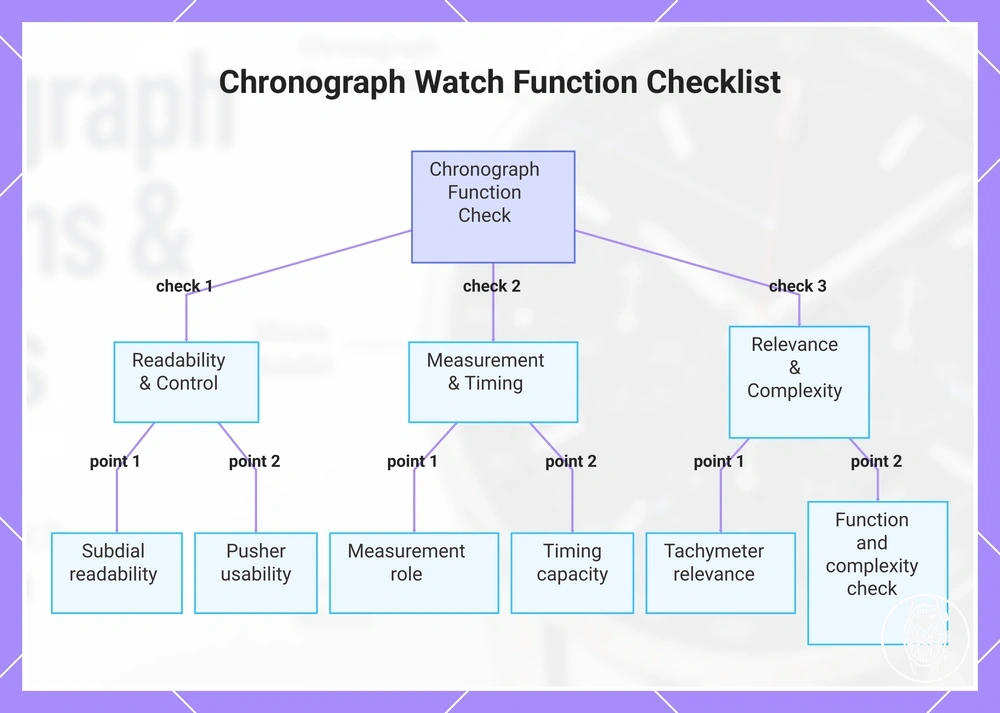
Before choosing a men's chronograph watch, check the function details for readability, measurement role, control feel, and practical use rather than dial complexity alone. The acceptable condition is that each visible chronograph feature has an identifiable purpose, can be read or operated comfortably, and supports the timing tasks you expect to perform. Function should therefore match intended use rather than the number of subdials or scales on the dial.
Function should therefore match intended use rather than the number of subdials or scales on the dial.
The main decision signals are subdial readability, clearly defined timing functions, pusher usability, timing capacity, and tachymeter relevance. The reviewed evidence describes chronograph subdials as displaying different timing roles and identifies start, stop, and reset as common chronograph control functions, so each feature should be evaluated by what it contributes to the intended timing need rather than by appearance alone. :contentReference[oaicite:0]{index=0}
- Subdial readability: Check whether labels, scale markings, hands, and contrast make each register easy to distinguish. The acceptable condition is that the displayed unit or role can be identified without relying on subdial position alone; poor dial clarity increases interpretation effort and reduces practical usefulness.
- Measurement role: Confirm what each subdial or chronograph hand measures, such as elapsed seconds, minutes, hours, or another documented indication. The acceptable condition is that the available measurement roles match the timing intervals you expect to use; a counter with no relevant timing purpose adds dial complexity without improving the required function.
- Pusher usability: Check whether the chronograph pushers are easy to identify, reach, and press during normal wear and whether their documented actions are clear. Acceptable pusher usability means the control feel allows the intended start, stop, and reset actions without confusion with the crown; awkward or ambiguous controls reduce practical use.
- Timing capacity: Check whether the displayed elapsed-time counters cover the longest interval you expect to measure. The acceptable condition is that the watch includes the required minute or hour measurement role for that use case; a minutes-only display is a limitation when the intended timing need extends into hours.
- Tachymeter relevance: Check whether rate measurement over a known distance or fixed interval is part of the intended use. A tachymeter is relevant when its scale design matches that measurement context; if rate calculation is not required, the scale adds visual information without adding a necessary timing function.
- Practical function versus dial complexity: Compare the number of visible registers and scales with the number of functions you are likely to use. The acceptable condition is a layout in which added elements provide a useful measurement or control role; additional visual complexity without a needed function has no decision advantage.
The final function check should favour readable timing information, useful measurement roles, comfortable controls, and features that match the intended timing needs. Broader selection criteria can then be considered in the men's chronograph watch guide.
Broader selection criteria can then be considered in the men's chronograph watch guide .
This chart groups the key function details to evaluate when choosing a men's chronograph watch into readability, measurement, and relevance categories.